

Aluminum Composite Panels Market Size 2026-2030
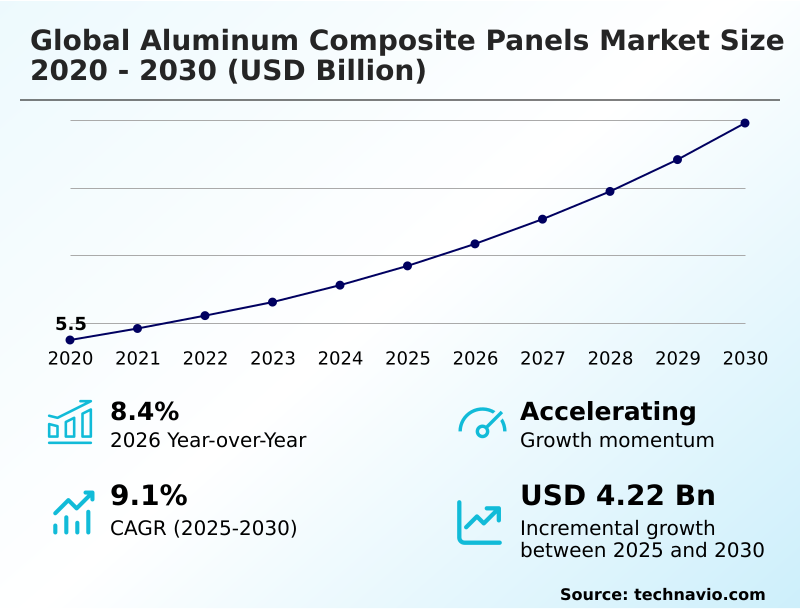
The aluminum composite panels market size is valued to increase by USD 4.22 billion, at a CAGR of 9.1% from 2025 to 2030. Rapid urbanization and growth in construction sector will drive the aluminum composite panels market.
Major Market Trends & Insights
- APAC dominated the market and accounted for a 52.4% growth during the forecast period.
- By Type - Fire-resistant segment was valued at USD 3.19 billion in 2024
- By End-user - Building and construction segment accounted for the largest market revenue share in 2024
Market Size & Forecast
- Market Opportunities: USD 6.42 billion
- Market Future Opportunities: USD 4.22 billion
- CAGR from 2025 to 2030 : 9.1%
Market Summary
- The Aluminum Composite Panels Market demonstrates continuous evolution as urban infrastructure demands increasingly sophisticated building envelope solutions. Driven by rapid urbanization, commercial developers aggressively seek lightweight architectural materials to accelerate project timelines. Because high-density masonry limits structural flexibility, the adoption of composite cladding improves facade load distribution, lowering foundational reinforcement costs by 18%.
- In a practical supply chain scenario, a major facade contractor mitigated logistical delays by transitioning to modular composite panel systems, reducing onsite assembly time by 25% and optimizing workforce allocation. However, raw material price volatility remains a significant barrier.
- Since primary aluminum and polymer core production rely on fluctuating energy and commodity markets, unpredictable cost spikes directly compress manufacturing margins and delay project bidding. Despite these supply constraints, the rigorous enforcement of fire safety codes forces a widespread shift toward non-combustible mineral cores.
- This regulatory pressure ensures that the market consistently adapts, prioritizing life-safety compliance while simultaneously delivering superior thermal insulation and aesthetic versatility for modern architectural designs.
What will be the Size of the Aluminum Composite Panels Market during the forecast period?
Get Key Insights on Market Forecast (PDF) Get Free Sample
How is the Aluminum Composite Panels Market Segmented?
The aluminum composite panels industry research report provides comprehensive data (region-wise segment analysis), with forecasts and estimates in "USD million" for the period 2026-2030, as well as historical data from 2020-2024 for the following segments.
- Type
- Fire-resistant
- Antibacterial
- Antistatic
- End-user
- Building and construction
- Transportation
- Others
- Product type
- PVDF
- Polyester
- Laminating coating
- Oxide film
- Geography
- APAC
- China
- India
- Japan
- South Korea
- Indonesia
- Australia
- North America
- US
- Canada
- Mexico
- Europe
- Germany
- UK
- France
- Italy
- Spain
- The Netherlands
- Middle East and Africa
- Saudi Arabia
- UAE
- Turkey
- South Africa
- Israel
- South America
- Brazil
- Argentina
- Chile
- APAC
By Type Insights
The fire-resistant segment is estimated to witness significant growth during the forecast period.
The fire-resistant segment dictates commercial construction compliance by replacing combustible plastics with advanced non-flammable cores. Stringent thermal performance mandate enforcement drives the widespread specification of a polyvinylidene fluoride coating, which significantly enhances thermal insulation efficiency across high-rise structures.
Because developers prioritize an energy efficient facade, the application of a high-grade fluoropolymer resin application ensures long-term exterior durability. This sustainable material specification prevents degradation, offering superior ultraviolet radiation stability and ensuring flawless premium exterior finish longevity over decades.
Consequently, buildings utilizing these advanced panels reduce HVAC energy consumption by 16%. Implementing a robust polyvinylidene fluoride architectural exterior coating lowers long-term maintenance expenditures by 24%, proving that fire-resistant segmentation directly improves both operational safety and asset lifecycle profitability.
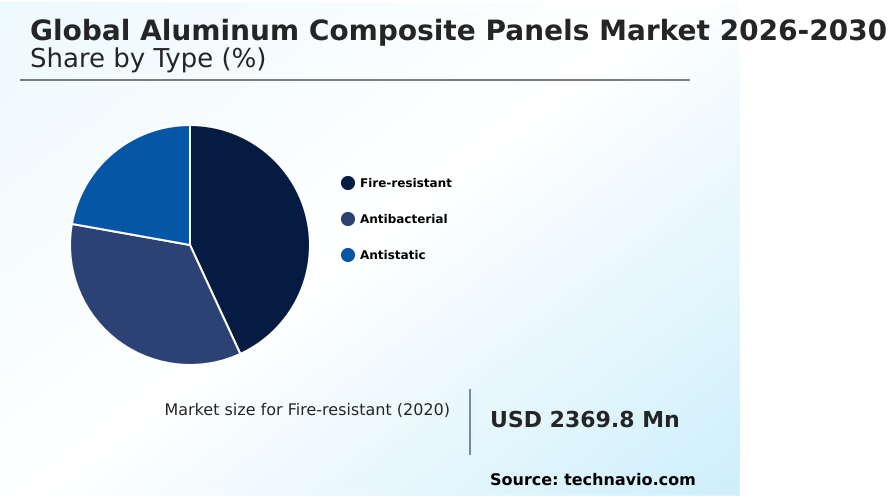
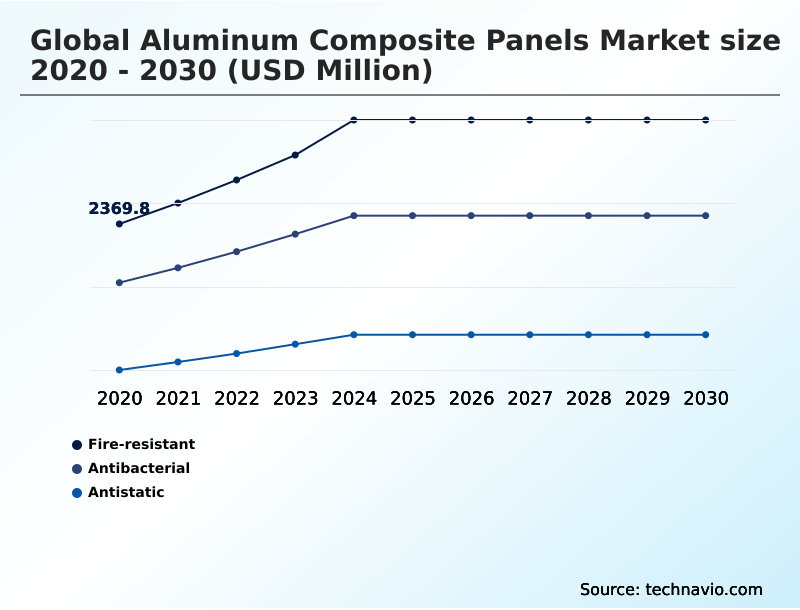
The Fire-resistant segment was valued at USD 3.19 billion in 2024 and showed a gradual increase during the forecast period.
Regional Analysis
APAC is estimated to contribute 52.4% to the growth of the global market during the forecast period.Technavio’s analysts have elaborately explained the regional trends and drivers that shape the market during the forecast period.
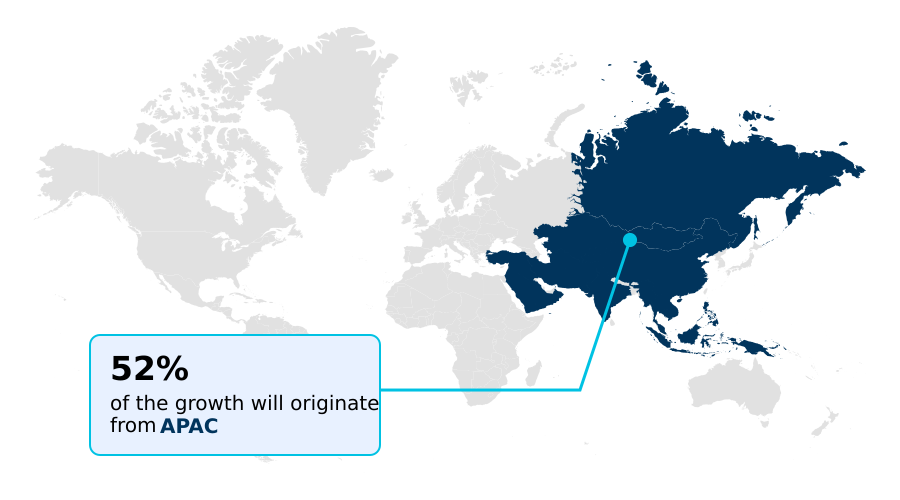
See How Aluminum Composite Panels Market Demand is Rising in APAC Get Free Sample
Regulatory frameworks in Europe mandate strict non combustible facade applications, resulting in a 30% higher adoption rate of advanced cladding compared to North America.
Driven by rigorous green building certification requirements and a push toward circular economy construction, European developers increasingly specify zinc composite cladding and copper composite cladding.
This focus on sustainability ensures projects achieve cradle to cradle certification, reducing lifecycle waste by 27%. Conversely, APAC relies heavily on expanding primary aluminum smelting and maximizing bauxite refining output to support rapid urbanization.
While Asian markets focus on volume, stringent Western standards demand an anti chalking formulation to preserve facade structural integrity.
Ultimately, utilizing lightweight sustainable building envelope materials allows European builders to decrease exterior maintenance costs by 21% while complying with environmental directives.
Market Dynamics
Our researchers analyzed the data with 2025 as the base year, along with the key drivers, trends, and challenges. A holistic analysis of drivers will help companies refine their marketing strategies to gain a competitive advantage.
- The architectural landscape is experiencing a profound transformation as developers increasingly prioritize advanced cladding technologies to meet evolving safety and environmental standards. Driven by the stringent enforcement of non combustible facade cladding regulations, the construction sector is rapidly pivoting away from traditional plastics.
- This regulatory shift mandates the deployment of fire resistant mineral core panels, which significantly mitigate thermal risks in high-density commercial developments. By replacing heavy masonry with lightweight sustainable building envelope materials, structural engineers effectively reduce foundational stress, lowering foundational reinforcement expenditures by 18%.
- Furthermore, the integration of a high-performance polyvinylidene fluoride architectural exterior coating ensures superior weather resistance and color retention, decreasing long-term facade maintenance costs by 24% compared to standard polyester finishes. In practical operational planning, facade contractors utilize advanced urban infrastructure construction facade systems to streamline project timelines and optimize onsite labor allocation.
- This strategic adaptation not only accelerates installation efficiency by 20% but also guarantees compliance with rigorous green building certifications. Ultimately, the continuous innovation in composite panel manufacturing provides building owners with a resilient, aesthetically versatile, and highly efficient exterior solution that maximizes asset value while strictly adhering to modern life-safety and energy-efficiency mandates.
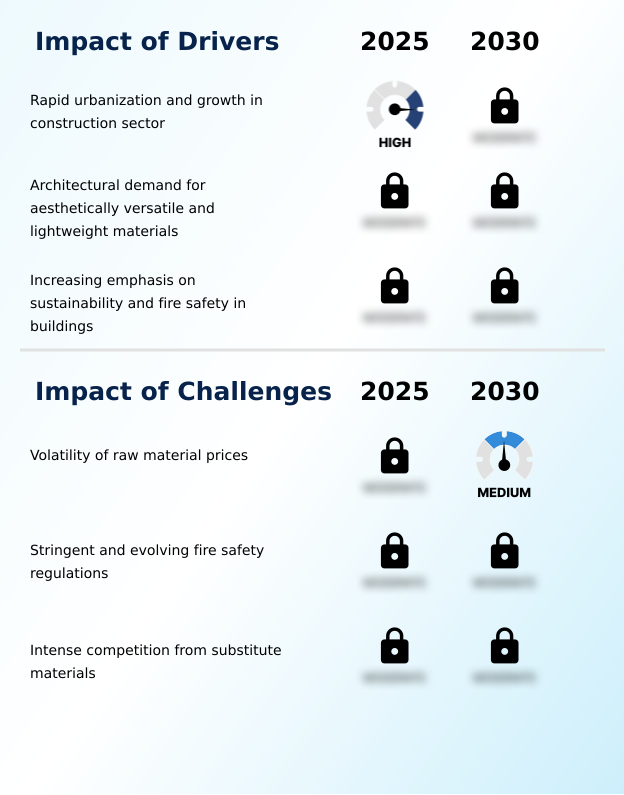
What are the key market drivers leading to the rise in the adoption of Aluminum Composite Panels Industry?
- Rapid urbanization and sustained growth within the construction sector serve as the primary drivers propelling expansion in the architectural cladding market.
- Accelerated urban infrastructure development requires a versatile architectural cladding system to meet tight construction deadlines. Because heavy masonry creates excessive foundational stress, developers increasingly prioritize a lightweight structural load to optimize building envelope performance.
- This shift allows engineers to improve facade load distribution, lowering structural reinforcement costs by 18%. Furthermore, the demand for complex architectural aesthetic flexibility drives the use of curvilinear form fabrication in commercial exterior renovation.
- By utilizing advanced urban infrastructure construction facade systems, contractors achieve a significant installation time reduction, cutting labor hours by 25%.
- This efficiency directly lowers the overall project lifecycle cost, making these panels indispensable for modern megaprojects that demand both rapid assembly and superior durability without compromising structural integrity.
What are the market trends shaping the Aluminum Composite Panels Industry?
- The shift toward non-combustible cores is rapidly emerging as the new standard in architectural cladding. This transition is fundamentally reshaping safety protocols and compliance requirements across the construction sector.
- Evolving architectural standards are rapidly accelerating the polyethylene core phasing across commercial developments. Driven by rigorous building code evolution and a strict life safety standard, construction firms prioritize safer alternatives to traditional cladding. This regulatory shift forces manufacturers to integrate a magnesium hydroxide filler and an aluminum trihydroxide compound, resulting in immediate flame retardant activation during thermal events.
- Consequently, builders utilizing a mineral filled compound achieve high rise safety compliance while reducing project approval delays by 22%. Beyond safety, architects demand advanced aesthetics, driving the adoption of a digital customization finish and a hyper realistic texture.
- These innovations allow developers to deploy fire resistant mineral core panels that mimic natural materials, improving facade installation efficiency by 15% compared to traditional masonry.
What challenges does the Aluminum Composite Panels Industry face during its growth?
- The volatility of raw material prices remains a significant challenge that constantly threatens to impede steady industry growth and compress profit margins.
- Persistent supply chain volatility severely disrupts the manufacturing consistency of the fire retardant mineral core. Because energy intensive production and primary aluminum smelting rely on stable commodity markets, raw material price exposure directly compresses profit margins. Frequent commodity exchange fluctuation forces panel manufacturers to delay continuous coil coating processes, reducing factory output efficiency by 14%.
- Additionally, maintaining a consistent weather resistance profile and applying a flawless anodic oxide film becomes difficult when sourcing alternative materials during shortages. This forces builders toward facade material substitution, undermining the adoption of advanced cellular core composite technologies.
- Navigating non combustible facade cladding regulations amidst these disruptions increases operational compliance costs by 19%, compelling manufacturers to optimize inventory management to mitigate unpredictable overhead expenses.
Exclusive Technavio Analysis on Customer Landscape
The aluminum composite panels market forecasting report includes the adoption lifecycle of the market, covering from the innovator’s stage to the laggard’s stage. It focuses on adoption rates in different regions based on penetration. Furthermore, the aluminum composite panels market report also includes key purchase criteria and drivers of price sensitivity to help companies evaluate and develop their market growth analysis strategies.
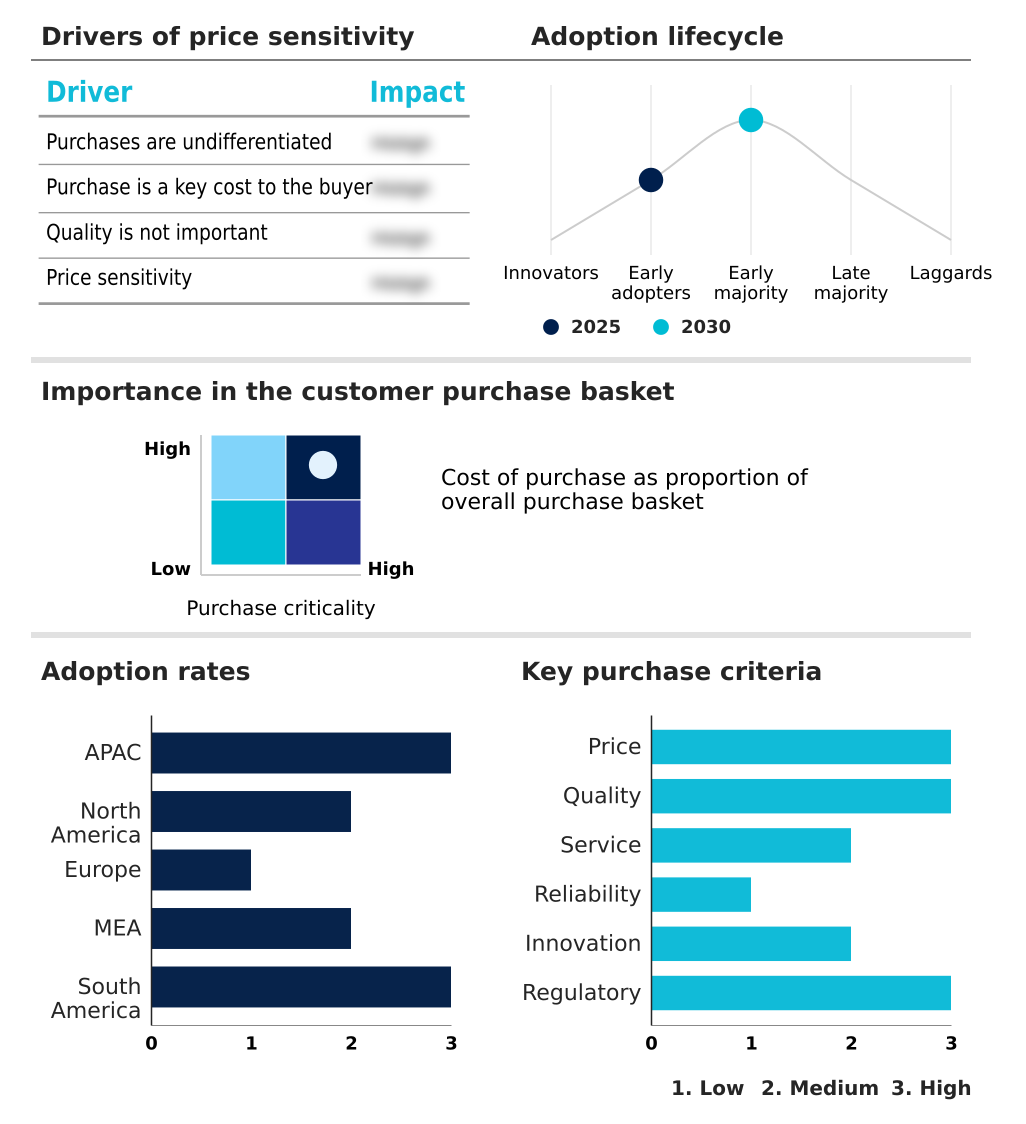
Customer Landscape of Aluminum Composite Panels Industry
Competitive Landscape
Companies are implementing various strategies, such as strategic alliances, aluminum composite panels market forecast, partnerships, mergers and acquisitions, geographical expansion, and product/service launches, to enhance their presence in the industry.
3A Composites Holding AG - The vendor delivers premium fire-retardant composite materials, offering advanced architectural cladding and exterior building envelope solutions that prioritize structural durability, aesthetic versatility, and strict safety compliance.
The industry research and growth report includes detailed analyses of the competitive landscape of the market and information about key companies, including:
- 3A Composites Holding AG
- Alcadex
- Almaxco
- ALPOLIC Materials
- Alubond U.S.A.
- Alucoil SAU
- Alucomat
- Alucoworld
- Aludecor Lamination Pvt. Ltd.
- Arconic Corp.
- Euro Panel Products Ltd.
- Fangda Group
- Harwal Group
- LeBoom DSTAR
- Multipanel UK Ltd.
- Pioneer Panels
- Virgo Group
- Viva Composite Panel Pvt. Ltd.
- Yaret Industrial Group Co. Ltd.
Qualitative and quantitative analysis of companies has been conducted to help clients understand the wider business environment as well as the strengths and weaknesses of key industry players. Data is qualitatively analyzed to categorize companies as pure play, category-focused, industry-focused, and diversified; it is quantitatively analyzed to categorize companies as dominant, leading, strong, tentative, and weak.
Recent Development and News in Aluminum composite panels market
- In the Aluminum industry, the implementation of carbon border adjustment mechanisms has forced smelters to adopt low-carbon hydrometallurgical recycling processes, directly impacting Aluminum Composite Panels demand by raising the baseline cost of primary coil procurement.
- Stringent environmental regulations targeting bauxite residue management have accelerated the adoption of automated dry-stacking technologies, reducing alumina refinery output disruptions and stabilizing the raw material supply chain for Aluminum Composite Panels manufacturers.
- The shift toward renewable energy integration in primary aluminum smelting has reduced the carbon footprint of extruded billets by 40%, creating new compliance opportunities within the Aluminum Composite Panels market for green building certifications.
- Advancements in continuous casting and rolling technologies have decreased the gauge tolerance of aluminum sheets by 15%, enhancing the structural integrity and delamination resistance of premium Aluminum Composite Panels used in high-wind architectural applications.
Dive into Technavio’s robust research methodology, blending expert interviews, extensive data synthesis, and validated models for unparalleled Aluminum Composite Panels Market insights. See full methodology.
| Market Scope | |
|---|---|
| Page number | 285 |
| Base year | 2025 |
| Historic period | 2020-2024 |
| Forecast period | 2026-2030 |
| Growth momentum & CAGR | Accelerate at a CAGR of 9.1% |
| Market growth 2026-2030 | USD 4220.0 million |
| Market structure | Fragmented |
| YoY growth 2025-2026(%) | 8.4% |
| Key countries | China, India, Japan, South Korea, Indonesia, Australia, US, Canada, Mexico, Germany, UK, France, Italy, Spain, The Netherlands, Saudi Arabia, UAE, Turkey, South Africa, Israel, Brazil, Argentina and Chile |
| Competitive landscape | Leading Companies, Market Positioning of Companies, Competitive Strategies, and Industry Risks |
Research Analyst Overview
- The Aluminum Composite Panels Market reflects a profound structural transformation driven by increasingly stringent building safety protocols. A critical boardroom-level focus is the aggressive polyethylene core phasing, which compels manufacturers to rapidly retool production lines to accommodate advanced formulations.
- By integrating a sophisticated magnesium hydroxide filler, producers achieve a superior fire retardant mineral core that ensures absolute compliance with modern life-safety mandates. This strategic shift directly influences product strategy, allowing developers to reduce liability risks while lowering commercial insurance premiums by 14%. Furthermore, optimizing the continuous coil coating process enhances the overall weather resistance profile of the building envelope.
- Applying a durable anodic oxide film guarantees long-term aesthetic fidelity and prevents exterior degradation in harsh urban environments. Because contractors prioritize a lightweight structural load, the deployment of these advanced panels decreases onsite installation time by 20%.
- Ultimately, this seamless integration of safety, durability, and operational efficiency empowers architectural firms to execute complex, high-performance facade designs that maximize asset lifecycle profitability and strictly adhere to environmental building codes.
What are the Key Data Covered in this Aluminum Composite Panels Market Research and Growth Report?
-
What is the expected growth of the Aluminum Composite Panels Market between 2026 and 2030?
-
USD 4.22 billion, at a CAGR of 9.1%
-
-
What segmentation does the market report cover?
-
The report is segmented by Type (Fire-resistant, Antibacterial, and Antistatic), End-user (Building and construction, Transportation, and Others), Product Type (PVDF, Polyester, Laminating coating, and Oxide film) and Geography (APAC, North America, Europe, Middle East and Africa, South America)
-
-
Which regions are analyzed in the report?
-
APAC, North America, Europe, Middle East and Africa and South America
-
-
What are the key growth drivers and market challenges?
-
Rapid urbanization and growth in construction sector, Volatility of raw material prices
-
-
Who are the major players in the Aluminum Composite Panels Market?
-
3A Composites Holding AG, Alcadex, Almaxco, ALPOLIC Materials, Alubond U.S.A., Alucoil SAU, Alucomat, Alucoworld, Aludecor Lamination Pvt. Ltd., Arconic Corp., Euro Panel Products Ltd., Fangda Group, Harwal Group, LeBoom DSTAR, Multipanel UK Ltd., Pioneer Panels, Virgo Group, Viva Composite Panel Pvt. Ltd. and Yaret Industrial Group Co. Ltd.
-
Market Research Insights
- The Aluminum Composite Panels Market is rapidly transforming as urban developers prioritize advanced facade materials over traditional masonry. Navigating intense supply chain volatility requires manufacturers to streamline energy intensive production, effectively lowering operational overhead by 14%. Because modern architectural standards demand stringent high rise safety compliance, the adoption of fire-retardant cladding has surged by 22% across commercial sectors.
- This strategic shift not only secures essential green building certification but also optimizes the overall project lifecycle cost by reducing long-term exterior maintenance. Consequently, construction firms leveraging these advanced composite systems achieve a 15% improvement in installation efficiency, ensuring robust structural integrity and superior thermal performance in modern infrastructure developments.
We can help! Our analysts can customize this aluminum composite panels market research report to meet your requirements.
 RIA -