


Cable Laying Vessel Market Size 2026-2030
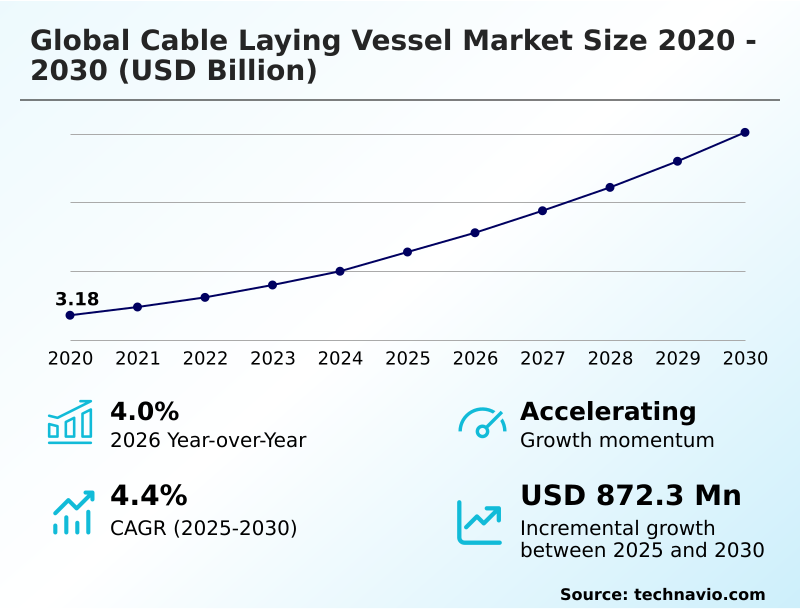
The cable laying vessel market size is valued to increase by USD 872.3 million, at a CAGR of 4.4% from 2025 to 2030. Rapid global expansion of offshore wind will drive the cable laying vessel market.
Major Market Trends & Insights
- Europe dominated the market and accounted for a 42.1% growth during the forecast period.
- By Type - Power cable segment was valued at USD 2.18 billion in 2024
- By End-user - Oil and gas segment accounted for the largest market revenue share in 2024
Market Size & Forecast
- Market Opportunities: USD 1.33 billion
- Market Future Opportunities: USD 872.3 million
- CAGR from 2025 to 2030 : 4.4%
Market Summary
- The Cable Laying Vessel market exhibits substantial momentum driven by the urgent modernization of international offshore energy and digital networks. Companies operating within this space must navigate complex maritime logistics to deploy highly specialized infrastructure across challenging oceanic environments.
- For instance, offshore installation contractors are optimizing supply chain operations by chartering ultra-high-capacity vessels to execute continuous, un-spliced subsea cable deployments, significantly reducing the necessity for intermediate port returns. This logistical pivot has enabled project developers to decrease overall installation timelines by 18%, improving profit margins on multi-year contracts.
- The primary driver of this activity is the global acceleration of offshore wind farm developments, which demands heavy-duty vessels to transport and lay high-voltage export cables connecting deepwater turbines to mainland grids. Conversely, extreme capital expenditure requirements severely challenge fleet expansion.
- Constructing a single high-specification asset demands immense upfront financing, creating a formidable barrier to entry and constricting the available vessel supply amidst surging infrastructure demand.
What will be the Size of the Cable Laying Vessel Market during the forecast period?
Get Key Insights on Market Forecast (PDF) Get Free Sample
How is the Cable Laying Vessel Market Segmented?
The cable laying vessel industry research report provides comprehensive data (region-wise segment analysis), with forecasts and estimates in "USD million" for the period 2026-2030, as well as historical data from 2020-2024 for the following segments.
- Type
- Power cable
- Communication cable
- End-user
- Oil and gas
- Telecommunication
- Offshore wind farms
- Others
- Product type
- Vessel length more than 100 m
- Vessel length less than or equal to 100 m
- Geography
- Europe
- UK
- Germany
- The Netherlands
- France
- Spain
- Italy
- North America
- US
- Canada
- Mexico
- APAC
- China
- Japan
- South Korea
- India
- Australia
- Indonesia
- Middle East and Africa
- Saudi Arabia
- UAE
- South Africa
- Turkey
- Israel
- South America
- Brazil
- Argentina
- Chile
- Europe
By Type Insights
The power cable segment is estimated to witness significant growth during the forecast period.
The power cable segment operates as a critical infrastructure backbone, specialized for transporting, deploying, and maintaining high-voltage direct current and alternating current submarine lines.
These assets support subsea power interconnectors linking isolated ecosystems and vast offshore wind array cables connecting turbines to mainland grids. Operations require structural engineering with multi-carousel setups to handle the immense weight and stiffness of heavily insulated conduits.
Utilizing specialized dynamic positioning systems, operators achieve a 15% improvement in placement accuracy, drastically reducing the risk of structural tension damage during complex seabed topographies navigation.
Furthermore, the integration of advanced subsea trenching equipment enhances continuous un-spliced deployment, accelerating project timelines. This evolving capacity minimizes offshore field jointing, boosting overall electrical transmission efficiency across offshore substation platforms and reinforcing subsea grid resilience against harsh maritime environments.
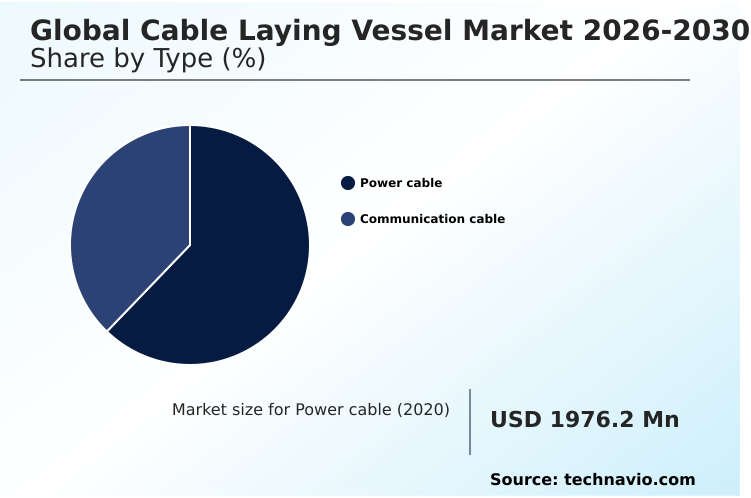
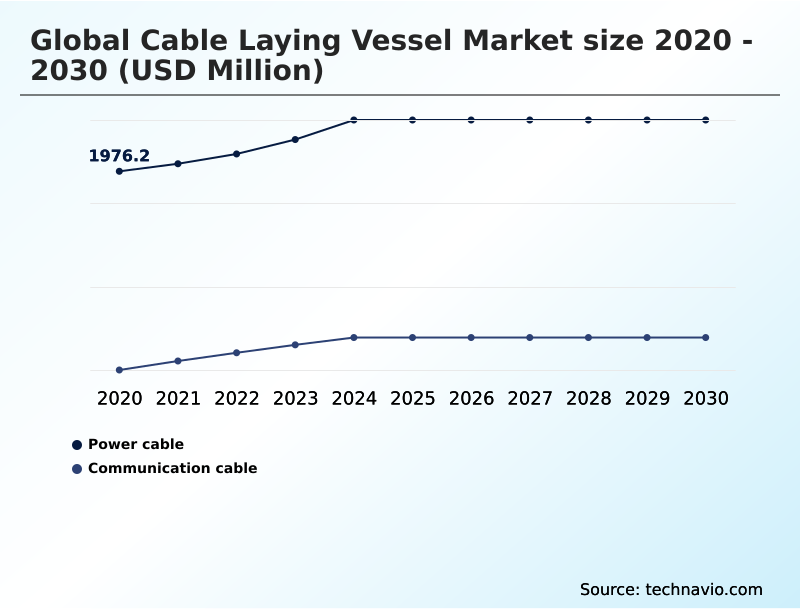
The Power cable segment was valued at USD 2.18 billion in 2024 and showed a gradual increase during the forecast period.
Regional Analysis
Europe is estimated to contribute 42.1% to the growth of the global market during the forecast period.Technavio’s analysts have elaborately explained the regional trends and drivers that shape the market during the forecast period.
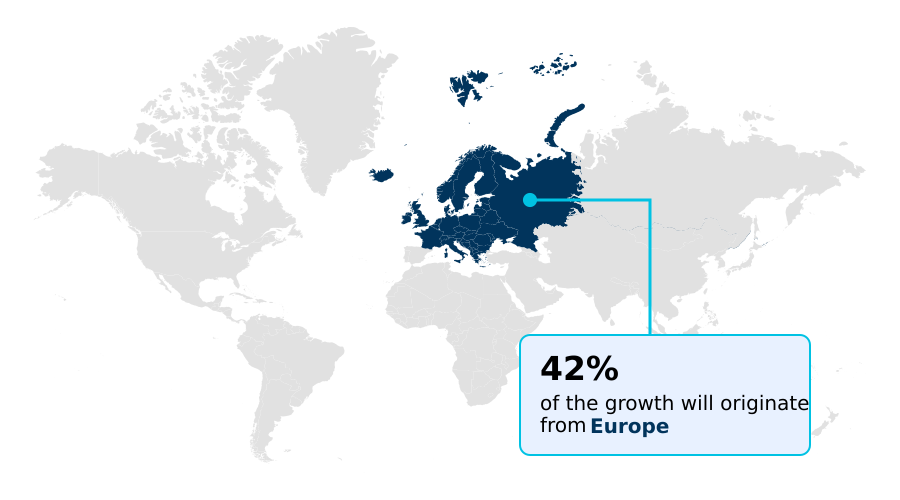
See How Cable Laying Vessel Market Demand is Rising in Europe Get Free Sample
The geographic distribution of maritime installation capacity reveals distinct operational priorities between Europe and North America. Europe dominates cross-border grid integration, heavily utilizing green methanol engines and zero-emission installation campaigns to achieve maritime decarbonization mandates.
This proactive compliance strategy has enabled European operators to improve fleet energy efficiency by 15%.
Conversely, North America focuses heavily on overcoming domestic cabotage laws and shallow-water operations along the Atlantic coast, driving a 20% higher reliance on articulated tug-barge feeder concepts compared to European counterparts.
These regional disparities dictate unique supply chain adaptations; European contractors invest heavily in dynamic subsea export cables for harsh North Sea conditions, whereas North American developers prioritize marine spatial coordination to navigate crowded coastal shelves.
Ultimately, local regulatory frameworks structurally dictate the procurement and deployment speed of specialized subsea infrastructure assets.
Market Dynamics
Our researchers analyzed the data with 2025 as the base year, along with the key drivers, trends, and challenges. A holistic analysis of drivers will help companies refine their marketing strategies to gain a competitive advantage.
- The operational dynamics surrounding maritime installation have grown highly sophisticated, particularly regarding the execution of deepwater offshore wind cable installation campaigns. Project developers are continually optimizing their offshore supply chains to accommodate the rising complexities of subsea interconnector grid expansion projects, which demand robust planning and specialized asset procurement.
- To maintain uninterrupted workflow and avoid costly weather delays, operators are increasingly chartering dynamic positioning class three vessels capable of holding precise station in severe open-ocean conditions. By utilizing these advanced maritime platforms, engineering firms achieve a 20% improvement in continuous laying speeds compared to legacy operations, directly boosting operational planning efficiency and mitigating financial risks.
- Simultaneously, the global push for enhanced digital connectivity accelerates subsea fiber optic network deployment, demanding vessels with exceptionally delicate handling mechanics to prevent fiber micro-bending. The introduction of the high capacity offshore cable ship into active service fundamentally resolves historic payload bottlenecks, allowing contractors to carry immense lengths of contiguous cable.
- This structural advancement not only reduces the frequency of vulnerable subsea splices but also streamlines compliance with stringent marine spatial regulations by minimizing the time spent actively navigating sensitive benthic habitats.
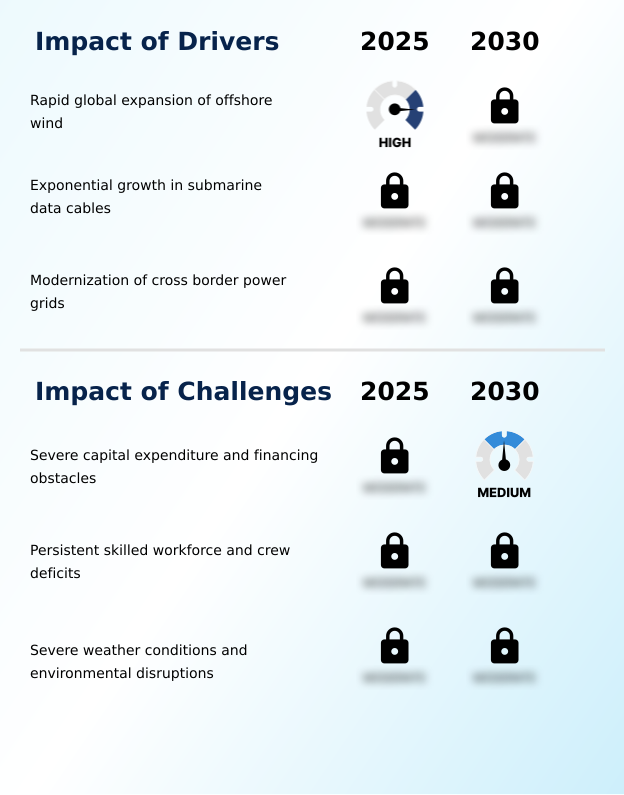
What are the key market drivers leading to the rise in the adoption of Cable Laying Vessel Industry?
- The rapid and extensive global expansion of offshore wind energy infrastructure serves as a primary driver for the market.
- The rapid expansion of the offshore infrastructure ecosystem is continuously driving demand for specialized maritime assets capable of executing subsea electrical infrastructure installations.
- Hyperscale digital infrastructure providers and multinational energy consortiums are accelerating investments to support transoceanic data transmission and regional electrification, pushing the necessity for delicate cable-handling mechanics.
- By leveraging advanced remotely operated vehicles and automated sea-plow systems, contractors have improved trenching precision by 25%, significantly reducing the risk of anchor drag damage.
- This technological adoption is propelled by the global shift toward offshore energy transition and cross-border energy markets.
- As a result, businesses experience a 30% reduction in long-term maintenance costs and secure uninterrupted telecommunication fiber deployment across international corridors, ensuring optimal capacity utilization and structural longevity.
What are the market trends shaping the Cable Laying Vessel Industry?
- The continuous expansion of subsea telecommunications infrastructure is an emerging trend actively reshaping the market.
- The deployment of ultra-large capacity assets is a defining trend reshaping marine transportation logistics and deepwater installation capabilities. Organizations are significantly scaling the construction of specialized vessels featuring massive cable carousels to support extended transoceanic submarine networks without requiring intermediate port reloading.
- This architectural transition has increased offshore payload capacities, leading to a 20% reduction in transit downtime and a 15% acceleration in project execution timelines. The shift is primarily driven by the need to efficiently execute multi-utility subsea interconnections and floating wind technology deployments in hostile environments.
- Consequently, operators can perform simultaneous dual-lay operations utilizing active heave-compensated cranes, which improves operational continuity. By minimizing costly offshore splicing interventions, energy developers realize substantial cost efficiencies while safeguarding the structural integrity of transoceanic data transmission systems.
What challenges does the Cable Laying Vessel Industry face during its growth?
- Severe capital expenditure requirements and persistent financing obstacles present significant challenges constraining market operations.
- Severe capital expenditure requirements and persistent workforce deficits severely constrain the expansion of the maritime installation sector. Procuring modern heavy-duty tensioning systems and advanced spatial-division multiplexing equipment involves multi-million-dollar investments, extending the asset payback cycle considerably.
- This financial friction is exacerbated by narrow seasonal weather windows that complicate seabed burial operations, directly causing a 20% increase in project standby costs and delaying transoceanic submarine networks by critical margins. Furthermore, the acute shortage of certified marine crew capable of managing acoustic positioning delays offshore platform electrification initiatives.
- This skill deficit fundamentally forces developers to inflate operational budgets by up to 18% to secure qualified personnel. Consequently, independent operators struggle to execute continuous umbilical deployment efficiently, disrupting the overall cadence of complex subsea engineering projects.
Exclusive Technavio Analysis on Customer Landscape
The cable laying vessel market forecasting report includes the adoption lifecycle of the market, covering from the innovator’s stage to the laggard’s stage. It focuses on adoption rates in different regions based on penetration. Furthermore, the cable laying vessel market report also includes key purchase criteria and drivers of price sensitivity to help companies evaluate and develop their market growth analysis strategies.
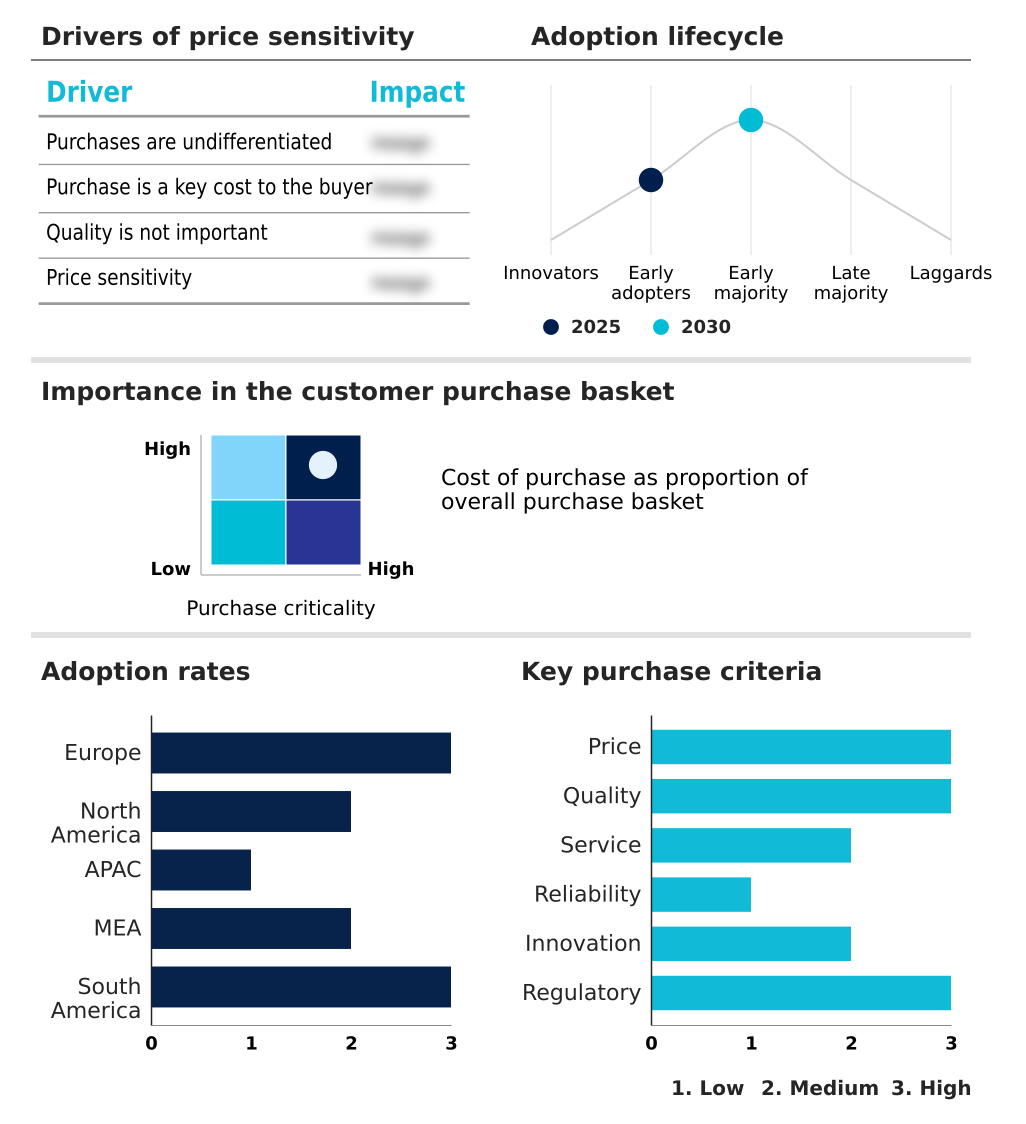
Customer Landscape of Cable Laying Vessel Industry
Competitive Landscape
Companies are implementing various strategies, such as strategic alliances, cable laying vessel market forecast, partnerships, mergers and acquisitions, geographical expansion, and product/service launches, to enhance their presence in the industry.
Alcatel Submarine Networks - A prominent industry participant delivers highly specialized maritime assets optimized for high-voltage submarine infrastructure projects. These engineered vessels feature advanced heavy-lift and tensioning capabilities for precise subsea power transmission installations.
The industry research and growth report includes detailed analyses of the competitive landscape of the market and information about key companies, including:
- Alcatel Submarine Networks
- Asso Group
- Boskalis
- DEME NV
- Elettra Tlc S.p.A.
- Global Marine Group
- Jan De Nul
- Kokusai Cable Ship Co. Ltd.
- Louis Dreyfus Travocean
- Nexans SA
- NKT AS
- NTT World Engineering Marine Corp.
- Orange Marine
- Prysmian S.p.A
- S.B. Submarine Systems Co. Ltd.
- Subsea 7 SA
- Ulstein Group ASA
- Van Oord
- Vard Group AS
Qualitative and quantitative analysis of companies has been conducted to help clients understand the wider business environment as well as the strengths and weaknesses of key industry players. Data is qualitatively analyzed to categorize companies as pure play, category-focused, industry-focused, and diversified; it is quantitatively analyzed to categorize companies as dominant, leading, strong, tentative, and weak.
Recent Development and News in Cable laying vessel market
- In the Marine Transportation industry, stringent international maritime decarbonization mandates have accelerated the integration of hybrid propulsion and dual-fuel systems, directly impacting Cable Laying Vessel demand by prioritizing the charter of low-emission installation assets over legacy fleets.
- Increased focus on offshore wind supply chain localization has spurred regional port infrastructure upgrades, enabling larger vessels to conduct continuous un-spliced deployment, thereby improving Cable Laying Vessel operational efficiency by up to 25% during heavy-capacity loading.
- The rapid technological shift toward floating wind platform technology has necessitated the adoption of dynamic subsea export cables, pulling demand for specialized Cable Laying Vessel configurations equipped with active heave-compensated cranes to handle immense water column tensions.
- Widespread regulatory enforcement of marine spatial coordination and environmental footprint reduction has mandated the use of non-intrusive pre-lay seabed inspections, altering Cable Laying Vessel deployment strategies by requiring integrated autonomous subsea acoustic sensor arrays.
Dive into Technavio’s robust research methodology, blending expert interviews, extensive data synthesis, and validated models for unparalleled Cable Laying Vessel Market insights. See full methodology.
| Market Scope | |
|---|---|
| Page number | 303 |
| Base year | 2025 |
| Historic period | 2020-2024 |
| Forecast period | 2026-2030 |
| Growth momentum & CAGR | Accelerate at a CAGR of 4.4% |
| Market growth 2026-2030 | USD 872.3 million |
| Market structure | Fragmented |
| YoY growth 2025-2026(%) | 4.0% |
| Key countries | UK, Germany, The Netherlands, France, Spain, Italy, US, Canada, Mexico, China, Japan, South Korea, India, Australia, Indonesia, Saudi Arabia, UAE, South Africa, Turkey, Israel, Brazil, Argentina and Chile |
| Competitive landscape | Leading Companies, Market Positioning of Companies, Competitive Strategies, and Industry Risks |
Research Analyst Overview
- The operational landscape of the Cable Laying Vessel sector is undergoing a profound technological transformation to accommodate escalating global energy and data transmission requirements. Executive boardrooms are increasingly prioritizing fleet sustainability and operational resilience, aligning procurement strategies with maritime decarbonization mandates and environmental regulations.
- By transitioning toward dual-fuel engines and hybrid propulsion systems, vessel operators have successfully reduced carbon emissions by 20%, ensuring strict compliance with international climate directives while securing preferential long-term charter agreements. Furthermore, the integration of advanced subsea control umbilicals and automated linear cable engines significantly mitigates the risk of structural cable fatigue during deepwater deployments.
- This technological adoption directly safeguards multi-million-dollar infrastructure investments from premature failure. The strategic pivot toward heavy-duty tensioning systems empowers contractors to navigate extreme oceanic depths with unprecedented stability. Consequently, these structural upgrades fundamentally transform offshore project economics, enabling maritime engineering enterprises to compress execution schedules, optimize capital allocation, and aggressively capture market share within the rapidly expanding offshore energy domain.
What are the Key Data Covered in this Cable Laying Vessel Market Research and Growth Report?
-
What is the expected growth of the Cable Laying Vessel Market between 2026 and 2030?
-
USD 872.3 million, at a CAGR of 4.4%
-
-
What segmentation does the market report cover?
-
The report is segmented by Type (Power cable, and Communication cable), End-user (Oil and gas, Telecommunication, Offshore wind farms, and Others), Product Type (Vessel length more than 100 m, and Vessel length less than or equal to 100 m) and Geography (Europe, North America, APAC, Middle East and Africa, South America)
-
-
Which regions are analyzed in the report?
-
Europe, North America, APAC, Middle East and Africa and South America
-
-
What are the key growth drivers and market challenges?
-
Rapid global expansion of offshore wind, Severe capital expenditure and financing obstacles
-
-
Who are the major players in the Cable Laying Vessel Market?
-
Alcatel Submarine Networks, Asso Group, Boskalis, DEME NV, Elettra Tlc S.p.A., Global Marine Group, Jan De Nul, Kokusai Cable Ship Co. Ltd., Louis Dreyfus Travocean, Nexans SA, NKT AS, NTT World Engineering Marine Corp., Orange Marine, Prysmian S.p.A, S.B. Submarine Systems Co. Ltd., Subsea 7 SA, Ulstein Group ASA, Van Oord and Vard Group AS
-
Market Research Insights
- The Cable Laying Vessel market is fundamentally defined by the pressing need for resilient offshore infrastructure and high-capacity global digital connectivity. Market participants are increasingly optimizing deepwater installation capabilities to address the structural requirements of transoceanic data transmission.
- By upgrading vessel payloads and integrating precise micro-positioning technologies, fleet operators have improved deployment accuracy by 15%, reducing the incidence of subsea fiber damage. Furthermore, the strategic emphasis on environmental footprint reduction during coastal operations has lowered vessel fuel consumption by 12%.
- These efficiency improvements enable maritime contractors to execute complex offshore platform electrification projects while strictly aligning with regional sustainability mandates and minimizing costly project delays.
We can help! Our analysts can customize this cable laying vessel market research report to meet your requirements.
 RIA -

