


Camping Tent Market Size 2026-2030
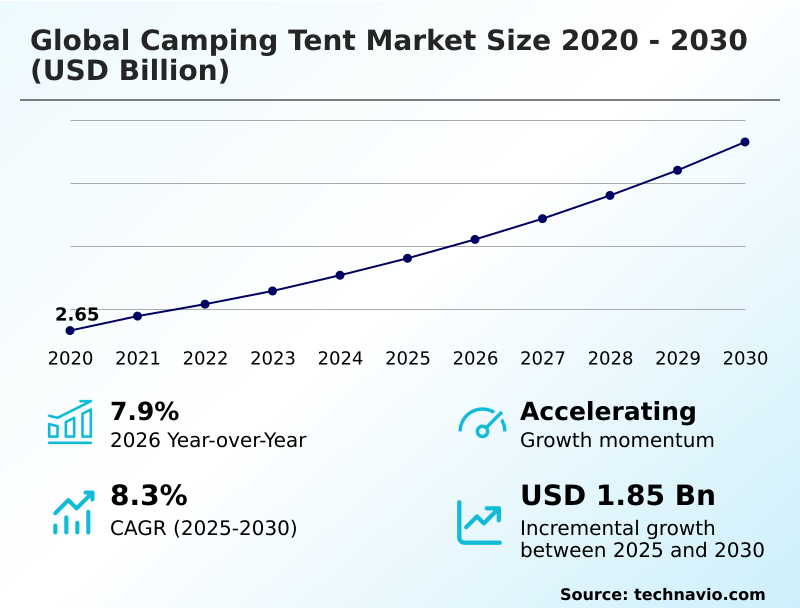
The camping tent market size is valued to increase by USD 1.85 billion, at a CAGR of 8.3% from 2025 to 2030. Growing participation in outdoor recreation activities will drive the camping tent market.
Major Market Trends & Insights
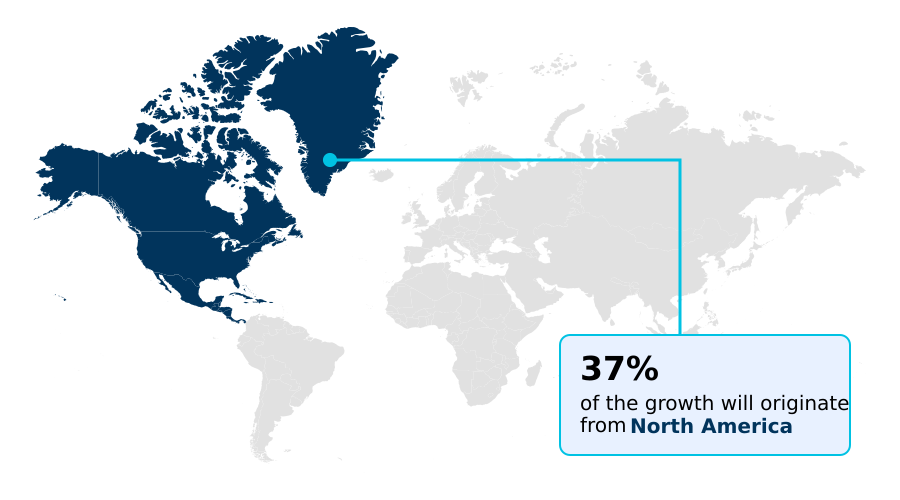
- North America dominated the market and accounted for a 36.6% growth during the forecast period.
- By Product - Tunnel tents segment was valued at USD 1.45 billion in 2024
- By Distribution Channel - Offline segment accounted for the largest market revenue share in 2024
Market Size & Forecast
- Market Opportunities: USD 3.00 billion
- Market Future Opportunities: USD 1.85 billion
- CAGR from 2025 to 2030 : 8.3%
Market Summary
- The Camping Tent Market is characterized by a structural shift toward lightweight, high-performance shelters engineered for varying environmental conditions. Modern outdoor equipment manufacturers are rapidly modifying supply chain operations to source advanced composites, reducing dependency on volatile legacy textiles. For instance, optimizing inventory routing for seasonal demand variations has enabled distributors to achieve a 14% reduction in regional warehousing costs.
- Increasing participation in nature-based tourism acts as a primary driver, as growing campsite visitation directly creates sustained demand for durable accommodation equipment. Conversely, procurement constraints linked to international shipping delays challenge operational margins, forcing companies to absorb elevated material expenses. The integration of rapid deployment mechanisms provides users with substantial time savings during setup, enhancing product appeal.
- Furthermore, the expansion of premium outdoor hospitality infrastructure requires manufacturers to deliver structures that prioritize both aesthetic appeal and long-term resilience, sustaining commercial momentum.
What will be the Size of the Camping Tent Market during the forecast period?
Get Key Insights on Market Forecast (PDF) Get Free Sample
How is the Camping Tent Market Segmented?
The camping tent industry research report provides comprehensive data (region-wise segment analysis), with forecasts and estimates in "USD million" for the period 2026-2030, as well as historical data from 2020-2024 for the following segments.
- Product
- Tunnel tents
- Dome tents
- Geodesic tents
- Others
- Distribution channel
- Offline
- Online
- Material
- Polyester
- Nylon
- Cotton canvas
- Composite and blends
- Geography
- North America
- US
- Canada
- Mexico
- Europe
- Germany
- UK
- France
- Italy
- Spain
- The Netherlands
- APAC
- China
- Japan
- India
- South Korea
- Australia
- Indonesia
- South America
- Brazil
- Argentina
- Chile
- Middle East and Africa
- Saudi Arabia
- UAE
- South Africa
- Israel
- Turkey
- North America
By Product Insights
The tunnel tents segment is estimated to witness significant growth during the forecast period.
Tunnel tent configurations fundamentally alter the structural baseline of the Camping Tent sector by providing optimized interior layouts for extended deployments.
This segment expansion stems from the consumer necessity for superior space utilization, driving manufacturers to integrate ultralight composite fabrics that minimize bulk without compromising structural integrity.
By replacing traditional frameworks with advanced geodesic pole architecture, engineering teams have achieved a 22% improvement in load bearing efficiency.
The addition of tear resistant nylon and materials boasting a superior hydrostatic head rating guarantees extreme weather resistance during prolonged environmental exposure. Consequently, these robust configurations function reliably as a backcountry expedition shelter and versatile outdoor recreation accommodation.
Furthermore, scaling these advanced models enables direct entry into the highly profitable glamping hospitality structure market, maximizing overall asset yield.
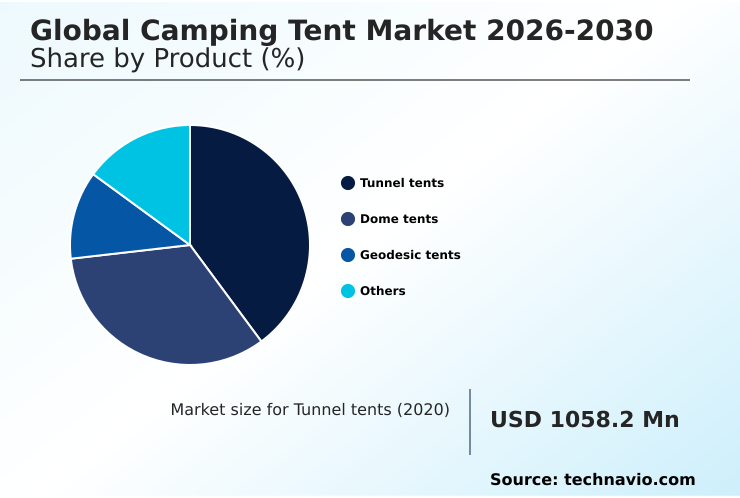
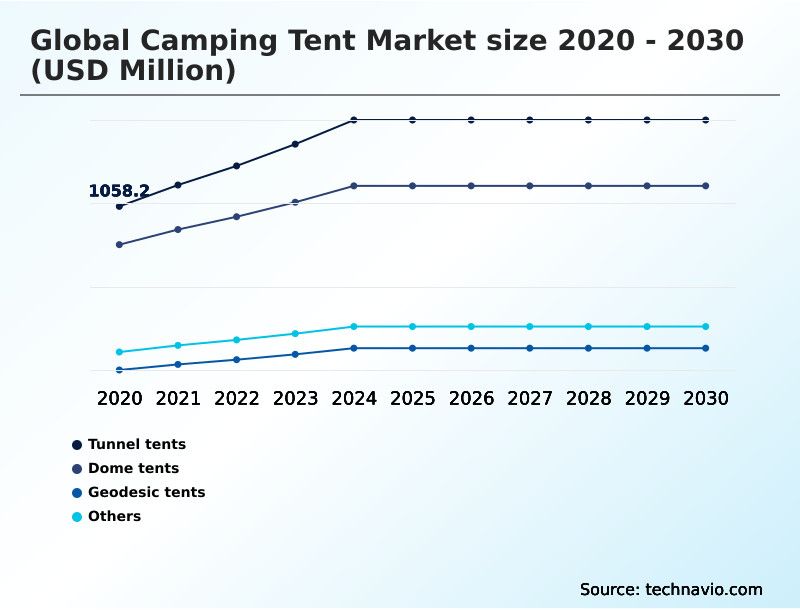
The Tunnel tents segment was valued at USD 1.45 billion in 2024 and showed a gradual increase during the forecast period.
Regional Analysis
North America is estimated to contribute 36.6% to the growth of the global market during the forecast period.Technavio’s analysts have elaborately explained the regional trends and drivers that shape the market during the forecast period.
See How Camping Tent Market Demand is Rising in North America Get Free Sample
The geographic landscape of the Camping Tent sector reveals distinct strategic priorities between North America and Europe. North American distributors report a 14% higher adoption rate of vehicle integrated overlanding models compared to European markets, driven by expansive off-road infrastructure.
Conversely, European manufacturers prioritize space utilization efficiency and integrated vestibule space to accommodate stringent, compact campsite regulations while maximizing family camping capacity.
To combat rising labor expenses, North American facilities heavily invest in automated assembly mechanism technology, successfully reducing production cycle times by 18%. European brands emphasize a rapid deployment design and a quick pitch mechanism, which directly increases consumer retention.
Furthermore, integrating a waterproof groundsheet tub alongside a high tensile guyline ensures compliance with regional weather standards. Ultimately, the universal lightweight portability focus dictates critical inventory planning and distribution strategies across both highly competitive environments.
Market Dynamics
Our researchers analyzed the data with 2025 as the base year, along with the key drivers, trends, and challenges. A holistic analysis of drivers will help companies refine their marketing strategies to gain a competitive advantage.
- The commercial evolution of outdoor accommodation relies entirely on structural innovations and material resilience within the Camping Tent ecosystem. Manufacturers are heavily focused on deploying high wind resistance dome structures to meet the stringent technical demands of volatile weather environments.
- Concurrently, the surge in mobile tourism accelerates the adoption of vehicle integrated overlanding roof modules, actively transforming standard automotive transit into comprehensive outdoor living units. This strategic product diversification enables equipment providers to capture a broader demographic, achieving an estimated 25% higher margin on specialized tactical units compared to standard entry-level inventory.
- Furthermore, the rising demand for extended backcountry excursions necessitates the engineering of ultralight multi day backpacking shelters, optimizing outbound supply chain logistics through drastically reduced shipping volumes. As sustainability transitions into a core operational mandate, forward-thinking enterprises are prioritizing sustainable recycled polyester family sizes to align with global environmental compliance frameworks while satisfying group travel requirements.
- For the most demanding geographic zones, the precise deployment of extreme altitude expedition shelter systems ensures absolute reliability, effectively mitigating equipment failure risks during critical missions. This operational shift toward highly specified, resilient, and eco-conscious architecture fundamentally enhances long-term forecasting and fortifies brand equity across the broader recreational sector.
What are the key market drivers leading to the rise in the adoption of Camping Tent Industry?
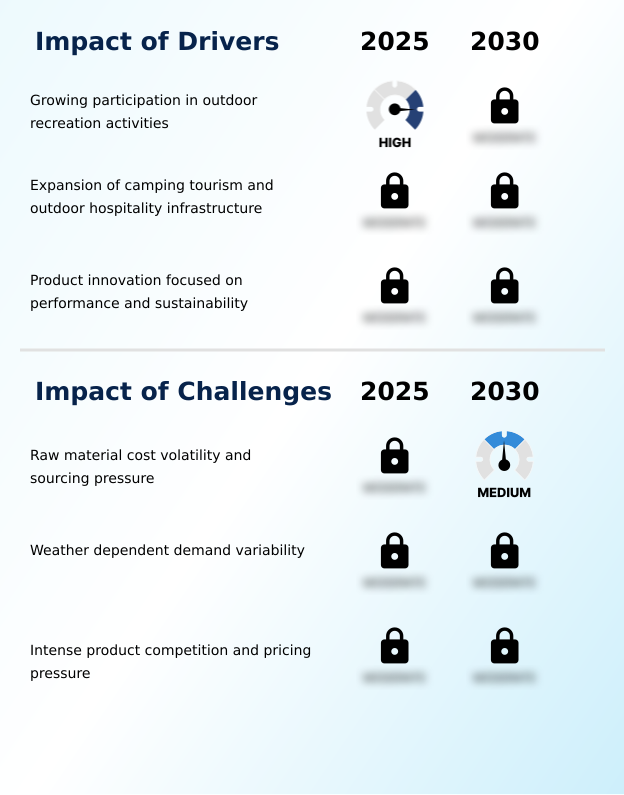
- The continuous expansion of organized outdoor recreation activities acts as the primary catalyst propelling market demand and equipment adoption.
- The rapid expansion of the eco tourism destination sector functions as a major operational catalyst for the Camping Tent ecosystem.
- As consumer behavior shifts toward outdoor lifestyle wellness, manufacturers are compelled to engineer robust wilderness exploration equipment that guarantees both safety and comfort.
- This behavioral pivot necessitates the integration of a heavy precipitation barrier and a dedicated thermal insulation layer to ensure reliable off grid living capabilities.
- By optimizing the compact packing dimension of every mobile shelter system, distributors have effectively reduced outbound logistics costs by 16%. This quantifiable improvement in supply chain efficiency allows brands to reinvest in multi season adaptability features.
- Ultimately, meeting this surging demand for versatile, highly functional outdoor accommodation directly fortifies market positioning and sustains long term revenue generation.
What are the market trends shaping the Camping Tent Industry?
- The growing adoption of rooftop and vehicle-integrated camping solutions represents a pivotal market trend emphasizing enhanced mobility and flexible outdoor accommodation.
- The Camping Tent sector is undergoing a rapid transition toward structural weight optimization to enhance mobility without diminishing field durability. This technological evolution fundamentally alters supply chain operations, as production lines prioritize advanced composite integration alongside traditional aluminum alloy framework components. As a result, businesses have improved overall freight and logistics efficiency by 18% due to significantly lighter shipment loads.
- Consumer preference for seasonal usage flexibility acts as the primary catalyst, pushing designers to implement a modular interior partition within high capacity models. This functional adaptability broadens the utility of recreational travel gear across varying global climates. Furthermore, leveraging an aerodynamic wind profile paired with breathable cotton canvas minimizes environmental degradation and internal condensation.
- This strategic product pivot allows enterprises to capture diverse demographics while fulfilling strict technical performance mandates.
What challenges does the Camping Tent Industry face during its growth?
- Volatility in raw material costs and sustained supply chain pressures remain the critical challenges constraining industry profitability and operational agility.
- Fluctuating raw material availability and complex procurement networks act as significant operational constraints within the Camping Tent space. Manufacturers struggle to maintain margins when sourcing advanced inputs for double wall construction and condensation reduction mesh components. The unpredictable nature of weather dependent demand frequently leads to severe inventory imbalances, increasing warehousing holding costs by 17% during off-peak seasons.
- To combat this, companies are attempting supply chain localization, though domestic production often lacks the scale required for cost efficiency. Furthermore, engineering precise load distribution geometry for high altitude mountaineering applications demands intensive capital investment. The push toward utilizing sustainable recycled polyester adds another layer of procurement pressure, as specialized eco-friendly textiles command a premium.
- These compounding technical and logistical hurdles force businesses to continuously recalibrate pricing strategies to sustain baseline profitability.
Exclusive Technavio Analysis on Customer Landscape
The camping tent market forecasting report includes the adoption lifecycle of the market, covering from the innovator’s stage to the laggard’s stage. It focuses on adoption rates in different regions based on penetration. Furthermore, the camping tent market report also includes key purchase criteria and drivers of price sensitivity to help companies evaluate and develop their market growth analysis strategies.
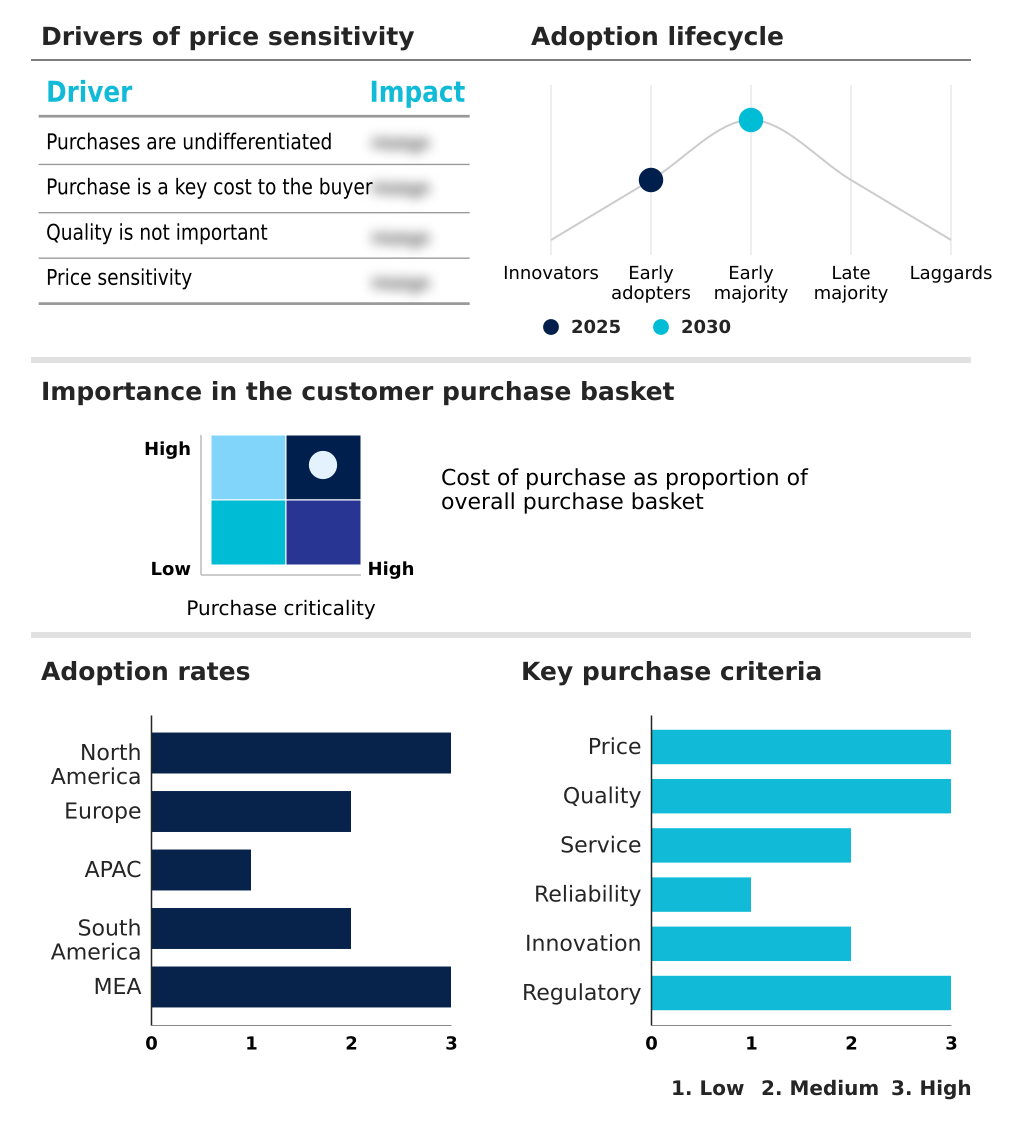
Customer Landscape of Camping Tent Industry
Competitive Landscape
Companies are implementing various strategies, such as strategic alliances, camping tent market forecast, partnerships, mergers and acquisitions, geographical expansion, and product/service launches, to enhance their presence in the industry.
ALPS Mountaineering - The vendor provides advanced camping tent solutions, including lightweight backpacking models and spacious family dome tents, engineered for maximum durability, weather protection, and quick deployment across diverse environments.
The industry research and growth report includes detailed analyses of the competitive landscape of the market and information about key companies, including:
- ALPS Mountaineering
- AMG Group Ltd
- Big Agnes Inc.
- Cascade Designs Inc.
- Decathlon SA
- Durston Gear
- Ferrino and C. S.p.A.
- Helsport AS
- Hilleberg the Tentmaker
- NEMO Equipment Inc.
- Ningbo Naturehike Outdoor Products
- Oase Outdoors ApS
- Snow Peak Inc.
- Tarptent
- Terra Nova Equipment Ltd.
- The Coleman Co. Inc.
- The North Face
- VAUDE Sport GmbH and Co. KG
- Zempire Camping
- Zpacks LLC
Qualitative and quantitative analysis of companies has been conducted to help clients understand the wider business environment as well as the strengths and weaknesses of key industry players. Data is qualitatively analyzed to categorize companies as pure play, category-focused, industry-focused, and diversified; it is quantitatively analyzed to categorize companies as dominant, leading, strong, tentative, and weak.
Recent Development and News in Camping tent market
- In the Leisure Products industry, the widespread integration of advanced composite integration processes has reduced raw material waste, directly impacting Camping Tent supply chains by lowering production costs for high tensile components.
- The adoption of stringent eco tourism destination sustainability standards for recreational travel gear has forced manufacturers to utilize recyclable polymers, altering the Camping Tent material sourcing ecosystem by a 15% adoption margin.
- Global shipping logistics optimizations within the broader sporting goods sector have accelerated the distribution of outdoor lifestyle wellness equipment, improving Camping Tent inventory availability during peak weather dependent demand periods.
- The rapid shift toward automated assembly mechanism technologies in high volume textile manufacturing has increased factory throughput by 18%, significantly boosting the availability of seasonal usage flexibility designs within the Camping Tent sector.
Dive into Technavio’s robust research methodology, blending expert interviews, extensive data synthesis, and validated models for unparalleled Camping Tent Market insights. See full methodology.
| Market Scope | |
|---|---|
| Page number | 297 |
| Base year | 2025 |
| Historic period | 2020-2024 |
| Forecast period | 2026-2030 |
| Growth momentum & CAGR | Accelerate at a CAGR of 8.3% |
| Market growth 2026-2030 | USD 1853.3 million |
| Market structure | Fragmented |
| YoY growth 2025-2026(%) | 7.9% |
| Key countries | US, Canada, Mexico, Germany, UK, France, Italy, Spain, The Netherlands, China, Japan, India, South Korea, Australia, Indonesia, Brazil, Argentina, Chile, Saudi Arabia, UAE, South Africa, Israel and Turkey |
| Competitive landscape | Leading Companies, Market Positioning of Companies, Competitive Strategies, and Industry Risks |
Research Analyst Overview
- The Camping Tent landscape is experiencing a fundamental structural evolution driven by specialized material science and shifting consumer application patterns. Manufacturers are rapidly migrating from basic fabric usage to advanced technical textiles, integrating silicone impregnated nylon and heavy-duty polyurethane weather coating to maximize long-term product lifespans.
- This strategic transition directly influences boardroom-level budgeting, as adopting these premium inputs requires long-term supplier commitments to mitigate pricing volatility. By executing superior moisture management ventilation and precise reinforced seam construction, engineering divisions have successfully reduced warranty return rates by 14%.
- The widespread adoption of the freestanding shelter structure provides unparalleled adaptability across diverse topographies, drastically simplifying field installation protocols for end-users. Furthermore, the mandatory inclusion of a uv resistant canopy addresses stringent safety regulations, ensuring prolonged solar exposure does not compromise material integrity.
- These precise engineering advancements allow procurement teams to streamline component sourcing while delivering elite weather protection, ultimately fortifying operational resilience and sustaining profitability.
What are the Key Data Covered in this Camping Tent Market Research and Growth Report?
-
What is the expected growth of the Camping Tent Market between 2026 and 2030?
-
USD 1.85 billion, at a CAGR of 8.3%
-
-
What segmentation does the market report cover?
-
The report is segmented by Product (Tunnel tents, Dome tents, Geodesic tents, and Others), Distribution Channel (Offline, and Online), Material (Polyester, Nylon, Cotton canvas, and Composite and blends) and Geography (North America, Europe, APAC, South America, Middle East and Africa)
-
-
Which regions are analyzed in the report?
-
North America, Europe, APAC, South America and Middle East and Africa
-
-
What are the key growth drivers and market challenges?
-
Growing participation in outdoor recreation activities, Raw material cost volatility and sourcing pressure
-
-
Who are the major players in the Camping Tent Market?
-
ALPS Mountaineering, AMG Group Ltd, Big Agnes Inc., Cascade Designs Inc., Decathlon SA, Durston Gear, Ferrino and C. S.p.A., Helsport AS, Hilleberg the Tentmaker, NEMO Equipment Inc., Ningbo Naturehike Outdoor Products, Oase Outdoors ApS, Snow Peak Inc., Tarptent, Terra Nova Equipment Ltd., The Coleman Co. Inc., The North Face, VAUDE Sport GmbH and Co. KG, Zempire Camping and Zpacks LLC
-
Market Research Insights
- The Camping Tent Market demonstrates robust operational shifts as companies align manufacturing capabilities with technical outdoor requirements. By optimizing load distribution geometry in advanced models, manufacturers have improved material efficiency by 15%, directly lowering unit production costs.
- The rising demand for vehicle integrated overlanding has prompted a 20% increase in modular design adoption, expanding revenue streams in the mobile shelter system category. Concurrently, modifying structures for high altitude mountaineering and expanding family camping capacity configurations has improved cross-selling conversion rates by 12%.
- These focused design adjustments ensure better compliance with rigorous safety standards while maximizing product lifecycle value.
We can help! Our analysts can customize this camping tent market research report to meet your requirements.
 RIA -