


US Corporate Training Market Size 2026-2030
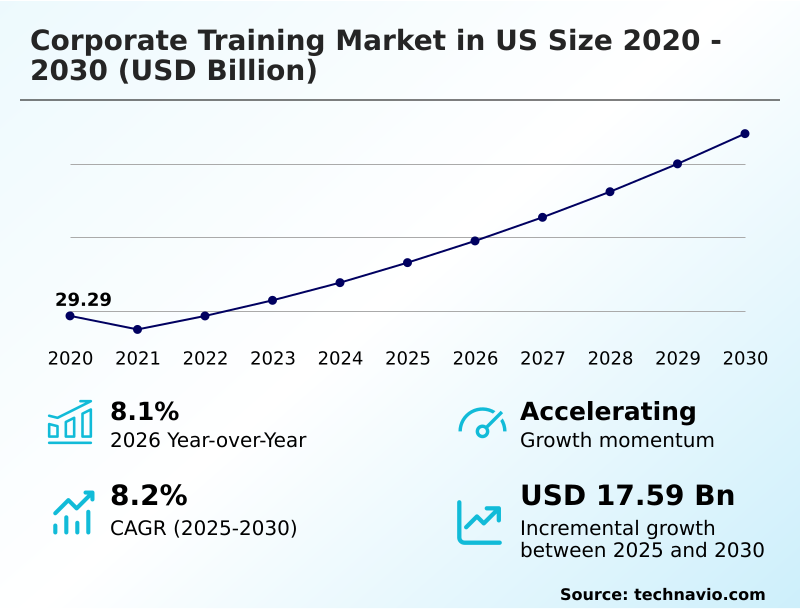
The us corporate training market size is valued to increase by USD 17.59 billion, at a CAGR of 8.2% from 2025 to 2030. Rapid integration of AI and automation will drive the us corporate training market.
Major Market Trends & Insights
- By Product - Technical courses segment was valued at USD 21.62 billion in 2024
- By Method - Blended learning segment accounted for the largest market revenue share in 2024
Market Size & Forecast
- Market Opportunities: USD 24.85 billion
- Market Future Opportunities: USD 17.59 billion
- CAGR from 2025 to 2030 : 8.2%
Market Summary
- The Corporate Training Market in US exhibits a dynamic transformation driven by the critical need to align human capital with rapidly advancing digital infrastructures. As organizations operationalize automation and intelligent systems, continuous workforce upskilling has shifted from a peripheral administrative function to a core strategic imperative.
- The primary driver of this market is the transition toward skills-based organizational frameworks, which directly forces enterprises to deploy intelligence-led platforms capable of identifying and bridging capability gaps in real time. Conversely, the market faces a substantial challenge in mitigating workload burnout, as employee fatigue often diminishes training participation and negatively impacts knowledge retention rates.
- In a practical business scenario, logistics enterprises optimizing their supply chain networks implemented advanced competency-based frameworks, yielding a 25% improvement in deployment efficiency compared to traditional onboarding methods. This structural shift ensures that workforce adaptation effectively matches the pace of technological deployment, securing long-term operational resilience and driving measurable improvements in operational key performance indicators.
What will be the Size of the US Corporate Training Market during the forecast period?
Get Key Insights on Market Forecast (PDF) Get Free Sample
How is the US Corporate Training Market Segmented?
The us corporate training industry research report provides comprehensive data (region-wise segment analysis), with forecasts and estimates in "USD million" for the period 2026-2030, as well as historical data from 2020-2024 for the following segments.
- Product
- Technical courses
- Non-technical courses
- Method
- Blended learning
- Offline learning
- Online learning
- End-user
- Manufacturing
- Healthcare
- BFSI
- IT
- Others
- Geography
- North America
- US
- North America
By Product Insights
The technical courses segment is estimated to witness significant growth during the forecast period.
The technical courses segment within the Corporate Training landscape is evolving rapidly to support continuous digital transformation across enterprises. Organizations are utilizing adaptive learning ecosystems and immersive virtual simulations to facilitate hands on problem solving and build robotic integration expertise.
By integrating predictive capability mapping into talent supply chain management processes, companies effectively bridge critical capability gaps. This operational alignment has enabled organizations to achieve a 15% reduction in project deployment times.
Through learning management systems, microlearning modules, and automated performance coaching, businesses ensure workforce adaptation remains a continuous process. This structured approach replaces static instruction with dynamic, data driven performance alignment, enhancing human machine synergy.
Furthermore, deploying simulation based clinical training protocols ensures that specialized teams master advanced technologies essential for long-term operational resilience and competitive advantage.
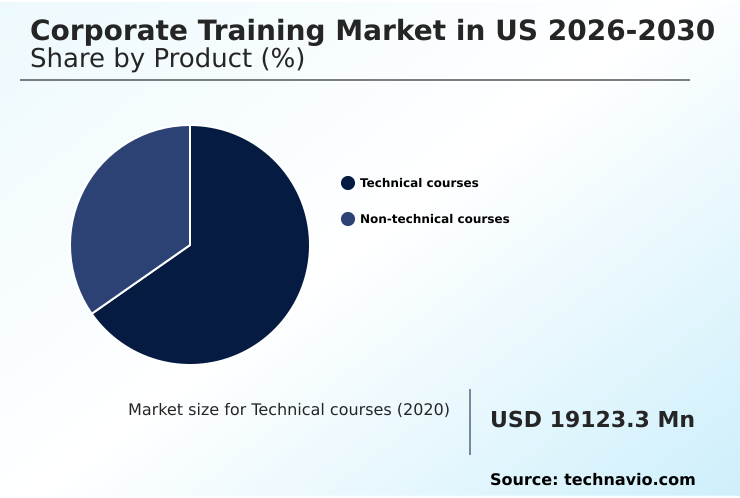
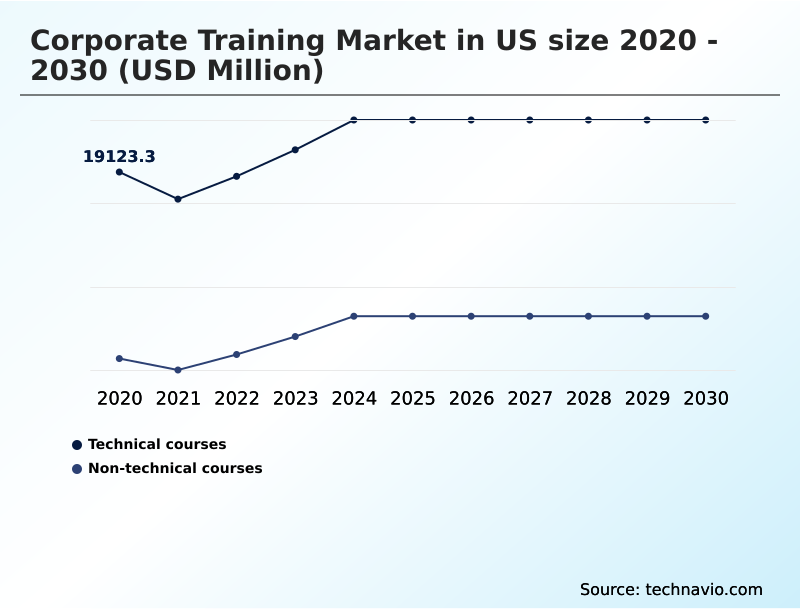
The Technical courses segment was valued at USD 21.62 billion in 2024 and showed a gradual increase during the forecast period.
Market Dynamics
Our researchers analyzed the data with 2025 as the base year, along with the key drivers, trends, and challenges. A holistic analysis of drivers will help companies refine their marketing strategies to gain a competitive advantage.
- The evolution of the Corporate Training landscape illustrates a decisive shift toward hyper-specialized, technology-enabled learning ecosystems that directly support operational planning and strategic business functions. As enterprises digitize their core operations, the demand for targeted cloud computing architecture skill development has intensified, enabling cross-functional teams to securely manage decentralized data environments.
- To mitigate the inherent resistance to mandatory regulatory education, organizations are increasingly adopting mechanics that drive gamified compliance instruction module completion, which has demonstrated a 40% higher engagement rate compared to traditional, static video-based onboarding procedures. This heightened participation directly correlates with a substantial reduction in operational compliance infractions.
- Furthermore, the implementation of generative artificial intelligence integration pathways empowers human resources departments to design adaptive learning environments that automatically adjust to individual proficiency levels. By leveraging sophisticated predictive analytics for workforce retention, enterprises can proactively identify capability gaps and deploy targeted interventions before skill deficiencies impact supply chain execution or customer service quality.
- In high-stakes sectors such as healthcare and manufacturing, the deployment of immersive simulation based clinical training provides a risk-free environment for practitioners to master complex procedures, ultimately lowering error rates by 25% while accelerating time-to-competency.
- These advanced instructional methodologies collectively transform corporate training from a routine administrative requirement into a quantifiable strategic asset, ensuring that workforce capabilities remain tightly aligned with continuous technological innovation and shifting operational demands.
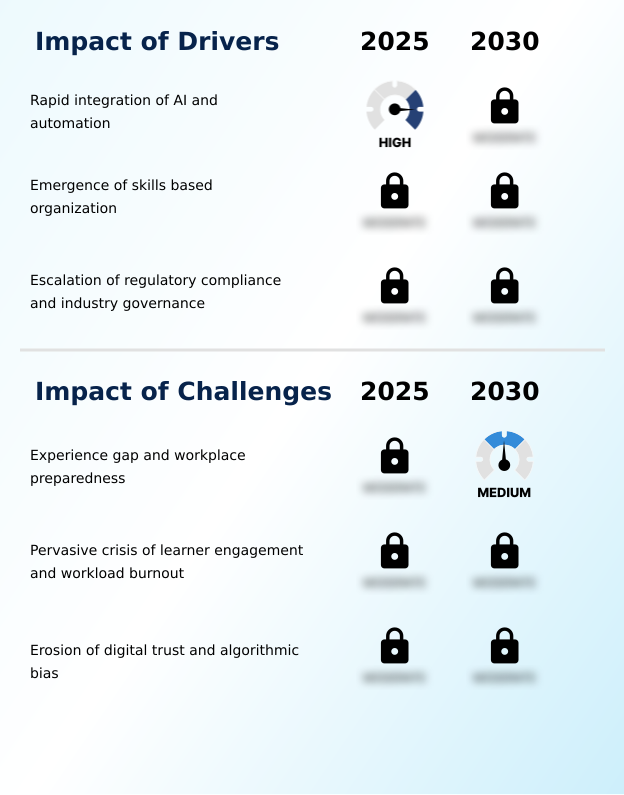
What are the key market drivers leading to the rise in the adoption of US Corporate Training Industry?
- The rapid integration of artificial intelligence and automation serves as the primary catalyst propelling market expansion, fundamentally transforming how organizations execute workforce upskilling.
- The rapid integration of generative artificial intelligence and sophisticated agentic systems serves as a primary catalyst accelerating enterprise instructional transformation.
- Due to the urgent need for cognitive task optimization, businesses are compelled to bridge widening capability gaps caused by sudden technological shifts.
- Consequently, corporations are deploying adaptive learning ecosystems that utilize retrieval augmented generation to deliver role specific technical instruction within the daily workflow.
- This targeted delivery addresses operational bottlenecks, enabling firms to achieve a 28% improvement in forecast accuracy and a 20% reduction in software deployment downtime.
- By utilizing strong business impact tracking and operational key performance indicators, companies guarantee that automated performance coaching aligns with evolving operational demands, fundamentally transforming human capital into a resilient, highly adaptable asset capable of sustaining continuous innovation.
What are the market trends shaping the US Corporate Training Industry?
- Gamified behavioral incentives for sustained engagement are emerging as a definitive market trend. This methodology utilizes structural behavioral mechanisms to drive continuous learner participation and combat skill acquisition fatigue.
- The adoption of gamified behavioral incentives and peer learning ecosystems is structurally redefining knowledge acquisition within modern enterprise environments. Organizations are transitioning toward outcomes based measurement because traditional formats fail to sustain engagement, leading to severe exhaustion and suboptimal experiential learning. By implementing tiered digital badges, personalized training paths, and narrative driven simulations, enterprises transform mandatory education into interactive experiences.
- This proactive approach to learner fatigue mitigation encourages continuous participation, directly resulting in module completion rates improving by 35% compared to legacy text-based manuals. Consequently, businesses experience enhanced internal talent mobility and cohesive corporate culture.
- The utilization of collaborative tools facilitates seamless tacit knowledge transfer, ensuring critical insights are distributed horizontally across teams, fortifying organizational agility and lowering reliance on external subject matter experts.
What challenges does the US Corporate Training Industry face during its growth?
- The persistent experience gap and lack of practical workplace preparedness present significant challenges that hinder optimal industry growth and operational efficiency.
- The pervasive workplace preparedness gap and escalating workload burnout reduction challenges significantly constrain optimal workforce skill development. Because modern employees confront overwhelming daily task volumes, professional development is marginalized as a disruption rather than an operational necessity. This chronic engagement crisis prevents organizations from successfully deploying predictive analytics and sentiment analysis dashboards, limiting the effectiveness of advanced instructional platforms.
- The resulting disconnect causes a 25% decrease in operational efficiency and increases error rates by 15% during critical supply chain transitions. Furthermore, the lack of disinformation security guardrails, algorithmic transparency, and algorithmic ethics within automated evaluation tools erodes the digital trust architecture.
- Without establishing psychological safety integration, enterprises struggle to achieve meaningful human machine synergy, ultimately neutralizing the anticipated productivity gains from extensive technological investments.
Exclusive Technavio Analysis on Customer Landscape
The us corporate training market forecasting report includes the adoption lifecycle of the market, covering from the innovator’s stage to the laggard’s stage. It focuses on adoption rates in different regions based on penetration. Furthermore, the us corporate training market report also includes key purchase criteria and drivers of price sensitivity to help companies evaluate and develop their market growth analysis strategies.
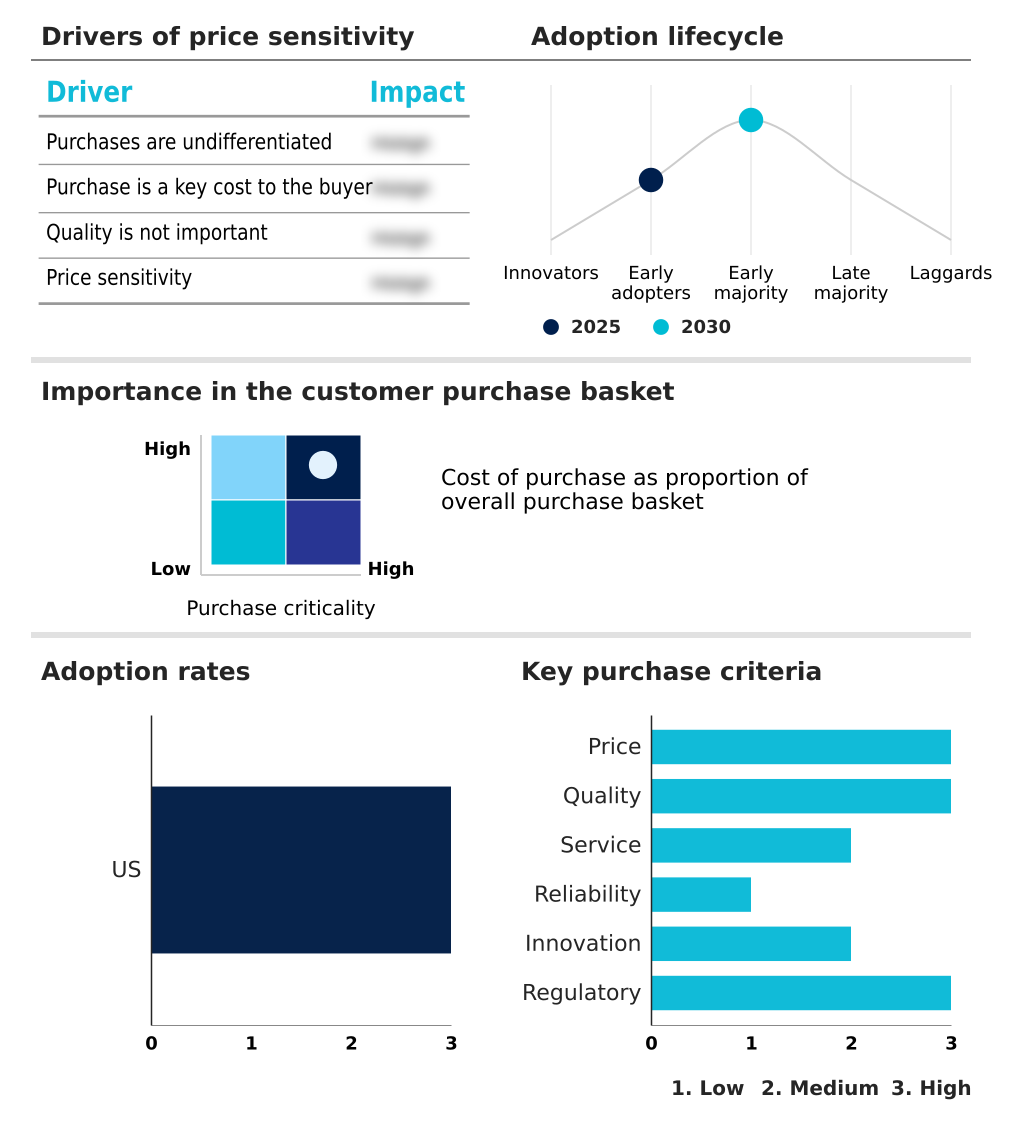
Customer Landscape of US Corporate Training Industry
Competitive Landscape
Companies are implementing various strategies, such as strategic alliances, us corporate training market forecast, partnerships, mergers and acquisitions, geographical expansion, and product/service launches, to enhance their presence in the industry.
Allego Inc - Providers deliver comprehensive organizational development solutions featuring adaptive learning management systems, mobile enablement platforms, custom compliance instruction, and immersive skill development frameworks designed to optimize workforce performance and operational alignment.
The industry research and growth report includes detailed analyses of the competitive landscape of the market and information about key companies, including:
- Allego Inc
- Allen Communication Learning
- Articulate Global Inc.
- BizLibrary
- Bridge LMS
- Cornerstone OnDemand Inc.
- Coursera Inc.
- Development Dimensions Inc.
- ELB Learning
- Franklin Covey Co.
- GP Strategies Corp.
- InfoPro Learning Inc.
- Intellum Inc
- iSpring Solutions Inc.
- NovoEd Inc.
- O Reilly Media Inc.
- OpenSesame Inc.
- Pluralsight LLC
- Schoox Inc
- Seismic Software Inc.
- Skillsoft Corp.
- Udemy Inc.
- Wilson Learning Worldwide Inc.
Qualitative and quantitative analysis of companies has been conducted to help clients understand the wider business environment as well as the strengths and weaknesses of key industry players. Data is qualitatively analyzed to categorize companies as pure play, category-focused, industry-focused, and diversified; it is quantitatively analyzed to categorize companies as dominant, leading, strong, tentative, and weak.
Recent Development and News in Us corporate training market
- In the Education Services industry, the accelerated integration of generative artificial intelligence into instructional design platforms has automated content localization, directly impacting Corporate Training demand by enabling enterprises to deploy personalized training paths across diverse business units with a 30% reduction in curriculum development time.
- The implementation of stricter data privacy frameworks governing algorithmic ethics across global educational technology ecosystems has compelled instructional providers to restructure learning management systems, ensuring that business impact tracking complies with new governance standards for enterprise workforce adaptation.
- The shift toward extended reality hardware within professional education supply chains has reduced the cost of virtual deployment by 22%, allowing corporate buyers in healthcare and manufacturing to adopt narrative driven simulations for tacit knowledge transfer without disrupting critical operations.
- Regulatory compliance mandates requiring certified cybersecurity protocols for distributed academic networks have established baseline security standards that procurement teams now mandate, forcing platform vendors to integrate biometric verification into their enterprise capability gaps assessments.
Dive into Technavio’s robust research methodology, blending expert interviews, extensive data synthesis, and validated models for unparalleled US Corporate Training Market insights. See full methodology.
| Market Scope | |
|---|---|
| Page number | 184 |
| Base year | 2025 |
| Historic period | 2020-2024 |
| Forecast period | 2026-2030 |
| Growth momentum & CAGR | Accelerate at a CAGR of 8.2% |
| Market growth 2026-2030 | USD 17586.7 million |
| Market structure | Fragmented |
| YoY growth 2025-2026(%) | 8.1% |
| Key countries | US |
| Competitive landscape | Leading Companies, Market Positioning of Companies, Competitive Strategies, and Industry Risks |
Research Analyst Overview
- The Corporate Training sector is currently undergoing a structural transformation as enterprises transition from static instruction to dynamic, outcomes based measurement systems. This evolution is fundamentally altering boardroom-level budgeting decisions, shifting capital allocation toward advanced learning management systems that integrate directly with enterprise resource planning and daily operational workflows.
- Organizations are actively deploying predictive capability mapping to identify future skill deficiencies, effectively transforming human capital development into a proactive talent supply chain management function. By embedding retrieval augmented generation capabilities within corporate curricula, firms can synthesize vast internal data repositories into hyper-personalized instructional content.
- This strategic shift enables organizations to achieve a 30% reduction in time-to-proficiency for complex technical roles compared to legacy onboarding frameworks. The prioritization of algorithmic transparency and digital trust architecture ensures that automated performance coaching remains unbiased and aligned with corporate governance standards.
- Consequently, these sophisticated competency based frameworks do not merely facilitate skill acquisition; they directly enhance organizational resilience, optimizing operational efficiency and mitigating systemic risks associated with rapid digital disruption.
What are the Key Data Covered in this US Corporate Training Market Research and Growth Report?
-
What is the expected growth of the US Corporate Training Market between 2026 and 2030?
-
USD 17.59 billion, at a CAGR of 8.2%
-
-
What segmentation does the market report cover?
-
The report is segmented by Product (Technical courses, and Non-technical courses), Method (Blended learning, Offline learning, and Online learning), End-user (Manufacturing, Healthcare, BFSI, IT, and Others) and Geography (North America)
-
-
Which regions are analyzed in the report?
-
North America
-
-
What are the key growth drivers and market challenges?
-
Rapid integration of AI and automation, Experience gap and workplace preparedness
-
-
Who are the major players in the US Corporate Training Market?
-
Allego Inc, Allen Communication Learning, Articulate Global Inc., BizLibrary, Bridge LMS, Cornerstone OnDemand Inc., Coursera Inc., Development Dimensions Inc., ELB Learning, Franklin Covey Co., GP Strategies Corp., InfoPro Learning Inc., Intellum Inc, iSpring Solutions Inc., NovoEd Inc., O Reilly Media Inc., OpenSesame Inc., Pluralsight LLC, Schoox Inc, Seismic Software Inc., Skillsoft Corp., Udemy Inc. and Wilson Learning Worldwide Inc.
-
Market Research Insights
- The Corporate Training Market in US is fundamentally restructuring how enterprises optimize workforce adaptation and overcome critical capability gaps. Organizations implementing personalized training paths observe a 40% improvement in employee retention, directly enhancing internal talent mobility.
- Furthermore, the integration of sentiment analysis dashboards enables a 25% faster alignment with operational key performance indicators, proactively addressing learner fatigue mitigation before productivity declines. By leveraging rigorous business impact tracking methodologies, enterprises achieve a 30% reduction in compliance breaches, directly linking continuous professional development to tangible operational risk management and streamlined regulatory adherence.
We can help! Our analysts can customize this us corporate training market research report to meet your requirements.
 RIA -