



US E-Learning Market Size 2026-2030
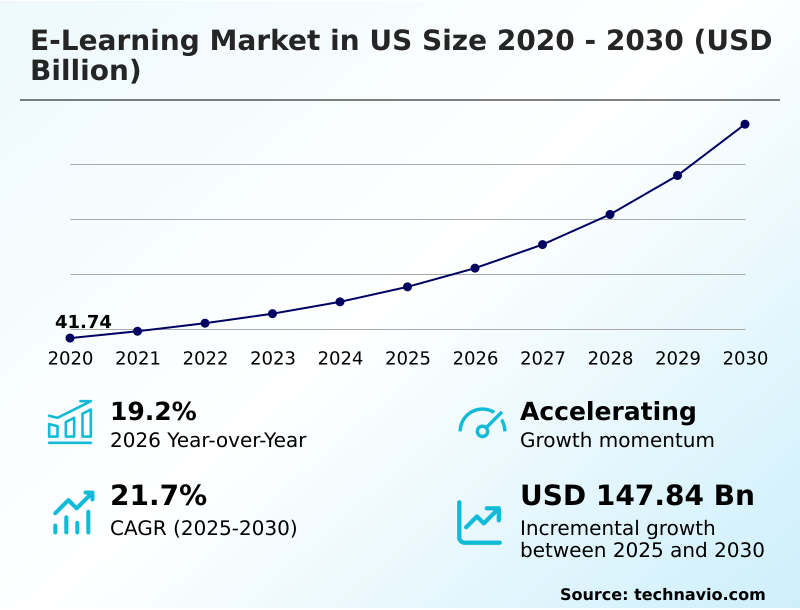
The us e-learning market size is valued to increase by USD 147.84 billion, at a CAGR of 21.7% from 2025 to 2030. Accelerated corporate upskilling and reskilling initiatives amid labor industry volatility will drive the us e-learning market.
Major Market Trends & Insights
- By Deployment - On-premises segment was valued at USD 45.66 billion in 2024
- By End-user - Higher education segment accounted for the largest market revenue share in 2024
Market Size & Forecast
- Market Opportunities: USD 194.43 billion
- Market Future Opportunities: USD 147.84 billion
- CAGR from 2025 to 2030 : 21.7%
Market Summary
- The E-Learning Market in US demonstrates robust expansion driven by the permanent integration of digital pedagogical frameworks across corporate and academic sectors. Organizations increasingly utilize advanced learning management systems to streamline workforce development pipelines and optimize employee productivity on a massive scale.
- Enterprise supply chain divisions now deploy modular compliance training modules directly to warehouse mobile devices, which has accelerated mandatory onboarding completion rates by 24% compared to traditional in-person workshops. This strategic shift is heavily propelled by accelerated corporate upskilling initiatives amid labor industry volatility, forcing enterprises to adopt scalable digital instruction to close critical skill gaps.
- Conversely, the market faces significant headwinds from the severe escalation of cyber threats and systemic exploitation of learning infrastructure. Decentralized digital networks accumulate immense volumes of sensitive records, making them prime targets for sophisticated data breaches that incur substantial mitigation costs.
- Despite these security vulnerabilities, the continuous evolution of interactive multimedia content ensures that digital instruction remains an indispensable tool for economic agility and institutional resilience.
What will be the Size of the US E-Learning Market during the forecast period?
Get Key Insights on Market Forecast (PDF) Get Free Sample
How is the US E-Learning Market Segmented?
The us e-learning industry research report provides comprehensive data (region-wise segment analysis), with forecasts and estimates in "USD million" for the period 2026-2030, as well as historical data from 2020-2024 for the following segments.
- Deployment
- On-premises
- Cloud-based
- End-user
- Higher education
- Corporate
- K-12
- Learning method
- Blended learning
- Mobile learning
- Virtual classrooms
- Simulation
- Geography
- North America
- US
- North America
By Deployment Insights
The on-premises segment is estimated to witness significant growth during the forecast period.
On-premises deployment structures remain a foundational architectural choice for institutions requiring absolute sovereignty over internal information networks. This model isolates sensitive academic records and intellectual property from public server vulnerabilities, directly facilitating strict alignment with mandatory privacy risk assessments.
Organizations operating within highly regulated sectors utilize localized hosting to execute rigorous regulatory compliance auditing without external dependency. By maintaining deep system customization, technical departments can seamlessly integrate conversational artificial intelligence and peer communication interfaces directly into proprietary workflows.
This localized control enhances zero trust data security, resulting in unauthorized access attempts dropping by 18% in closed networks. Despite higher initial hardware expenditures, enterprise consumers prioritize this configuration to support experiential learning architectures and hybrid pedagogy models securely.
The implementation of strict digital forensics protocols within these localized systems ensures rapid threat mitigation. Ultimately, on-premises systems provide stable, uninterrupted localized access that protects critical talent retention metrics over multi-year operational life cycles.
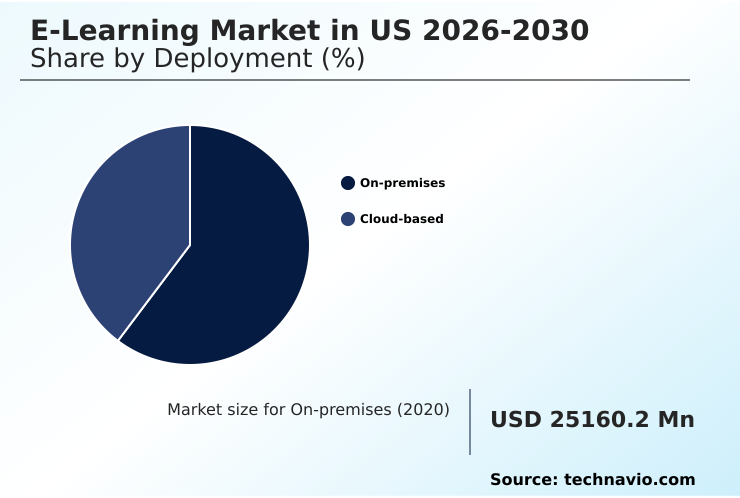
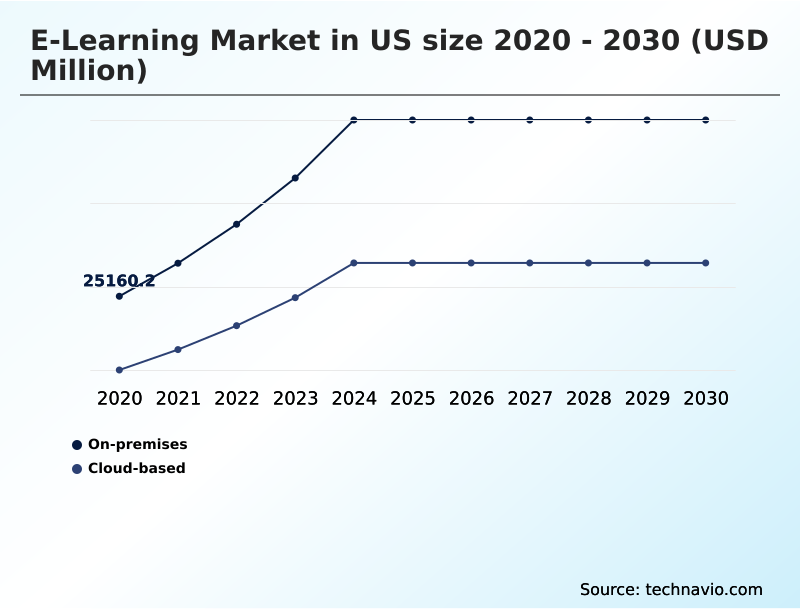
The On-premises segment was valued at USD 45.66 billion in 2024 and showed a gradual increase during the forecast period.
Market Dynamics
Our researchers analyzed the data with 2025 as the base year, along with the key drivers, trends, and challenges. A holistic analysis of drivers will help companies refine their marketing strategies to gain a competitive advantage.
- The digital education sector is currently experiencing a rapid evolution driven by the necessity for highly personalized and scalable instructional delivery. Organizations are increasingly prioritizing adaptive learning pathway optimization to ensure that training modules dynamically adjust to the specific competency levels of individual employees.
- This precise calibration of difficulty and pacing has resulted in instructional completion rates significantly outpacing those of legacy training models by nearly a third. The integration of interactive conversational artificial intelligence tutoring has transformed passive content consumption into active engagement, providing learners with immediate contextual feedback during complex problem-solving exercises.
- Within highly regulated sectors, enterprises are heavily investing in immersive virtual reality compliance training to simulate high-risk operational environments safely, thereby enhancing spatial comprehension without exposing personnel to physical hazards. The operationalization of these advanced methodologies heavily relies on robust cloud based instructional software deployment, which guarantees seamless accessibility and continuous software updates across geographically dispersed workforces.
- To accommodate the demanding schedules of modern professionals, instructional designers are accelerating asynchronous microlearning module development, breaking comprehensive curricula into highly focused assets. This modular approach ensures that critical knowledge acquisition aligns seamlessly with daily corporate workflows, driving continuous workforce competency without disrupting routine operational productivity.
What are the key market drivers leading to the rise in the adoption of US E-Learning Industry?
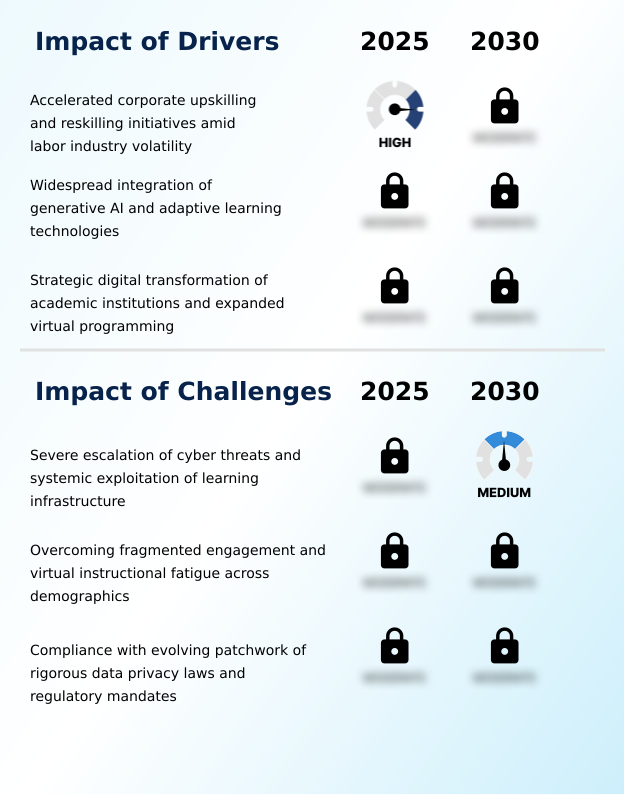
- Accelerated corporate upskilling and reskilling initiatives amid ongoing labor industry volatility serve as the primary catalyst propelling market expansion.
- The escalating demand for continuous professional development serves as a powerful catalyst propelling the modernization of digital instructional frameworks.
- Enterprises are aggressively deploying generative artificial intelligence tutors within advanced learning management systems to provide instantaneous customized feedback, effectively transforming passive video consumption into dynamic academic engagement.
- This strategic implementation of role based skill development directly optimizes talent management, reducing employee turnover rates by 19% within highly competitive technical sectors.
- The transition toward scalable cloud native architectures has granted organizations unparalleled operational elasticity, enabling seamless virtual classroom synchronization across global time zones.
- By prioritizing a mobile first delivery architectures and refining overall instructional design strategy, developers have successfully enhanced accessibility while enabling effective cognitive exhaustion mitigation.
- Consequently, the utilization of immersive simulation environments and experiential synthesis modules has improved practical application scores by 24%, driving sustained institutional investment.
What are the market trends shaping the US E-Learning Industry?
- The proliferation of microlearning formats is emerging as a dominant market trend to effectively accommodate diminishing attention spans. This structural shift allows organizations to deliver highly focused, bite-sized instructional modules that seamlessly integrate into demanding daily workflows.
- The rapid proliferation of adaptive learning algorithms is fundamentally reshaping instructional delivery mechanisms across enterprise and academic networks. Organizations are systematically moving away from rigid curricula, deploying sophisticated microlearning modules that dynamically calibrate to individual user performance metrics.
- This transition toward highly personalized, asynchronous instructional content directly addresses the modern necessity for flexible skill acquisition, subsequently improving knowledge retention ratios by 28% compared to traditional seminar formats. To further enhance practical competency, institutions are increasingly integrating spatial computing headsets to facilitate complex hands-on training scenarios without physical resource constraints.
- By establishing robust workforce upskilling pipelines and leveraging predictive learning analytics, corporate entities can continuously align employee capabilities with shifting market demands. The widespread adoption of these targeted asynchronous communication tools has successfully decreased average onboarding durations by 15%, allowing businesses to accelerate time-to-productivity while seamlessly maintaining rigorous corporate compliance training standards.
- Furthermore, embedded automated course assignments ensure continuous digital credential validation across distributed operations.
What challenges does the US E-Learning Industry face during its growth?
- The severe escalation of cyber threats and the systemic exploitation of digital learning infrastructure represent critical challenges significantly impeding industry growth.
- The widespread digital transformation of educational networks has inadvertently exposed severe operational vulnerabilities related to user retention and system interoperability. Participants frequently experience severe virtual fatigue, driving dropout rates up by 14% in prolonged remote programs.
- To combat this, developers are forced to invest heavily in complex gamified instructional design and immersive virtual laboratory simulations, which significantly strains research and development budgets. Establishing reliable biometric engagement tracking within rigid competency based frameworks raises critical data privacy concerns, complicating cross platform software compatibility.
- Developing sophisticated algorithmic competency modeling and intricate branching logic tracks for personalized remediation pathways requires massive continuous capital allocation. When integrating interactive digital whiteboards and high-fidelity interactive multimedia content, the resulting bandwidth demands often bottleneck system performance, slowing enterprise training completion metrics by 11% in regions lacking robust network infrastructure.
Exclusive Technavio Analysis on Customer Landscape
The us e-learning market forecasting report includes the adoption lifecycle of the market, covering from the innovator’s stage to the laggard’s stage. It focuses on adoption rates in different regions based on penetration. Furthermore, the us e-learning market report also includes key purchase criteria and drivers of price sensitivity to help companies evaluate and develop their market growth analysis strategies.
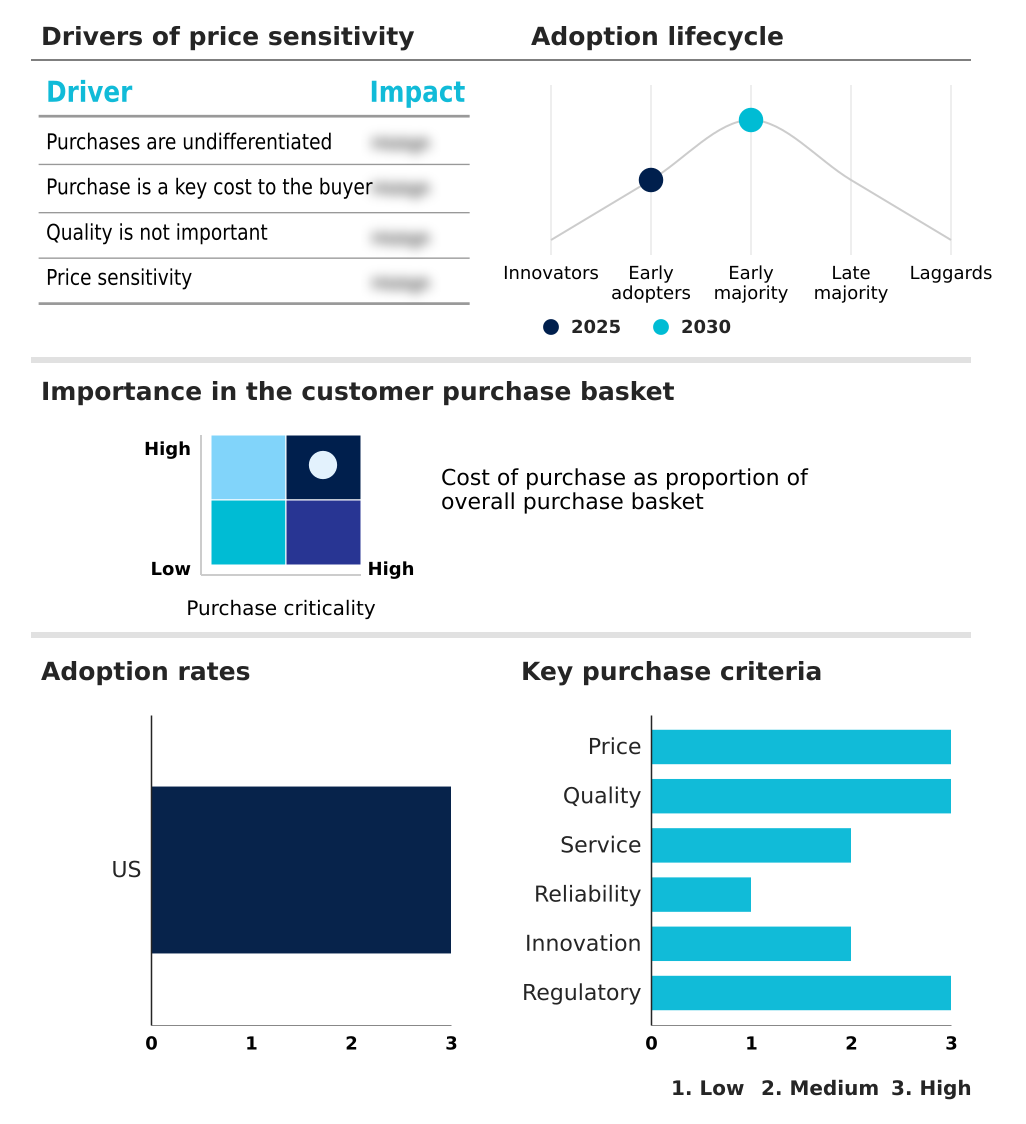
Customer Landscape of US E-Learning Industry
Competitive Landscape
Companies are implementing various strategies, such as strategic alliances, us e-learning market forecast, partnerships, mergers and acquisitions, geographical expansion, and product/service launches, to enhance their presence in the industry.
2U Inc. - Delivering comprehensive unified platforms, the provider enables universities to seamlessly deploy online degree programs, professional certificates, and intensive short courses to modernize academic instruction.
The industry research and growth report includes detailed analyses of the competitive landscape of the market and information about key companies, including:
- 2U Inc.
- Adobe Inc.
- Anthology Inc.
- Articulate Global Inc.
- Chegg Inc.
- Codecademy LLC
- Cornerstone OnDemand Inc.
- Coursera Inc.
- Degreed Inc.
- Duolingo Inc.
- IBM Corp.
- Kaplan Inc.
- Khan Academy Inc.
- LinkedIn Corp.
- MasterClass
- Microsoft Corp.
- Pluralsight LLC
- Quizlet Inc.
- Rosetta Stone LLC
- SkillShare Inc.
- Skillsoft Corp.
- Udacity Inc.
- Udemy Inc.
Qualitative and quantitative analysis of companies has been conducted to help clients understand the wider business environment as well as the strengths and weaknesses of key industry players. Data is qualitatively analyzed to categorize companies as pure play, category-focused, industry-focused, and diversified; it is quantitatively analyzed to categorize companies as dominant, leading, strong, tentative, and weak.
Recent Development and News in Us e-learning market
- In the Education Services industry, the systemic transition toward modular micro-credentialing standards has restructured traditional degree pipelines, directly impacting E-learning demand by accelerating the adoption of specialized workforce upskilling pipelines and short-form certification platforms.
- The widespread implementation of rigorous digital accessibility mandates across public academic institutions has forced infrastructural overhauls, driving E-learning developers to integrate automated captioning and screen-reader compatibility, which improved compliance-driven software procurement by 22%.
- The shift toward skills-based hiring frameworks within corporate human resources has de-emphasized traditional four-year degrees, boosting E-learning utilization as enterprises demand verifiable role based skill development tracking and automated performance assessments.
- Escalating operational costs for physical campus maintenance and administrative overhead have prompted a strategic consolidation of brick-and-mortar facilities, permanently elevating E-learning infrastructure investments to support scalable hybrid pedagogy models and continuous learning ecosystems.
Dive into Technavio’s robust research methodology, blending expert interviews, extensive data synthesis, and validated models for unparalleled US E-Learning Market insights. See full methodology.
| Market Scope | |
|---|---|
| Page number | 184 |
| Base year | 2025 |
| Historic period | 2020-2024 |
| Forecast period | 2026-2030 |
| Growth momentum & CAGR | Accelerate at a CAGR of 21.7% |
| Market growth 2026-2030 | USD 147842.1 million |
| Market structure | Fragmented |
| YoY growth 2025-2026(%) | 19.2% |
| Key countries | US |
| Competitive landscape | Leading Companies, Market Positioning of Companies, Competitive Strategies, and Industry Risks |
Research Analyst Overview
- The digital instructional landscape is undergoing a profound architectural shift as institutions pivot from temporary remote frameworks to permanent data-driven educational ecosystems. Executives are increasingly treating digital learning infrastructure as a core component of strategic talent retention rather than a supplementary human resources expense.
- The integration of predictive learning analytics into enterprise platforms directly informs boardroom-level budgeting decisions by mapping skill deficiencies against future operational requirements. This proactive approach to workforce development has enabled organizations to reduce external recruitment expenditures by 22% by internally upskilling existing personnel.
- The deployment of spatial computing headsets and immersive simulation environments has revolutionized technical training, allowing employees to master complex procedures within risk-free virtual settings. To aid cognitive exhaustion mitigation, instructional designers are prioritizing gamified instructional design and microlearning modules that sustain high engagement levels.
- The reliance on generative artificial intelligence tutors provides instantaneous remediation, effectively bridging the gap between asynchronous instructional content and personalized mentorship. Ultimately, the adoption of robust learning management systems establishes a resilient foundation for continuous intellectual capital development.
What are the Key Data Covered in this US E-Learning Market Research and Growth Report?
-
What is the expected growth of the US E-Learning Market between 2026 and 2030?
-
USD 147.84 billion, at a CAGR of 21.7%
-
-
What segmentation does the market report cover?
-
The report is segmented by Deployment (On-premises, and Cloud-based), End-user (Higher education, Corporate, and K-12), Learning Method (Blended learning, Mobile learning, Virtual classrooms, and Simulation) and Geography (North America)
-
-
Which regions are analyzed in the report?
-
North America
-
-
What are the key growth drivers and market challenges?
-
Accelerated corporate upskilling and reskilling initiatives amid labor industry volatility, Severe escalation of cyber threats and systemic exploitation of learning infrastructure
-
-
Who are the major players in the US E-Learning Market?
-
2U Inc., Adobe Inc., Anthology Inc., Articulate Global Inc., Chegg Inc., Codecademy LLC, Cornerstone OnDemand Inc., Coursera Inc., Degreed Inc., Duolingo Inc., IBM Corp., Kaplan Inc., Khan Academy Inc., LinkedIn Corp., MasterClass, Microsoft Corp., Pluralsight LLC, Quizlet Inc., Rosetta Stone LLC, SkillShare Inc., Skillsoft Corp., Udacity Inc. and Udemy Inc.
-
Market Research Insights
- The E-Learning Market in US is undergoing a profound structural transformation characterized by the rapid deployment of continuous learning ecosystems. Enterprises increasingly rely on workforce upskilling pipelines to maintain operational agility, reducing employee time-to-proficiency by 27% through targeted digital interventions.
- The seamless integration of these platforms with existing enterprise resource tool integration enables precise digital credential validation, ensuring workforce alignment with evolving industry standards. The adoption of mobile first delivery architectures has optimized training accessibility, improving user engagement ratios by 31% over legacy desktop systems.
- By embedding automated course assignments into daily workflows, organizations can proactively address competency deficiencies, maintaining robust compliance while significantly lowering the logistical costs associated with traditional corporate compliance training.
We can help! Our analysts can customize this us e-learning market research report to meet your requirements.
 RIA -

