



Food Additives Market Size 2026-2030
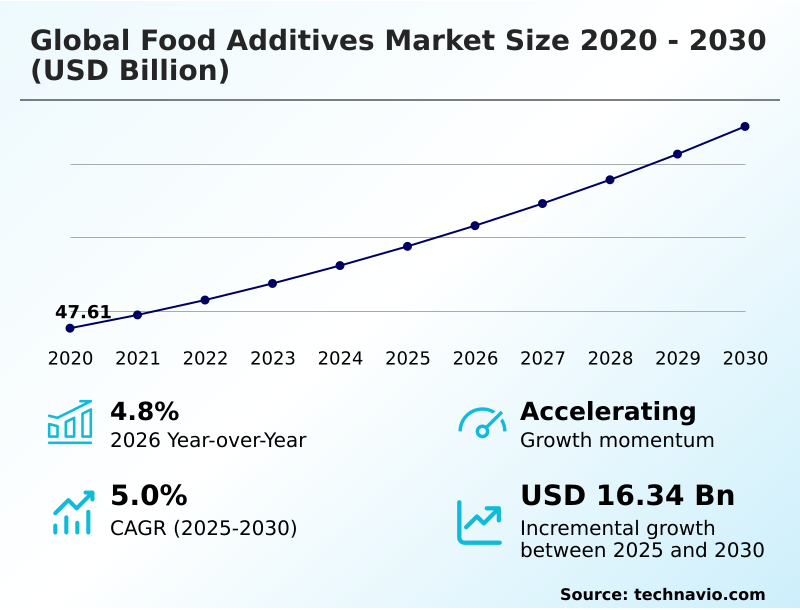
The food additives market size is valued to increase by USD 16.34 billion, at a CAGR of 5% from 2025 to 2030. Growing demand for processed and convenience food consumption will drive the food additives market.
Major Market Trends & Insights
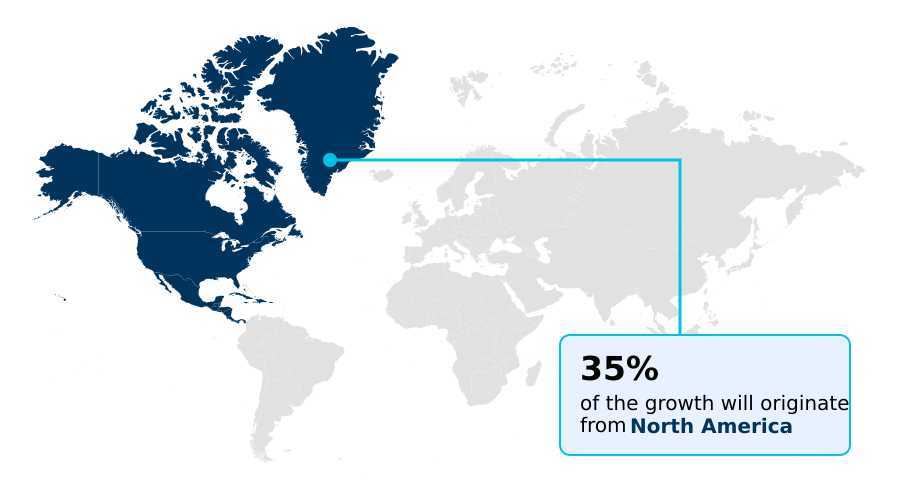
- North America dominated the market and accounted for a 35.4% growth during the forecast period.
- By Application - Bakery and confectionery segment was valued at USD 15.83 billion in 2024
- By Product - Flavors and enhancers segment accounted for the largest market revenue share in 2024
Market Size & Forecast
- Market Opportunities: USD 27.51 billion
- Market Future Opportunities: USD 16.34 billion
- CAGR from 2025 to 2030 : 5%
Market Summary
- The Food Additives Market exhibits continuous structural evolution as processors demand sophisticated functional inputs to stabilize complex matrices across diverse environmental conditions. Manufacturers routinely deploy advanced emulsification solutions within convenience meal preservation, allowing large-scale frozen food producers to prevent moisture migration during freeze-thaw cycles and reduce product rejection rates by up to 14% compared to standard formulations.
- The sustained expansion of urban retail infrastructure drives the need for extended retail shelf stability, prompting food developers to rely heavily on synergistic flavor compounds to ensure sensory consistency across vast distribution networks.
- Conversely, the industry faces substantial bottlenecks due to complex compliance frameworks that mandate extensive safety validations, effectively delaying the commercialization of novel bio-based ingredients and increasing R&D overhead. Because production yield optimization remains a paramount operational goal, processing facilities actively seek multi-functional systems that simplify inventory management and reduce handling errors.
- Ultimately, navigating volatile feedstock markets requires continuous adaptation in sourcing strategies to secure reliable raw material streams for consistent flavor enhancement operations.
What will be the Size of the Food Additives Market during the forecast period?
Get Key Insights on Market Forecast (PDF) Get Free Sample
How is the Food Additives Market Segmented?
The food additives industry research report provides comprehensive data (region-wise segment analysis), with forecasts and estimates in "USD million" for the period 2026-2030, as well as historical data from 2020-2024 for the following segments.
- Application
- Bakery and confectionery
- Beverages
- Convenience food
- Snacks
- Others
- Product
- Flavors and enhancers
- Acidulants
- Colorants
- Sweeteners
- Others
- Source
- Natural
- Synthetic
- Geography
- North America
- US
- Canada
- Mexico
- APAC
- China
- Japan
- India
- South Korea
- Australia
- Indonesia
- Europe
- Germany
- UK
- France
- Italy
- Spain
- The Netherlands
- South America
- Brazil
- Argentina
- Chile
- Middle East and Africa
- Saudi Arabia
- UAE
- South Africa
- Israel
- Turkey
- North America
By Application Insights
The bakery and confectionery segment is estimated to witness significant growth during the forecast period.
The bakery and confectionery application demonstrates continuous dependency on functional ingredient formulation to maintain product integrity. Advanced emulsification technologies dictate crumb structure, enabling manufacturers to reduce batch rejection rates by nearly 18% during high-speed production cycles.
Integrating moisture management solutions ensures bakery moisture retention, allowing packaged baked goods to achieve extended shelf stability without sacrificing beverage flavor consistency in companion products.
Utilizing plant derived texturizers further supports structural integrity in fillings, ensuring physical stability under fluctuating ambient conditions and facilitating confectionery appearance standardization.
This segmentation highlights a clear operational impact, as industrial bakeries shift toward clean label transition protocols to meet transparency requirements while preserving dairy texture improvement.
Consequently, the reliance on acidulant systems minimizes processing downtime and standardizes end-product appearance, directly linking savory snack seasoning strategies to improved throughput efficiency and reduced waste.
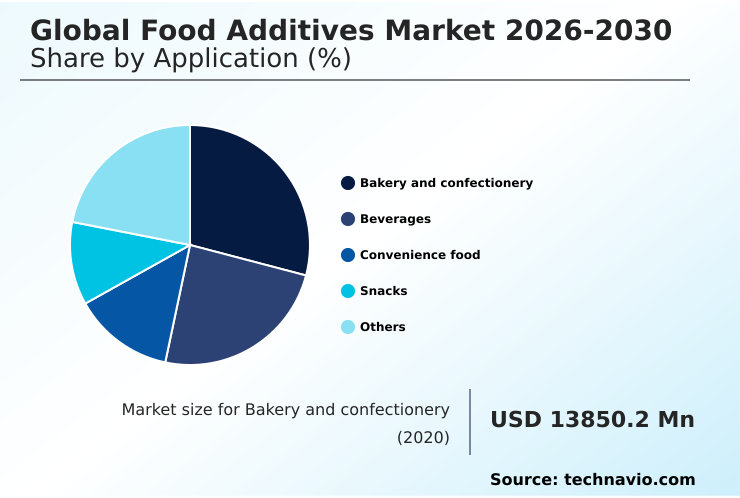
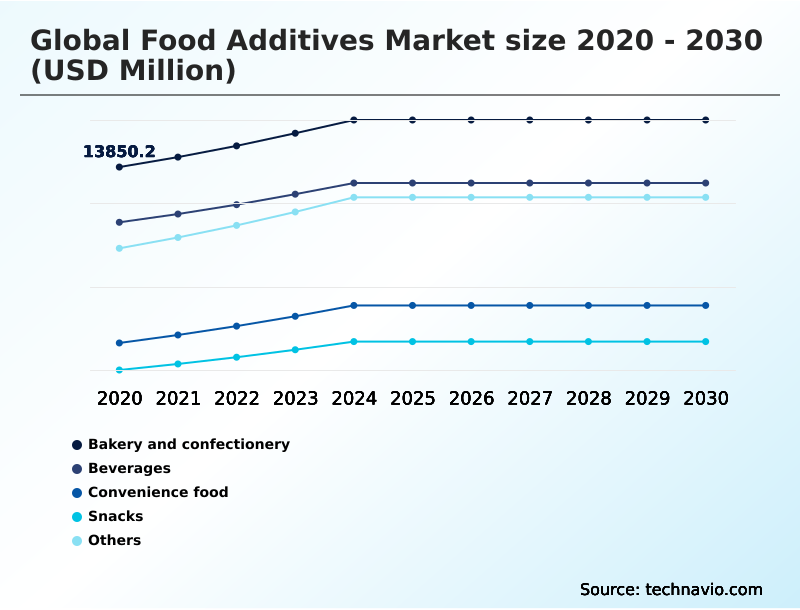
The Bakery and confectionery segment was valued at USD 15.83 billion in 2024 and showed a gradual increase during the forecast period.
Regional Analysis
North America is estimated to contribute 35.4% to the growth of the global market during the forecast period.Technavio’s analysts have elaborately explained the regional trends and drivers that shape the market during the forecast period.
See How Food Additives Market Demand is Rising in North America Get Free Sample
Geographic variations in processing infrastructure heavily influence the integration of functional food formulation inputs across the ecosystem.
North America maintains a distinct operational advantage over Europe, demonstrating an 18% faster adoption rate of bio based emulsifiers due to highly integrated biotechnology networks and fewer localized regulatory bottlenecks.
This infrastructural maturity allows North American manufacturers to deploy heat stable pigments with greater efficiency, reducing formulation delays by nearly 15%.
In contrast, Europe heavily prioritizes ph regulation agents to comply with stringent regional mandates, leading to a 20% higher reliance on naturally derived color stabilization techniques for product standardization.
Because European supply chains prioritize verifiable provenance, local producers frequently encounter higher initial raw material expenditures.
Consequently, these regional supply chain disparities dictate distinct formulation cost optimization strategies, compelling food developers to localize their flavor enhancement systems to align with specific regional operational requirements and production yield enhancement targets.
Market Dynamics
Our researchers analyzed the data with 2025 as the base year, along with the key drivers, trends, and challenges. A holistic analysis of drivers will help companies refine their marketing strategies to gain a competitive advantage.
- The formulation of modern processed foods requires meticulous integration of specialized components to balance consumer expectations with industrial scalability. Manufacturers are increasingly utilizing plant derived texturizers for bakery to eliminate synthetic emulsifiers while maintaining critical structural properties, resulting in processing lines that exhibit approximately 15% greater resilience to temperature fluctuations during distribution.
- This operational shift directly reduces supply chain spoilage and enhances overall inventory yield. Simultaneously, the deployment of fermentation derived ingredients for beverage offers advanced phase separation control, allowing liquid processing facilities to maintain consistent visual appeal without artificial stabilizers.
- Furthermore, addressing off-notes in functional drinks has driven the adoption of sweetness modulation in nutritional beverages, a critical strategy for balancing high-protein profiles with acceptable taste metrics. Because prolonged storage environments degrade ingredient integrity, integrating sophisticated microbial control mechanisms for food is essential to secure extended shelf-life capabilities and minimize retail-level product recalls.
- Finally, the shift toward transparent ingredient sourcing compels producers to prioritize clean label formulations for dairy, ensuring that yogurts and functional milks retain their desired viscosity throughout the cold chain. By embedding these highly specialized components into standard manufacturing protocols, developers can achieve consistent sensory delivery while optimizing their supply chain compliance and operational planning parameters.
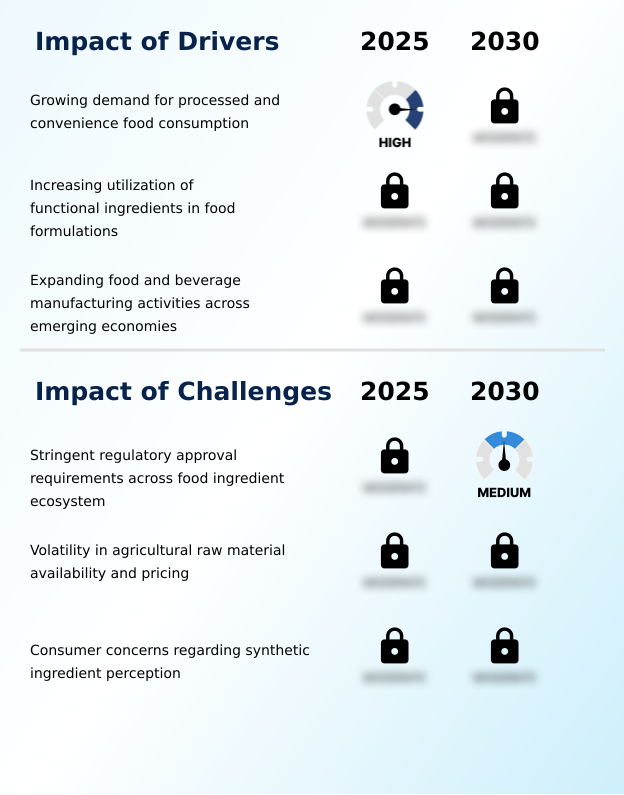
What are the key market drivers leading to the rise in the adoption of Food Additives Industry?
- The escalating consumption of processed and convenience meal solutions acts as a primary catalyst, compelling manufacturers to integrate advanced preservation and texturizing technologies to maintain product stability across extended supply chains.
- The escalating volume of convenience meal preservation acts as a primary catalyst for the integration of microbial control mechanisms across processing networks.
- Because extended supply chains expose packaged foods to severe environmental fluctuations, manufacturers implement robust shelf life extension technologies to prevent premature degradation, effectively lowering logistics-related spoilage rates by nearly 18%.
- This operational necessity drives continuous demand for precise viscosity modification tools that maintain ingredient dispersion rates throughout rigorous freeze-thaw cycles.
- Furthermore, the imperative to maintain sensory profile optimization compels formulators to utilize highly stable enzymatic dough conditioners, resulting in a 14% improvement in batch uniformity control post-pasteurization.
- Ultimately, these targeted formulation upgrades enhance production yield enhancement, enabling developers to execute clean label transition protocols while securing dependable product performance in strict alignment with regulatory compliance frameworks.
What are the market trends shaping the Food Additives Industry?
- The continuous shift toward clean-label formulation strategies is fundamentally altering product development pathways across the sector. Manufacturers are increasingly prioritizing recognizable botanical extract sourcing to align with evolving transparency expectations while maintaining functional performance.
- The aggressive shift toward clean label transition protocols is driving manufacturers to redesign fundamental product architectures using botanical extract sourcing. Because consumer preferences increasingly reject synthetic additives, formulation teams are rapidly substituting traditional chemicals with fermentation derived ingredients, improving brand compliance metrics while achieving a 15% reduction in regulatory friction.
- This systemic transition requires extensive sensory evaluation testing to ensure natural alternatives mirror legacy performance in nutritional product palatability. By adopting sophisticated moisture management solutions, industrial facilities maintain meat structural integrity, directly contributing to a 12% improvement in retail shelf life metrics. Consequently, the reliance on advanced phase separation prevention allows facilities to standardize fermented food stabilization lines.
- This structural pivot directly impacts downstream logistics, enabling suppliers to streamline operations and enhance process throughput efficiency across continuous manufacturing cycles.
What challenges does the Food Additives Industry face during its growth?
- Complex and divergent regulatory compliance frameworks present substantial operational hurdles, significantly prolonging approval timelines and increasing developmental costs for novel ingredient formulations.
- The inherent unpredictability of agricultural feedstock reliance presents a severe operational constraint, forcing suppliers to constantly adjust multi functional ingredient systems and pricing models. Because extreme weather patterns disrupt the availability of raw materials, processing facilities encounter severe bottlenecks when executing consistent botanical extract sourcing, leading to a 20% increase in short-term procurement costs.
- This supply volatility directly compromises formulation cost optimization efforts, as manufacturers struggle to secure adequate oxidation control agents without inflating prices. Consequently, the difficulty in maintaining taste masking solutions with inconsistent inputs drives up batch rejection rates by approximately 11%.
- Navigating these supply volatility mitigation disruptions requires continuous recalibration of high intensity sweeteners to ensure that end products meet strict quality parameters despite raw material variability and the limitations of current biotechnology capacity scaling.
Exclusive Technavio Analysis on Customer Landscape
The food additives market forecasting report includes the adoption lifecycle of the market, covering from the innovator’s stage to the laggard’s stage. It focuses on adoption rates in different regions based on penetration. Furthermore, the food additives market report also includes key purchase criteria and drivers of price sensitivity to help companies evaluate and develop their market growth analysis strategies.
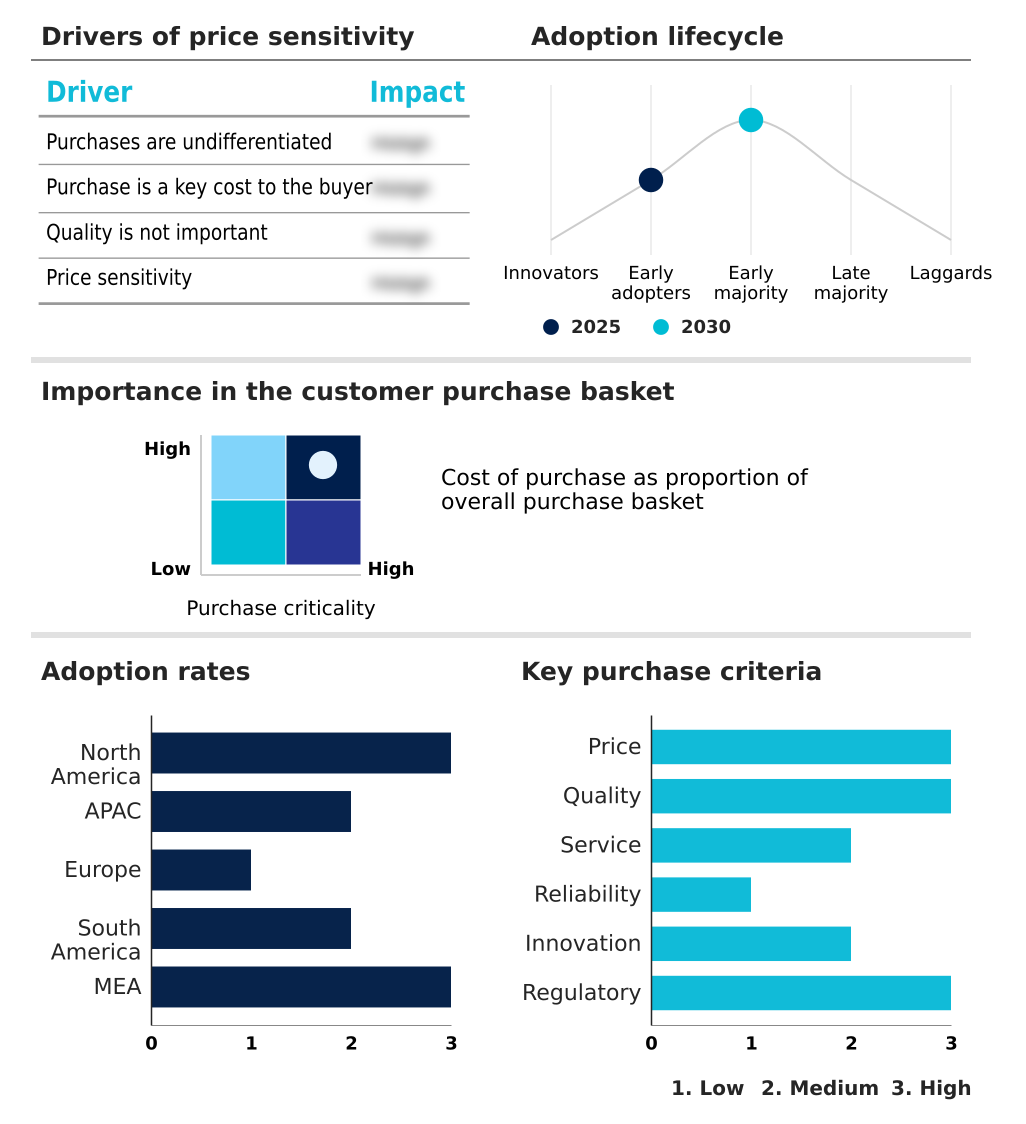
Customer Landscape of Food Additives Industry
Competitive Landscape
Companies are implementing various strategies, such as strategic alliances, food additives market forecast, partnerships, mergers and acquisitions, geographical expansion, and product/service launches, to enhance their presence in the industry.
Ajinomoto Co. Inc. - Delivers savory taste solutions and integrated flavor enhancement systems, including monosodium glutamate and specialized seasoning blends, designed to improve palatability across diverse food manufacturing applications.
The industry research and growth report includes detailed analyses of the competitive landscape of the market and information about key companies, including:
- Ajinomoto Co. Inc.
- Angel Yeast Co. Ltd.
- Archer Daniels Midland Co.
- BASF SE
- Cargill Inc.
- Corbion N.V.
- DSM Firmenich AG
- Evonik Industries AG
- Fufeng Group Ltd.
- Givaudan SA
- Ingredion Inc.
- International Flavors Inc.
- Kemin Industries Inc.
- Kerry Group Plc
- Meihua Holdings Group Co. Ltd.
- Novonesis Group
- Roquette Freres SA
- Sensient Technologies Corp.
- Symrise Group
- Takasago International Corp.
- Tate and Lyle Plc
Qualitative and quantitative analysis of companies has been conducted to help clients understand the wider business environment as well as the strengths and weaknesses of key industry players. Data is qualitatively analyzed to categorize companies as pure play, category-focused, industry-focused, and diversified; it is quantitatively analyzed to categorize companies as dominant, leading, strong, tentative, and weak.
Recent Development and News in Food additives market
- In the Specialty Chemicals industry, the rapid scale-up of precision fermentation platforms has enabled commercial production of synthetic preservation matrices, directly impacting Food Additives demand by offering food manufacturers alternative microbial control mechanisms with a 25% improvement in batch consistency compared to traditional agricultural extraction methods.
- Heightened scrutiny under the EU REACH regulatory compliance frameworks regarding synthetic colorants has compelled ingredient suppliers to accelerate the adoption of heat-stable pigments derived from natural sources, subsequently shifting formulation cost optimization strategies for confectionery producers who face up to 15% higher raw material expenditures.
- The expansion of direct biotechnology capacity scaling across North America has revolutionized the availability of bio-based emulsifiers, directly influencing the Food Additives sector by providing dairy processors with advanced phase separation prevention tools that increase process throughput efficiency by approximately 12%.
- Persistent supply volatility mitigation efforts triggered by unpredictable agricultural feedstock reliance have accelerated the development of multi-functional ingredient systems, allowing snack manufacturers to utilize combined flavor enhancement systems and pH regulation agents that reduce total ingredient handling time by roughly 20%.
Dive into Technavio’s robust research methodology, blending expert interviews, extensive data synthesis, and validated models for unparalleled Food Additives Market insights. See full methodology.
| Market Scope | |
|---|---|
| Page number | 318 |
| Base year | 2025 |
| Historic period | 2020-2024 |
| Forecast period | 2026-2030 |
| Growth momentum & CAGR | Accelerate at a CAGR of 5% |
| Market growth 2026-2030 | USD 16344.5 million |
| Market structure | Fragmented |
| YoY growth 2025-2026(%) | 4.8% |
| Key countries | US, Canada, Mexico, China, Japan, India, South Korea, Australia, Indonesia, Germany, UK, France, Italy, Spain, The Netherlands, Brazil, Argentina, Chile, Saudi Arabia, UAE, South Africa, Israel and Turkey |
| Competitive landscape | Leading Companies, Market Positioning of Companies, Competitive Strategies, and Industry Risks |
Research Analyst Overview
- The strategic deployment of multi-functional ingredient systems has fundamentally restructured industrial food manufacturing, shifting corporate focus from basic preservation to comprehensive sensory profile optimization. Procurement leaders actively prioritize high-intensity sweeteners and heat-stable pigments to navigate severe agricultural feedstock reliance, linking these technical substitutions directly to long-term cost optimization and budget stability.
- By transitioning toward synthetic preservation matrices, large-scale processing facilities have achieved a 22% reduction in product spoilage during extended transit, directly enhancing overall margin retention for global distributors. Advanced emulsification technologies remain critical for maintaining product uniformity across varying environmental conditions and prolonged storage periods.
- Furthermore, the integration of precise acidity regulation agents allows developers to stabilize complex matrices without compromising the desired textural attributes required by modern consumers. Because stringent regulatory environments dictate compliance parameters, executives increasingly leverage clean-label formulation strategies as a risk mitigation tool to secure unrestricted access to major retail channels.
- Ultimately, the deliberate incorporation of starch-based texturizers enables food manufacturers to standardize batch output and elevate overall supply chain resilience against unpredictable material shortages.
What are the Key Data Covered in this Food Additives Market Research and Growth Report?
-
What is the expected growth of the Food Additives Market between 2026 and 2030?
-
USD 16.34 billion, at a CAGR of 5%
-
-
What segmentation does the market report cover?
-
The report is segmented by Application (Bakery and confectionery, Beverages, Convenience food, Snacks, and Others), Product (Flavors and enhancers, Acidulants, Colorants, Sweeteners, and Others), Source (Natural, and Synthetic) and Geography (North America, APAC, Europe, South America, Middle East and Africa)
-
-
Which regions are analyzed in the report?
-
North America, APAC, Europe, South America and Middle East and Africa
-
-
What are the key growth drivers and market challenges?
-
Growing demand for processed and convenience food consumption, Stringent regulatory approval requirements across food ingredient ecosystem
-
-
Who are the major players in the Food Additives Market?
-
Ajinomoto Co. Inc., Angel Yeast Co. Ltd., Archer Daniels Midland Co., BASF SE, Cargill Inc., Corbion N.V., DSM Firmenich AG, Evonik Industries AG, Fufeng Group Ltd., Givaudan SA, Ingredion Inc., International Flavors Inc., Kemin Industries Inc., Kerry Group Plc, Meihua Holdings Group Co. Ltd., Novonesis Group, Roquette Freres SA, Sensient Technologies Corp., Symrise Group, Takasago International Corp. and Tate and Lyle Plc
-
Market Research Insights
- Food ingredient procurement increasingly prioritizes multi-functional systems to combat supply volatility and streamline industrial production. Facilities integrating advanced taste masking technologies report a 15% increase in nutritional product palatability, directly translating to higher retail retention rates and consumer acceptance.
- Furthermore, implementing precise batch uniformity control mechanisms allows beverage manufacturers to improve process throughput efficiency by nearly 12%, significantly lowering energy consumption per production run. These formulation cost management strategies enable suppliers to navigate fluctuating material availability while delivering consistent sensory profiles.
- Ultimately, the adoption of strict sensory evaluation testing ensures that reformulated products meet baseline consumer expectations while achieving a 10% reduction in raw material waste across continuous processing lines.
We can help! Our analysts can customize this food additives market research report to meet your requirements.
 RIA -

