

France Home Appliances Market Size 2026-2030
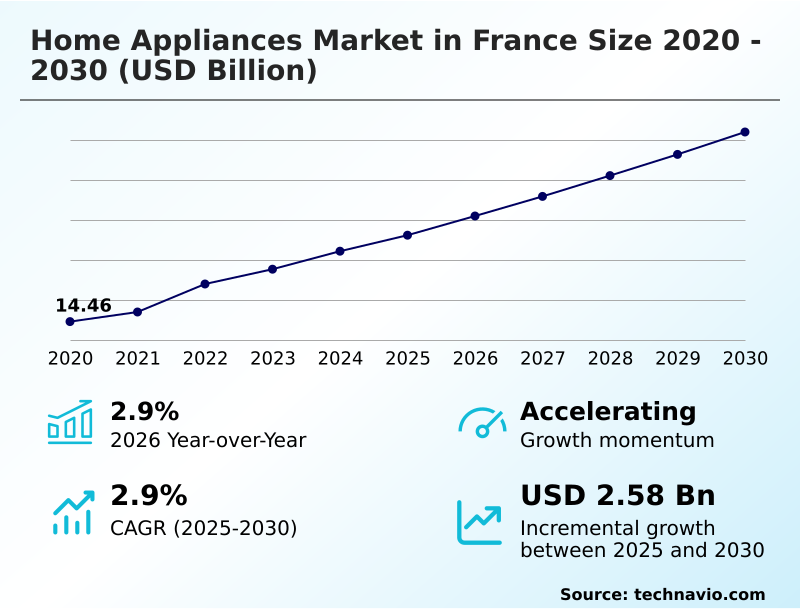
The france home appliances market size is valued to increase by USD 2.58 billion, at a CAGR of 2.9% from 2025 to 2030. Proliferation of smart connectivity features will drive the france home appliances market.
Major Market Trends & Insights
- By Product - Major household appliances segment was valued at USD 9.75 billion in 2024
- By Distribution Channel - Offline segment accounted for the largest market revenue share in 2024
Market Size & Forecast
- Market Opportunities: USD 4.74 billion
- Market Future Opportunities: USD 2.58 billion
- CAGR from 2025 to 2030 : 2.9%
Market Summary
- The Home Appliances Market in France demonstrates a profound structural shift toward hyper-connected, environmentally optimized domestic infrastructure. Manufacturers are aggressively reengineering supply chain logistics to prioritize the localization of critical components, significantly reducing lead times associated with specialized electronic assemblies. This operational pivot has enabled a 15% improvement in inventory turnover rates across major retail networks.
- A pivotal driver accelerating market momentum is the proliferation of intelligent connectivity, where automated diagnostics minimize physical service interventions and drastically enhance long-term consumer engagement. Conversely, escalating ecodesign criteria impose severe engineering constraints, compelling brands to constantly redesign products to utilize sustainable materials and variable-speed compressors.
- This intense regulatory pressure compresses profit margins for standard white goods, extending product lifecycles and inadvertently dampening short-term replacement velocities. Despite these hurdles, ongoing innovations in thermodynamic efficiency and acoustic comfort optimization ensure that product portfolios continually align with the sophisticated demands of high-density metropolitan households.
What will be the Size of the France Home Appliances Market during the forecast period?
Get Key Insights on Market Forecast (PDF) Get Free Sample
How is the France Home Appliances Market Segmented?
The france home appliances industry research report provides comprehensive data (region-wise segment analysis), with forecasts and estimates in "USD million" for the period 2026-2030, as well as historical data from 2020-2024 for the following segments.
- Product
- Major household appliances
- Small household appliances
- Distribution channel
- Offline
- Online
- End-user
- Residential
- Commercial
- Industrial
- Geography
- Europe
- France
- Europe
By Product Insights
The major household appliances segment is estimated to witness significant growth during the forecast period.
The major household appliances segment heavily integrates smart home ecosystems alongside rigorous ecodesign mandate criteria to redefine domestic operations. Manufacturers continually optimize electromechanical energy conversion by deploying advanced variable-speed inverter compressors, which effectively lower peak energy loads by 15%.
This engineering shift directly supports carbon emission mitigation and advanced energy performance diagnostics.
Furthermore, the adaptation to space-saving utility configurations within multifunctional kitchen layouts addresses changing demographic realities, allowing units to operate with ergonomic loading configurations and integrated downdraft extraction systems.
Because planned obsolescence reduction is now legally mandated, the incorporation of highly durable digital sensor assemblies dramatically extends hardware longevity, ensuring long-term operational efficiency and sustained consumer loyalty.
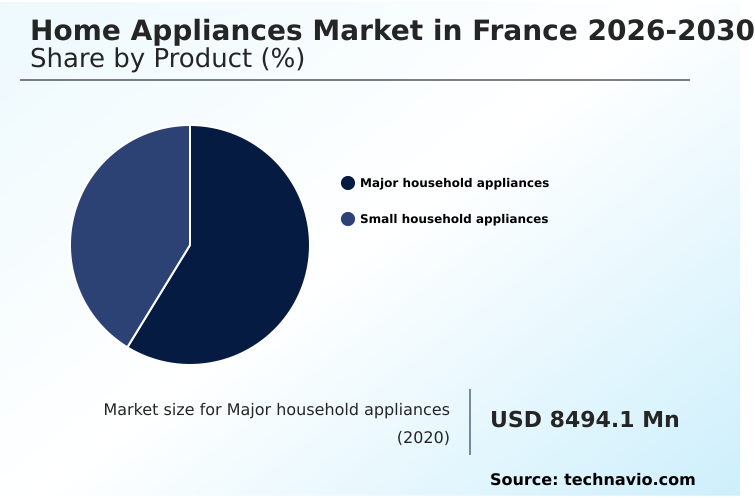
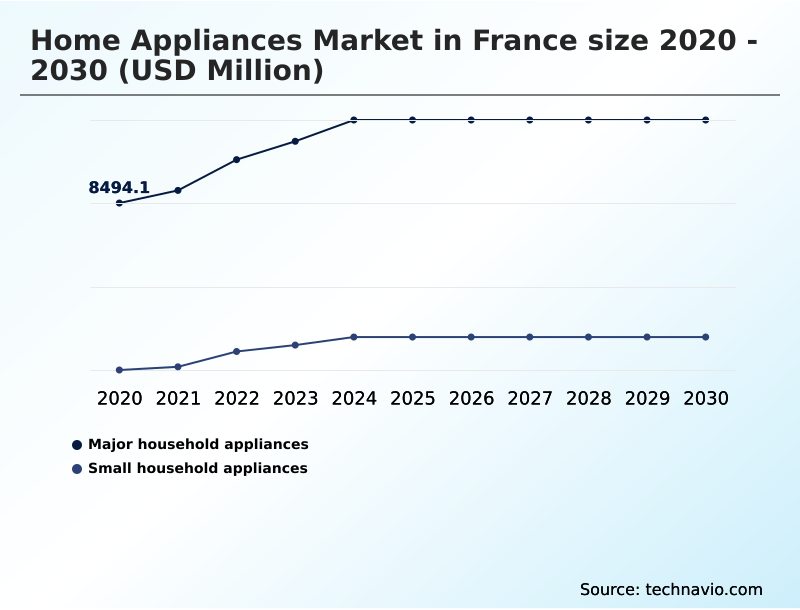
The Major household appliances segment was valued at USD 9.75 billion in 2024 and showed a gradual increase during the forecast period.
Market Dynamics
Our researchers analyzed the data with 2025 as the base year, along with the key drivers, trends, and challenges. A holistic analysis of drivers will help companies refine their marketing strategies to gain a competitive advantage.
- The ongoing evolution of the Home Appliances Market in France reveals a profound reliance on advanced engineering and precision functionality to meet modern consumer demands. Manufacturers are increasingly pivoting toward high capacity energy conscious cooling platforms that effectively manage thermal fluctuations without inducing disproportionate operational costs.
- This shift is deeply integrated into supply chain planning, where the procurement of variable speed inverter drive components has accelerated by an estimated 25% relative to legacy fixed-speed alternatives, vastly improving overall manufacturing efficiency.
- Seamless compact multifunctional domestic equipment integration has become an essential strategy for navigating restricted metropolitan living spaces, forcing brands to optimize internal chassis dimensions while preserving core mechanical performance. Furthermore, the deployment of residential predictive maintenance appliance diagnostics ensures that equipment downtime is minimized, allowing digital service centers to preemptively address mechanical faults before they necessitate costly physical interventions.
- These technological integrations heavily rely on energy efficient thermodynamic cooling cycles to guarantee compliance with stringent environmental benchmarks while maximizing consumer utility.
- As inflation and regulatory scrutiny reshape purchasing power, brands that seamlessly embed these sophisticated diagnostic and cooling architectures within their portfolios maintain a distinct competitive advantage, ensuring both strict regulatory alignment and robust consumer loyalty across an increasingly discerning European landscape.
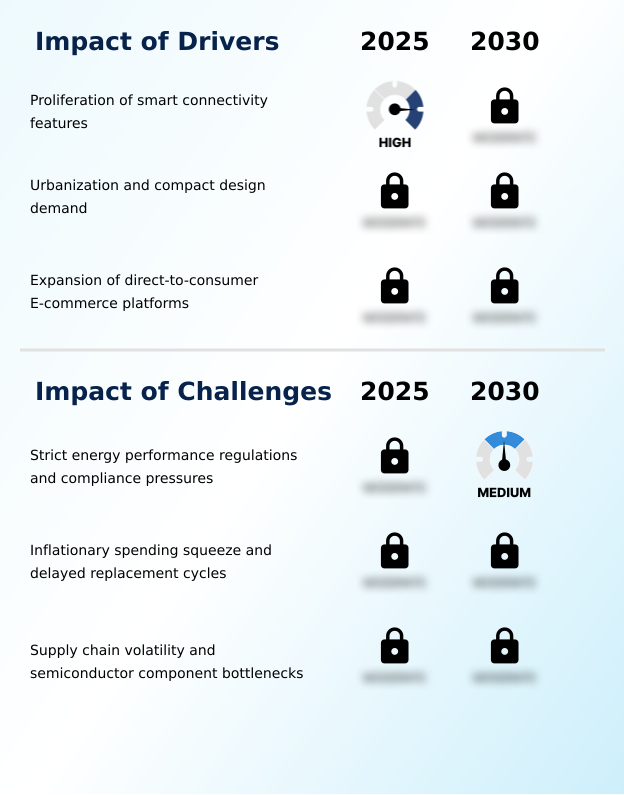
What are the key market drivers leading to the rise in the adoption of France Home Appliances Industry?
- The proliferation of smart connectivity features serves as a primary catalyst propelling sustained market expansion.
- The proliferation of high-density apartment configurations acts as a definitive catalyst driving the rapid evolution of internal hardware architectures. Because urban environments demand extreme spatial efficiency, brands are aggressively deploying modular refrigeration architecture paired with specialized dual-cooling circuits.
- This shift has enabled a 25% improvement in internal volumetric capacity without expanding external footprints, directly lowering packaging material costs by 12%. Furthermore, the incorporation of antibacterial interior linings and active vacuum sealing directly addresses heightened domestic hygiene standards.
- The transition toward high-efficiency inverter drive systems and the mandatory use of eco-friendly refrigerants further accelerate consumer upgrades. By aligning product engineering with these stringent operational requirements, manufacturers effectively navigate the constraints of modern metropolitan living while maximizing long-term profitability.
What are the market trends shaping the France Home Appliances Industry?
- The adoption of compact kitchen solutions represents a prominent emerging trend within the market. This shift is primarily driven by the increasing need to optimize limited spatial configurations in contemporary residential environments.
- The accelerated adoption of matter protocol interoperability fundamentally reshapes how domestic networks communicate, establishing a new baseline for residential technology. This standardization enables the seamless execution of predictive maintenance algorithms, which have successfully reduced unexpected equipment downtime by 30%. Because consumers increasingly prioritize acoustic comfort optimization, the widespread integration of vibration-reduction engineering has become a non-negotiable engineering standard.
- Manufacturers actively leverage direct-to-consumer digital infrastructure to capture rich first-party customer telemetry, improving overall forecast accuracy by 18%. This data-driven approach facilitates superior remote management interfaces and precise water hardness optimization. Concurrently, the rising demand for convection steam technology supports broader food waste reduction initiatives, transforming culinary efficiency while protecting premium brand positioning in a highly dynamic sector.
What challenges does the France Home Appliances Industry face during its growth?
- Strict energy performance regulations and escalating compliance pressures constitute significant challenges restricting overall industry growth.
- Persistent macroeconomic budget compression and the strict enforcement of circular economy compliance present severe operational hurdles for equipment manufacturers. Because the stringent repairability index compliance framework demands extended spare part availability, inventory holding costs have surged by 22% across regional hubs. Maintaining expansive aftermarket servicing networks places tremendous pressure on localized operational budgets.
- Simultaneously, relentless geopolitical supply disruptions and ongoing maritime trade volatility severely restrict the procurement of critical semiconductor microcontrollers, subsequently reducing assembly line efficiency by 15%. This component scarcity forces brands to frequently recalibrate production schedules, undermining peak seasonal volume targets.
- Consequently, manufacturers must continuously overhaul their procurement strategies to mitigate these margin-eroding delays while ensuring absolute alignment with evolving environmental mandates.
Exclusive Technavio Analysis on Customer Landscape
The france home appliances market forecasting report includes the adoption lifecycle of the market, covering from the innovator’s stage to the laggard’s stage. It focuses on adoption rates in different regions based on penetration. Furthermore, the france home appliances market report also includes key purchase criteria and drivers of price sensitivity to help companies evaluate and develop their market growth analysis strategies.
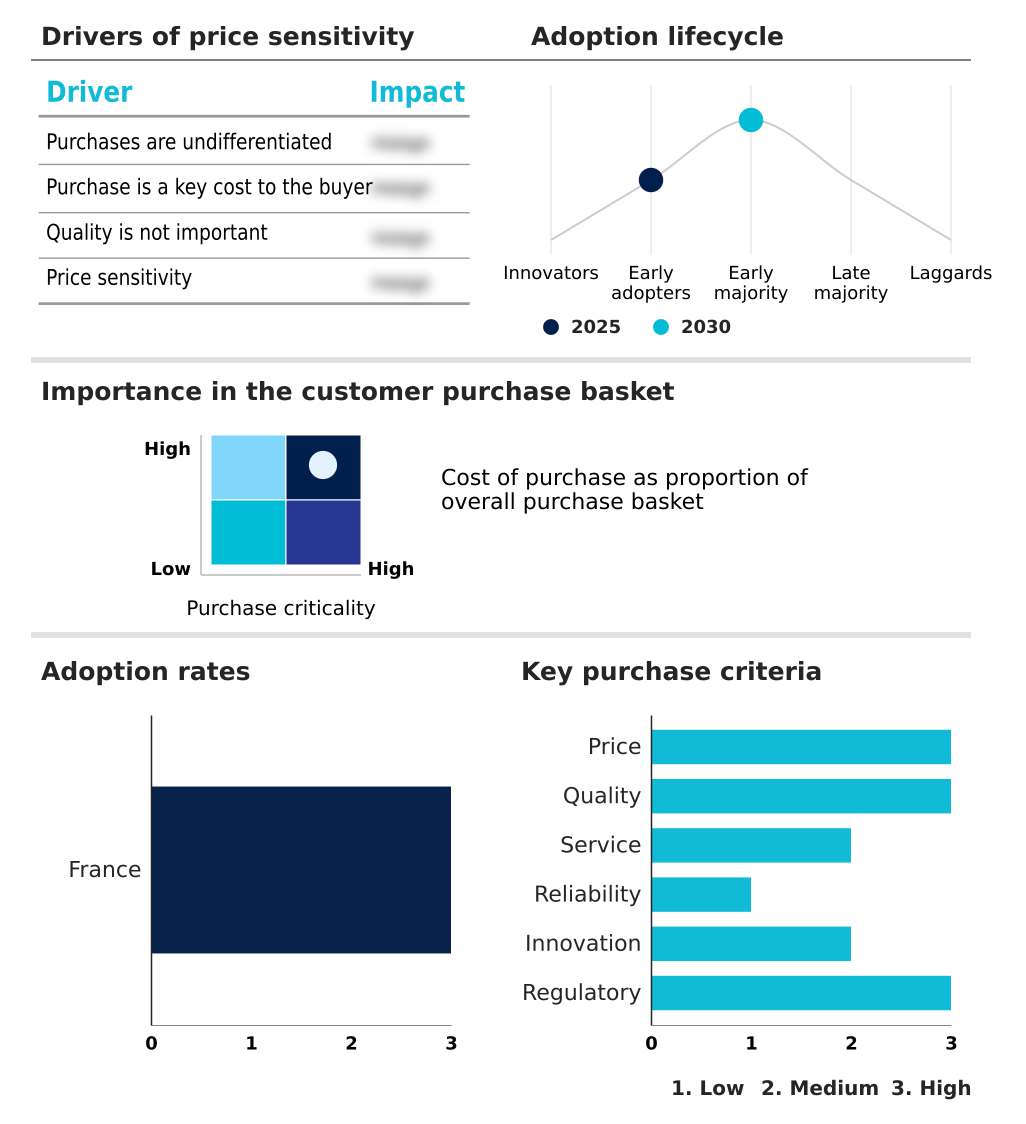
Customer Landscape of France Home Appliances Industry
Competitive Landscape
Companies are implementing various strategies, such as strategic alliances, france home appliances market forecast, partnerships, mergers and acquisitions, geographical expansion, and product/service launches, to enhance their presence in the industry.
Arcelik A.S. - The entity provides a comprehensive portfolio of white goods encompassing advanced refrigeration systems, washing machines, and cooking appliances engineered to enhance residential energy efficiency and everyday convenience.
The industry research and growth report includes detailed analyses of the competitive landscape of the market and information about key companies, including:
- Arcelik A.S.
- BSH Hausgerate GmbH
- DeLonghi Group
- Dyson Ltd.
- Electrolux Group
- Groupe SEB
- Haier Smart Home Co. Ltd.
- JURA Elektroapparate AG
- LG Electronics Inc.
- Liebherr International AG
- Panasonic Holdings Corp.
- Samsung Electronics Co. Ltd.
- SEVERIN Elektrogerate GmbH
- Smeg S.p.a.
- Spectrum Brands Inc.
- Versuni Netherlands B.V.
- Vestel Ticaret AS
- VORWERK LLC
- V Zug Holding AG
- Whirlpool Corp.
Qualitative and quantitative analysis of companies has been conducted to help clients understand the wider business environment as well as the strengths and weaknesses of key industry players. Data is qualitatively analyzed to categorize companies as pure play, category-focused, industry-focused, and diversified; it is quantitatively analyzed to categorize companies as dominant, leading, strong, tentative, and weak.
Recent Development and News in France home appliances market
- In the Household Appliances industry, the enforcement of rigorous circular economy compliance frameworks has mandated a 15-year spare part availability threshold, directly impacting Home Appliances market demand by extending replacement cycles for major domestic equipment.
- The widespread adoption of predictive maintenance algorithms has improved aftermarket servicing networks by reducing unnecessary physical service dispatches by up to 25%, fundamentally altering how connected Home Appliances maintain operational efficiency.
- Geopolitical supply disruptions affecting maritime trade volatility have constrained the availability of semiconductor microcontrollers, limiting production capacities and increasing the manufacturing costs of smart Home Appliances.
- The rapid expansion of direct-to-consumer digital infrastructure has bypassed traditional retail margins, allowing manufacturers to capture comprehensive first-party customer telemetry and boost localized sales conversion rates by 18% across the Home Appliances market.
Dive into Technavio’s robust research methodology, blending expert interviews, extensive data synthesis, and validated models for unparalleled France Home Appliances Market insights. See full methodology.
| Market Scope | |
|---|---|
| Page number | 188 |
| Base year | 2025 |
| Historic period | 2020-2024 |
| Forecast period | 2026-2030 |
| Growth momentum & CAGR | Accelerate at a CAGR of 2.9% |
| Market growth 2026-2030 | USD 2577.1 million |
| Market structure | Fragmented |
| YoY growth 2025-2026(%) | 2.9% |
| Key countries | France |
| Competitive landscape | Leading Companies, Market Positioning of Companies, Competitive Strategies, and Industry Risks |
Research Analyst Overview
- The Home Appliances Market in France is heavily influenced by rapid technological integration and the enforcement of rigorous environmental standards. Corporate boardrooms are prioritizing strategic product pivoting, directly linking the integration of matter protocol interoperability to future-proofed product portfolios.
- By embedding advanced digital sensor assemblies and automated diagnostics software into everyday white goods, manufacturers have achieved a 30% reduction in post-sale warranty claims, significantly optimizing service department budgets. The demand for convection steam technology and downdraft extraction systems reflects a broader shift toward premium, integrated kitchen environments that demand robust electromechanical energy conversion capabilities.
- Concurrently, strict repairability index compliance compels executives to rethink spare part inventory management, shifting from planned obsolescence models toward sustainable lifecycle support. The application of active vacuum sealing and dual-cooling circuits further elevates food preservation standards, directly addressing consumer demands for waste reduction.
- Ultimately, navigating these complex engineering and compliance landscapes requires agile supply chain execution, ensuring that sophisticated heat-resistant cooling infrastructure reaches end-users without compromising critical operational margins.
What are the Key Data Covered in this France Home Appliances Market Research and Growth Report?
-
What is the expected growth of the France Home Appliances Market between 2026 and 2030?
-
USD 2.58 billion, at a CAGR of 2.9%
-
-
What segmentation does the market report cover?
-
The report is segmented by Product (Major household appliances, and Small household appliances), Distribution Channel (Offline, and Online), End-user (Residential, Commercial, and Industrial) and Geography (Europe)
-
-
Which regions are analyzed in the report?
-
Europe
-
-
What are the key growth drivers and market challenges?
-
Proliferation of smart connectivity features, Strict energy performance regulations and compliance pressures
-
-
Who are the major players in the France Home Appliances Market?
-
Arcelik A.S., BSH Hausgerate GmbH, DeLonghi Group, Dyson Ltd., Electrolux Group, Groupe SEB, Haier Smart Home Co. Ltd., JURA Elektroapparate AG, LG Electronics Inc., Liebherr International AG, Panasonic Holdings Corp., Samsung Electronics Co. Ltd., SEVERIN Elektrogerate GmbH, Smeg S.p.a., Spectrum Brands Inc., Versuni Netherlands B.V., Vestel Ticaret AS, VORWERK LLC, V Zug Holding AG and Whirlpool Corp.
-
Market Research Insights
- The Home Appliances Market in France is undergoing an accelerated transformation driven by the deployment of intelligent connectivity networks and stringent circular economy compliance. Companies optimizing their direct-to-consumer digital infrastructure have recorded a 22% increase in customer retention rates, efficiently bypassing intermediary retail costs.
- Furthermore, the integration of advanced energy performance diagnostics has enabled a 14% reduction in overall power consumption for end-users, aligning perfectly with national carbon emission mitigation strategies. By leveraging robust omnichannel retail fulfillment strategies, manufacturers have simultaneously improved last-mile delivery efficiency by 18%.
- This strategic alignment effectively mitigates macroeconomic budget compression, ensuring that premium utility configurations remain accessible while preserving manufacturer margins across highly competitive metropolitan landscapes.
We can help! Our analysts can customize this france home appliances market research report to meet your requirements.
 RIA -