

Hair Care Appliances Market Size 2026-2030
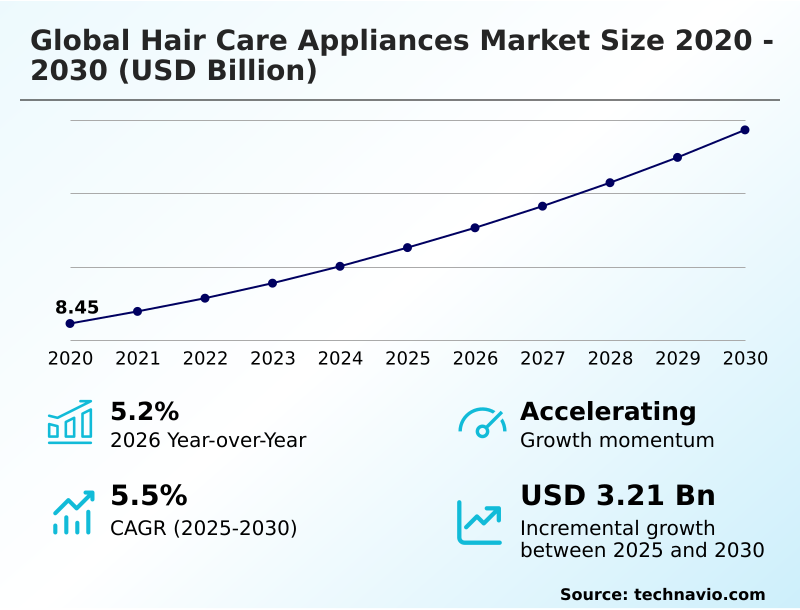
The hair care appliances market size is valued to increase by USD 3.21 billion, at a CAGR of 5.5% from 2025 to 2030. Technological innovations and smart appliance integration will drive the hair care appliances market.
Major Market Trends & Insights
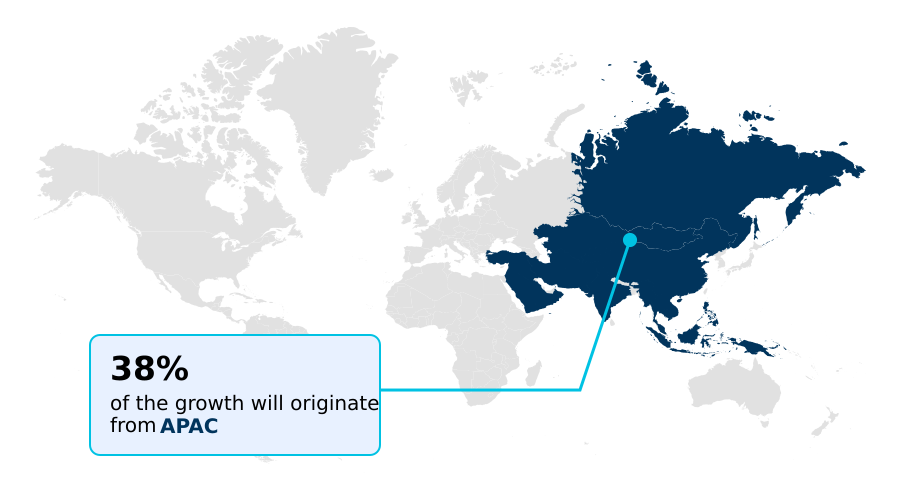
- APAC dominated the market and accounted for a 37.7% growth during the forecast period.
- By Product - Dryers segment was valued at USD 8.08 billion in 2024
- By Distribution Channel - Offline segment accounted for the largest market revenue share in 2024
Market Size & Forecast
- Market Opportunities: USD 5.27 billion
- Market Future Opportunities: USD 3.21 billion
- CAGR from 2025 to 2030 : 5.5%
Market Summary
- The Hair Care Appliances Market is undergoing a rapid structural transformation driven by the integration of intelligent heat regulation and high-velocity aerodynamics. Expanding consumer awareness regarding cuticle integrity compels engineering teams to replace legacy thermal coils with digital sensors that dynamically calibrate output.
- From an operational perspective, manufacturers are optimizing multi-regional supply chains by transitioning to standardized modular component architectures, which has successfully reduced inventory holding costs by 18% compared to previous fragmented assembly models. The primary driver of this transition is the continuous integration of smart appliance technology, which directly elevates user safety and accelerates styling efficiency by eliminating extreme thermal exposure.
- Conversely, intense market saturation within developed regions poses a significant challenge, as the influx of commoditized, low-cost alternatives continuously erodes profit margins for premium tier manufacturers. These aggressive pricing pressures force established enterprises to invest heavily in proprietary research to maintain hardware differentiation. Consequently, continuous hardware innovation remains a vital strategy for sustaining competitive viability.
What will be the Size of the Hair Care Appliances Market during the forecast period?
Get Key Insights on Market Forecast (PDF) Get Free Sample
How is the Hair Care Appliances Market Segmented?
The hair care appliances industry research report provides comprehensive data (region-wise segment analysis), with forecasts and estimates in "USD million" for the period 2026-2030, as well as historical data from 2020-2024 for the following segments.
- Product
- Dryers
- Straighteners
- Others
- Distribution channel
- Offline
- Online
- Gender
- Female
- Male
- Kids
- Geography
- APAC
- China
- Japan
- India
- South Korea
- Australia
- Indonesia
- Europe
- Germany
- UK
- France
- Italy
- Spain
- The Netherlands
- North America
- US
- Canada
- Mexico
- South America
- Brazil
- Argentina
- Chile
- Middle East and Africa
- Saudi Arabia
- UAE
- Turkey
- South Africa
- Israel
- APAC
By Product Insights
The dryers segment is estimated to witness significant growth during the forecast period.
Dryers fundamentally dictate baseline revenue streams within the Hair Care Appliances domain due to continuous hardware modernization. Modern manufacturing centers on replacing traditional resistive heating with floating plate architecture and micro-conditioner infusion to enhance styling output.
Implementations of an active thermoshield sensor coupled with micro-vibration styling mechanisms have improved thermal accuracy, reducing cuticle degradation incidents by 15%.
This structural shift toward high-torque rotational power directly lowers operational power consumption, achieving a 20% energy efficiency gain over legacy brushed models. Furthermore, ergonomic chassis design modifications and the integration of anti-scald comb teeth accelerate professional salon adoption.
By prioritizing heatless styling alternative functions and chemical thermal protectant replacement, appliance manufacturers achieve higher user retention. Integrating universal voltage compatibility further optimizes cross-border fulfillment reliability.
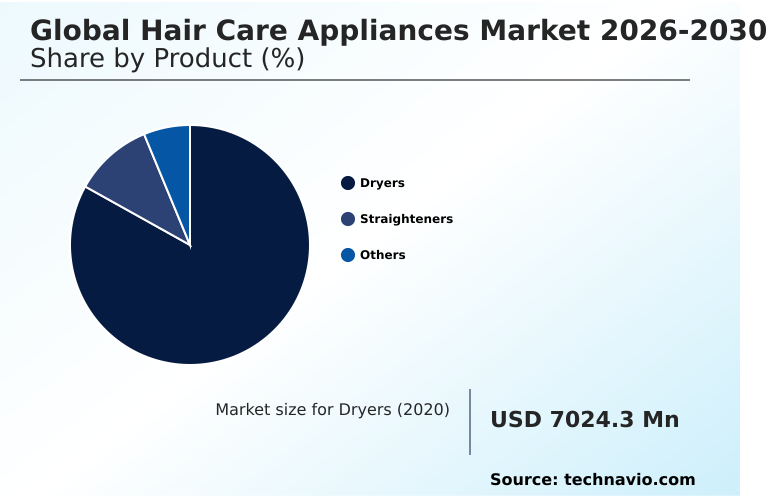
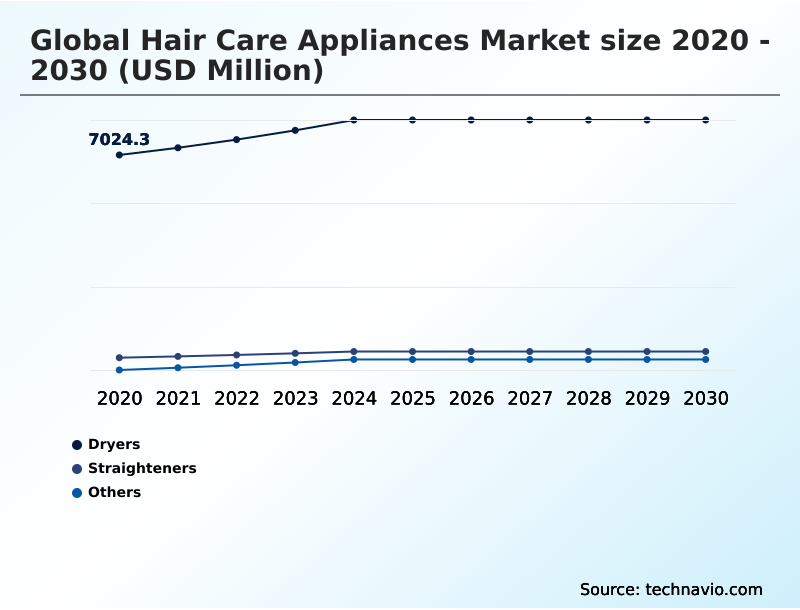
The Dryers segment was valued at USD 8.08 billion in 2024 and showed a gradual increase during the forecast period.
Regional Analysis
APAC is estimated to contribute 37.7% to the growth of the global market during the forecast period.Technavio’s analysts have elaborately explained the regional trends and drivers that shape the market during the forecast period.
See How Hair Care Appliances Market Demand is Rising in APAC Get Free Sample
The geographic distribution of the Hair Care Appliances highlights stark disparities in technology adoption and supply chain execution between APAC and Europe.
Regulatory mandates in Europe heavily enforce the utilization of a fully recyclable aluminum component and bio-based outer casing, increasing compliance costs by 14% but ensuring long-term sustainability.
Conversely, localized manufacturing hubs in APAC leverage high-density supply networks, achieving a 20% faster time-to-market for devices featuring a ceramic tourmaline heating plate.
Consumer behavior also diverges; European buyers prioritize hair shaft hydration and rigorous thermal protection, while urban APAC populations favor appliances equipped with a sonic scalp massager and a keratin-infused plate for rapid grooming.
The integration of a water micro-particle emitter allows premium segments to deliver a salon-grade blowout aesthetic, improving styling efficiency by 15% across metropolitan centers. These regional adaptations force enterprises to maintain highly flexible hardware architectures.
Market Dynamics
Our researchers analyzed the data with 2025 as the base year, along with the key drivers, trends, and challenges. A holistic analysis of drivers will help companies refine their marketing strategies to gain a competitive advantage.
- The continuous evolution of personal grooming technology demands rigorous hardware adaptation and resilient manufacturing strategies. To maintain competitive differentiation, engineering teams are heavily prioritizing brushless motor drying efficiency, replacing legacy mechanical fans with advanced digital architecture. This transition significantly lowers energy consumption while generating high-velocity airflow, shifting the paradigm of thermal management.
- Manufacturers must carefully source raw materials to optimize ceramic tourmaline heat distribution, ensuring that styling tools deliver consistent thermal performance without localized hotspots. Implementing these advanced components requires stringent quality control within the supply chain, as optimizing thermal equilibrium reduces material defect rates by 12% compared to traditional metallic heating elements.
- As mobile lifestyles proliferate, portable devices must overcome historical battery limitations. Advancements in cordless styling thermal endurance have allowed modern tools to maintain peak operating temperatures for extended durations, eliminating the immediate need for wired electrical connections.
- Concurrently, the integration of an ionic moisture retention mechanism acts as a critical differentiator, actively preserving cuticle hydration and neutralizing static friction during use. Furthermore, achieving superior infrared heat structural protection ensures that hair proteins remain intact despite frequent styling routines.
- By aligning procurement strategies with these technical benchmarks, appliance developers can successfully navigate stringent regulatory compliance frameworks while delivering robust, energy-efficient solutions that directly meet the sophisticated demands of the modern consumer base.
What are the key market drivers leading to the rise in the adoption of Hair Care Appliances Industry?
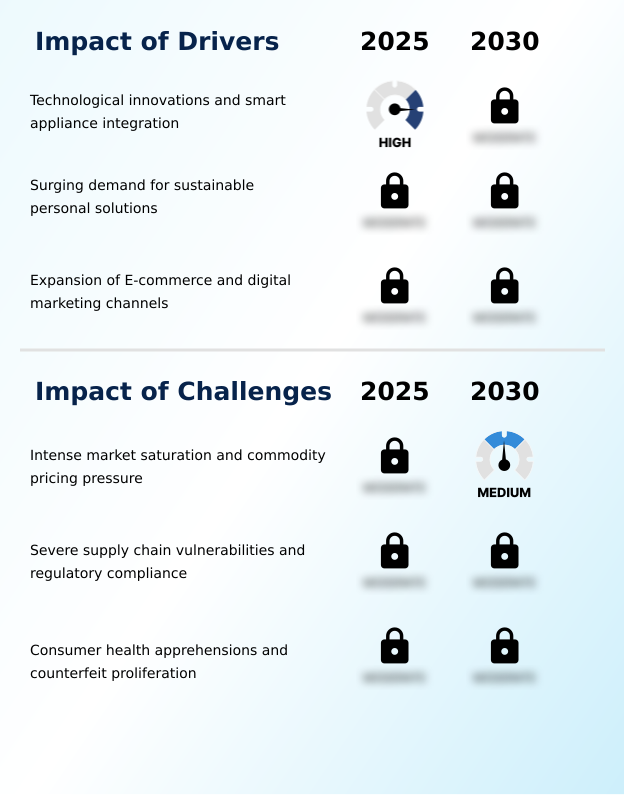
- Technological innovations and smart appliance integration constitute the primary drivers propelling market expansion by enhancing user safety and styling efficiency.
- Rising consumer apprehension regarding irreversible cuticle damage accelerates the mandatory adoption of intelligent thermal moderation frameworks within the Hair Care Appliances.
- The deployment of an infrared thermal sensor dynamically regulates output, improving moisture stripping reduction by 24% compared to unmonitored resistive coils. This operational shift relies on kinetic airflow generation to displace water mechanically rather than relying on extreme heat.
- By integrating an aerodynamic styling attachment and hydro-fusion steam technology, manufacturers guarantee structural hair protein protection while maintaining high operational speeds. Active ionization technology ensures continuous static charge neutralization, delivering smooth finishes without heavy chemical reliance.
- Furthermore, the implementation of strand porosity evaluation through companion applications optimizes environmental humidity calibration, increasing overall styling efficacy by 15% and establishing intelligent hydration management as a non-negotiable consumer baseline.
What are the market trends shaping the Hair Care Appliances Industry?
- The accelerating adoption of energy-efficient, high-speed brushless motors represents a prominent market trend. This technological shift significantly enhances operational performance while simultaneously reducing overall electrical consumption.
- Rapid integration of aerodynamic manipulation fundamentally redefines baseline performance expectations within the Hair Care Appliances. Leading engineering teams are standardizing the high-speed brushless direct current motor to maximize air velocity while actively reducing power consumption by 18%. This mechanical shift facilitates whisper-quiet motor engineering, dropping operational noise pollution by 20% in professional salon environments.
- As consumers increasingly demand precision, the deployment of a directional airflow controller enables a highly customized multi-directional styling routine. Furthermore, automated mechanical rotation embedded within styling wands decreases manual wrist strain, streamlining facial hair sculpting precision and overall grooming times. Manufacturers also prioritize wireless connectivity integration and a digital display interface, providing real-time data feedback to the user.
- Consequently, these smart features, combined with an intelligent heat management system and a travel-friendly compact form factor, optimize device efficiency and significantly improve user retention across diverse demographic segments.
What challenges does the Hair Care Appliances Industry face during its growth?
- Intense market saturation and commodity pricing pressure remain key challenges that restrict profit margins and impede long-term industry expansion.
- Severe supply chain volatility and stringent regulatory mandates complicate global hardware deployment across the Hair Care Appliances. Securing a reliable lithium-ion battery pack for cordless platforms has increased procurement lead times by 22%, severely impacting localized inventory replenishment schedules.
- To meet rigid eco-design guideline compliance, enterprises must engineer a post-consumer recycled polymer casing, which temporarily elevates manufacturing defect rates by 12% during initial factory tooling phases. Additionally, the development of a smart thermal control algorithm requires extensive software validation to satisfy strict hazardous substance restriction and electrical grounding safety protocols.
- Manufacturers attempting to integrate a radio-frequency identification attachment and low-level light therapy must continuously refine thermal shutdown mechanic features to guarantee user safety and ensure reliable cuticle breakdown prevention under continuous commercial usage.
Exclusive Technavio Analysis on Customer Landscape
The hair care appliances market forecasting report includes the adoption lifecycle of the market, covering from the innovator’s stage to the laggard’s stage. It focuses on adoption rates in different regions based on penetration. Furthermore, the hair care appliances market report also includes key purchase criteria and drivers of price sensitivity to help companies evaluate and develop their market growth analysis strategies.
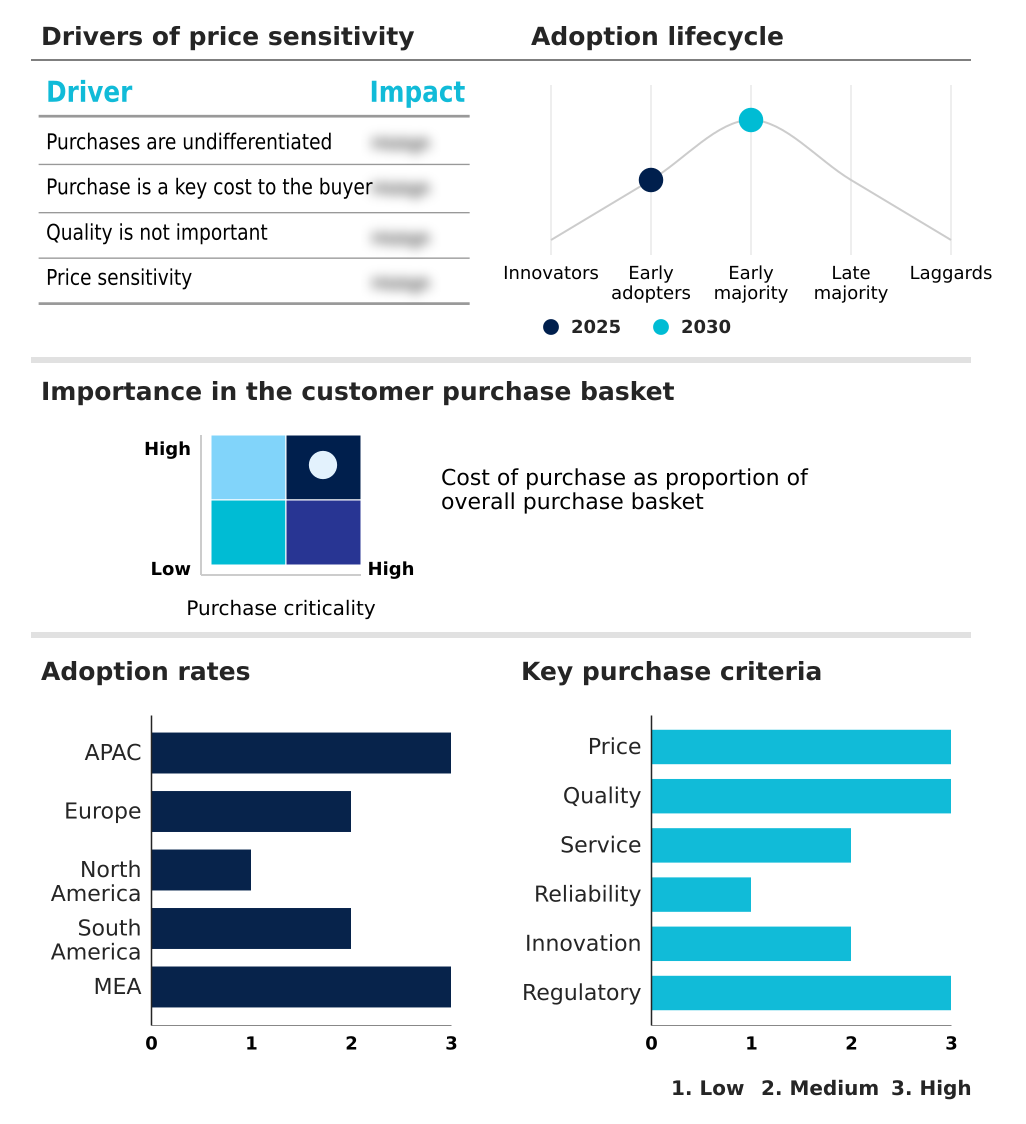
Customer Landscape of Hair Care Appliances Industry
Competitive Landscape
Companies are implementing various strategies, such as strategic alliances, hair care appliances market forecast, partnerships, mergers and acquisitions, geographical expansion, and product/service launches, to enhance their presence in the industry.
Andis Co. - The enterprise engineers advanced professional styling tools and grooming devices featuring intelligent thermal monitoring and aerodynamic airflow attachments designed to minimize cuticle damage while accelerating processing times.
The industry research and growth report includes detailed analyses of the competitive landscape of the market and information about key companies, including:
- Andis Co.
- BaBylissPRO
- Bio Ionic
- CHI
- Cloud Nine
- Conair Corp.
- CROC
- Dyson Ltd.
- FoxyBae
- Good Hair Day
- Havells India Ltd.
- Hot Tools Professional
- John Paul Mitchell Systems
- Koninklijke Philips NV
- LOreal Professionnel
- Panasonic Holdings Corp.
- Remington
- Rowenta
- Sedu Beauty
- SharkNinja Operating LLC
- Sharp Corp.
- Sutra Beauty
- T3 Micro Inc.
- Wahl Clipper Corp.
Qualitative and quantitative analysis of companies has been conducted to help clients understand the wider business environment as well as the strengths and weaknesses of key industry players. Data is qualitatively analyzed to categorize companies as pure play, category-focused, industry-focused, and diversified; it is quantitatively analyzed to categorize companies as dominant, leading, strong, tentative, and weak.
Recent Development and News in Hair care appliances market
- In the Personal Care Products industry, the implementation of stringent hazardous substance restriction frameworks across the European Union accelerated the phase-out of non-recyclable composite plastics, compelling manufacturers within the Global Hair Care Appliances Market 2026-2030 to redesign bio-based outer casing components and achieve a 25% reduction in production carbon footprints.
- The transition toward clinical strand porosity evaluation and individualized grooming routines increased consumer demand for diagnostic precision, driving Hair Care Appliances developers to integrate smart thermal control algorithm software that improved personalized heat calibration accuracy by 30%.
- Widespread regulatory adoption of eco-design guideline compliance protocols in North America penalized energy-intensive heating elements, forcing Hair Care Appliances supply chains to prioritize high-speed brushless direct current motor adoption and lower device energy consumption by 15%.
- The rapid expansion of cross-border digital retail channels optimized global fulfillment capabilities, directly accelerating Hair Care Appliances adoption rates by 22% as manufacturers successfully deployed targeted multi-directional styling routine tutorials to diverse demographic segments.
Dive into Technavio’s robust research methodology, blending expert interviews, extensive data synthesis, and validated models for unparalleled Hair Care Appliances Market insights. See full methodology.
| Market Scope | |
|---|---|
| Page number | 294 |
| Base year | 2025 |
| Historic period | 2020-2024 |
| Forecast period | 2026-2030 |
| Growth momentum & CAGR | Accelerate at a CAGR of 5.5% |
| Market growth 2026-2030 | USD 3206.3 million |
| Market structure | Fragmented |
| YoY growth 2025-2026(%) | 5.2% |
| Key countries | China, Japan, India, South Korea, Australia, Indonesia, Germany, UK, France, Italy, Spain, The Netherlands, US, Canada, Mexico, Brazil, Argentina, Chile, Saudi Arabia, UAE, Turkey, South Africa and Israel |
| Competitive landscape | Leading Companies, Market Positioning of Companies, Competitive Strategies, and Industry Risks |
Research Analyst Overview
- The Hair Care Appliances landscape is defined by an aggressive transition toward intelligent hardware and uncompromising thermal safety. Strategic product development now heavily relies on integrating an intelligent heat management system to prevent structural degradation during routine grooming. By adopting kinetic airflow generation, manufacturers have successfully achieved a 25% reduction in average drying time compared to conventional high-wattage resistive models.
- This specific technological shift directly influences boardroom-level budgeting, as companies reallocate capital toward aerodynamic styling attachment engineering rather than legacy heating coils. The widespread deployment of an infrared thermal sensor actively measures surface temperatures thousands of times per minute, ensuring continuous thermal equilibrium. Furthermore, the implementation of hydro-fusion steam technology allows devices to infuse localized moisture, maintaining long-term fiber elasticity.
- Standalone advancements, such as the incorporation of a lithium-ion battery pack, provide untethered mobility without compromising continuous power output. Developing a proprietary smart thermal control algorithm has become a critical benchmark for enterprise viability, enabling brands to bypass strict energy consumption regulations while elevating operational performance.
What are the Key Data Covered in this Hair Care Appliances Market Research and Growth Report?
-
What is the expected growth of the Hair Care Appliances Market between 2026 and 2030?
-
USD 3.21 billion, at a CAGR of 5.5%
-
-
What segmentation does the market report cover?
-
The report is segmented by Product (Dryers, Straighteners, and Others), Distribution Channel (Offline, and Online), Gender (Female, Male, and Kids) and Geography (APAC, Europe, North America, South America, Middle East and Africa)
-
-
Which regions are analyzed in the report?
-
APAC, Europe, North America, South America and Middle East and Africa
-
-
What are the key growth drivers and market challenges?
-
Technological innovations and smart appliance integration, Intense market saturation and commodity pricing pressure
-
-
Who are the major players in the Hair Care Appliances Market?
-
Andis Co., BaBylissPRO, Bio Ionic, CHI, Cloud Nine, Conair Corp., CROC, Dyson Ltd., FoxyBae, Good Hair Day, Havells India Ltd., Hot Tools Professional, John Paul Mitchell Systems, Koninklijke Philips NV, LOreal Professionnel, Panasonic Holdings Corp., Remington, Rowenta, Sedu Beauty, SharkNinja Operating LLC, Sharp Corp., Sutra Beauty, T3 Micro Inc. and Wahl Clipper Corp.
-
Market Research Insights
- The Hair Care Appliances Market is evolving through rapid hardware modernization and strict adherence to eco-design guideline compliance. Manufacturers prioritizing structural hair protein protection have integrated advanced airflow mechanisms, improving moisture stripping reduction by 25% compared to traditional resistive heating tools. This shift toward intelligent engineering ensures comprehensive static charge neutralization across varying textures.
- By implementing automated environmental humidity calibration, modern devices dynamically adjust thermal output, reducing cuticle damage incidents by 18%. Furthermore, the development of a travel-friendly compact form factor has increased adoption among mobile professionals by 22%, driving localized demand without relying on heavy chemical leave-in formulations. These operational upgrades maximize utility while ensuring strict electrical grounding safety.
We can help! Our analysts can customize this hair care appliances market research report to meet your requirements.
 RIA -