


Mems (Micro-Electro-Mechanical Systems) Microphone Market Size 2026-2030
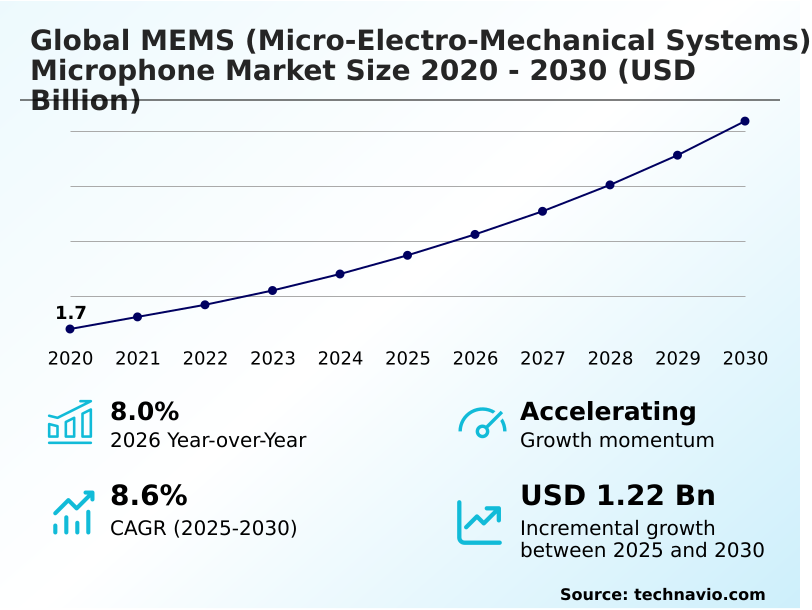
The mems (micro-electro-mechanical systems) microphone market size is valued to increase by USD 1.22 billion, at a CAGR of 8.6% from 2025 to 2030. Exponential proliferation of voice-activated interfaces and virtual assistants in smart environments will drive the mems (micro-electro-mechanical systems) microphone market.
Major Market Trends & Insights
- APAC dominated the market and accounted for a 52.9% growth during the forecast period.
- By Application - Consumer electronics segment was valued at USD 1.58 billion in 2024
- By Type - Analog segment accounted for the largest market revenue share in 2024
Market Size & Forecast
- Market Opportunities: USD 1.88 billion
- Market Future Opportunities: USD 1.22 billion
- CAGR from 2025 to 2030 : 8.6%
Market Summary
- The MEMS (Micro-Electro-Mechanical Systems) Microphone market is defined by the critical transition from traditional analog acoustic components to highly integrated, ultra-low-power silicon architectures. As original equipment manufacturers overhaul consumer and industrial hardware pipelines, the mandate for miniaturized electro-acoustic transducer solutions has intensified.
- In modern automotive assembly workflows, integrating sophisticated in-cabin acoustics and active noise cancellation requires localized multi-sensor networks that reliably isolate passenger commands from ambient road interference. Implementing these specialized digital architectures has resulted in a 40% improvement in voice recognition accuracy compared to legacy condenser variants.
- The exponential proliferation of voice-activated interfaces and true wireless stereo devices acts as a primary driver, fundamentally forcing mass-market procurement cycles that bolster manufacturing economies of scale. Conversely, the market faces structural constraints due to the immense capital expenditure required to establish high-yield semiconductor fabrication lines.
- Complex supply chain vulnerabilities regarding ultra-pure silicon wafers directly limit regional production flexibility, periodically delaying new product development cycles and compressing short-term operational margins for regional hardware suppliers.
What will be the Size of the Mems (Micro-Electro-Mechanical Systems) Microphone Market during the forecast period?
Get Key Insights on Market Forecast (PDF) Get Free Sample
How is the Mems (Micro-Electro-Mechanical Systems) Microphone Market Segmented?
The mems (micro-electro-mechanical systems) microphone industry research report provides comprehensive data (region-wise segment analysis), with forecasts and estimates in "USD million" for the period 2026-2030, as well as historical data from 2020-2024 for the following segments.
- Application
- Consumer electronics
- Healthcare
- Automotive
- Others
- Type
- Analog
- Digital
- Technology
- Capacitive
- Piezoelectric
- Geography
- APAC
- China
- Japan
- South Korea
- India
- Australia
- Indonesia
- North America
- US
- Canada
- Mexico
- Europe
- Germany
- UK
- France
- Italy
- Spain
- The Netherlands
- South America
- Brazil
- Argentina
- Chile
- Middle East and Africa
- Saudi Arabia
- UAE
- South Africa
- Turkey
- Israel
- APAC
By Application Insights
The consumer electronics segment is estimated to witness significant growth during the forecast period.
The consumer electronics segment of the MEMS (Micro-Electro-Mechanical Systems) Microphone market represents the largest deployment arena, driven by the structural integration of complex multi-microphone configurations into mobile and wearable hardware.
Modern true wireless stereo ecosystems and smartphones routinely utilize multi-channel acoustic sensor modules to facilitate advanced computational audio and spatial audio recording.
The shift from analog to digital signal processing audio array designs has dramatically minimized printed circuit board layout complexity.
By embedding an application-specific integrated circuit directly onto the sensor die, hardware engineers have achieved a 25% reduction in signal interference from adjacent high-frequency cellular antennas. This architectural consolidation allows manufacturers to scale production efficiently while optimizing power profiles.
Consequently, the rapid evolution of edge AI processing and wake-word detection frameworks necessitates the continuous procurement of these sophisticated, high-fidelity components to ensure pristine natural language processing accuracy.
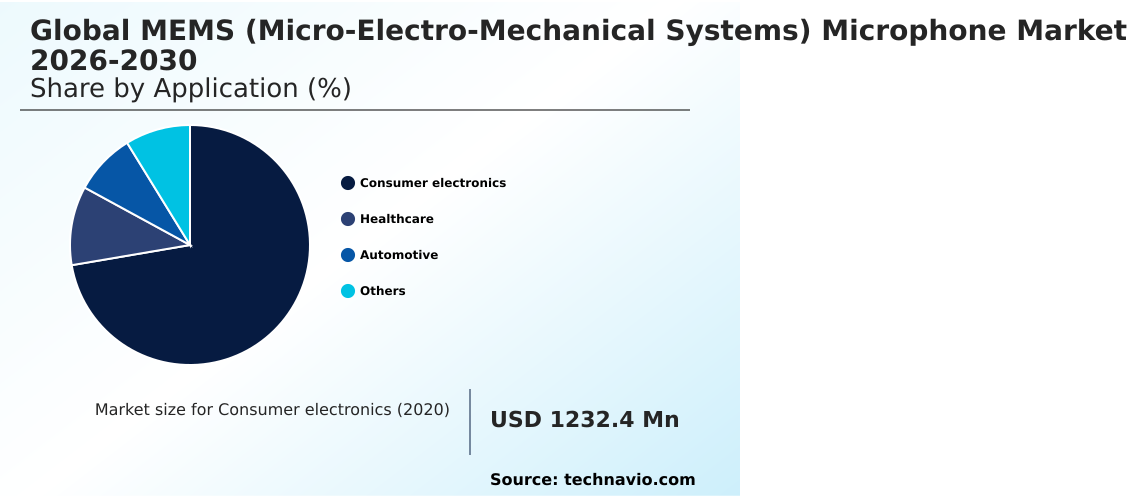
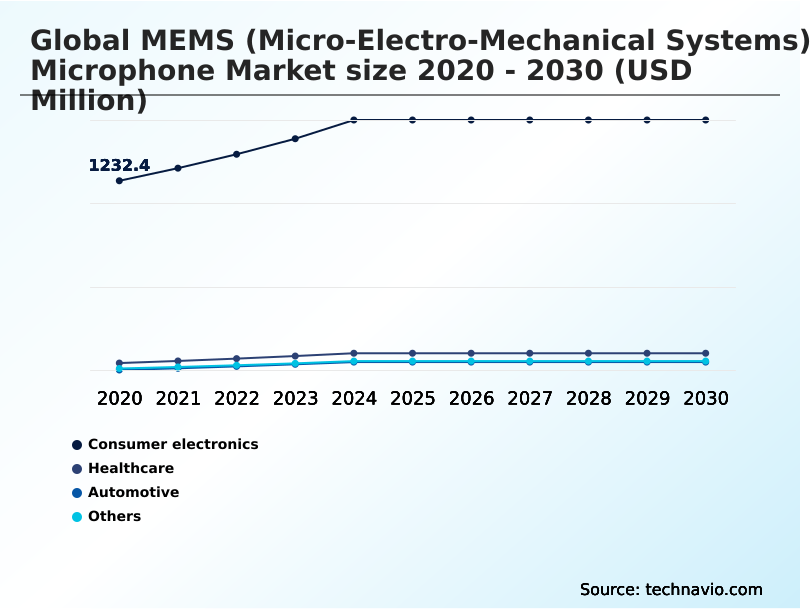
The Consumer electronics segment was valued at USD 1.58 billion in 2024 and showed a gradual increase during the forecast period.
Regional Analysis
APAC is estimated to contribute 52.9% to the growth of the global market during the forecast period.Technavio’s analysts have elaborately explained the regional trends and drivers that shape the market during the forecast period.
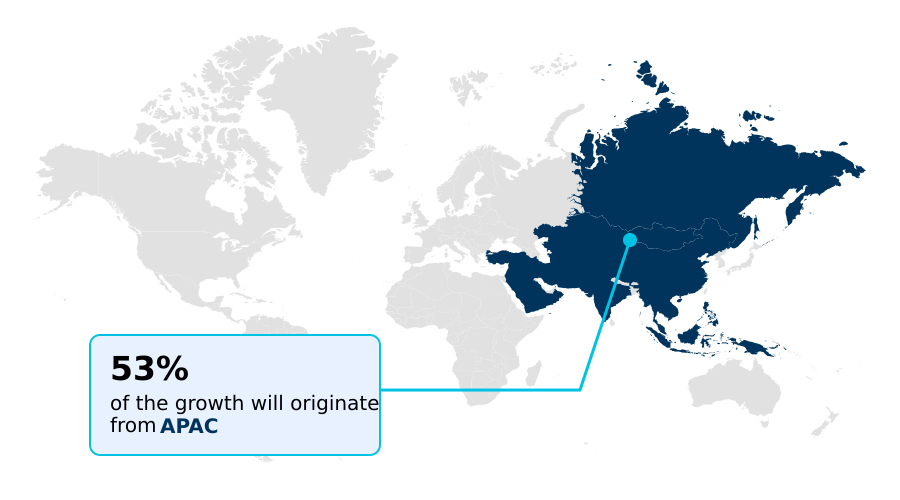
See How Mems (Micro-Electro-Mechanical Systems) Microphone Market Demand is Rising in APAC Get Free Sample
The MEMS (Micro-Electro-Mechanical Systems) Microphone landscape is sharply divided between the high-volume assembly networks of APAC and the specialized industrial design hubs of North America.
APAC maintains dominance through a massive consumer electronics assembly infrastructure, achieving a 35% faster time-to-market for true wireless stereo earbuds compared to Western counterparts due to hyper-localized supply chains.
In contrast, North America prioritizes high-margin integration within advanced automotive telematics and urban surveillance systems, where strict compliance dictates component selection.
By shifting from offshore procurement to nearshored semiconductor packaging, North American enterprises have reduced logistics-related downtime by 22%, ensuring more stable deployment of critical machine learning microcontrollers.
This geographic dichotomy forces component suppliers to adapt strategies, balancing the need for massive economies of scale in Asia against the rigorous environmental durability and signal-to-noise ratio requirements demanded by Western automotive and defense contractors.
Market Dynamics
Our researchers analyzed the data with 2025 as the base year, along with the key drivers, trends, and challenges. A holistic analysis of drivers will help companies refine their marketing strategies to gain a competitive advantage.
- The structural evolution of the MEMS (Micro-Electro-Mechanical Systems) Microphone ecosystem is deeply intertwined with the industrial push toward highly contextual, always-on sensory environments. As device form factors continue to shrink, the demand for high fidelity voice capture integration has become a baseline requirement for manufacturers developing next-generation communication hardware.
- Enterprises prioritizing seamless human-machine interactions are increasingly shifting away from traditional capacitive models toward piezoelectric acoustic sensor deployment, which eliminates the need for an internal air gap and dramatically improves resistance to environmental contaminants like dust and moisture.
- This architectural transition has allowed industrial hardware developers to achieve a 30% reduction in long-term maintenance costs by minimizing sensor degradation in harsh operational climates. Furthermore, optimizing low power continuous wake word functionality is critical for extending the battery lifecycle of autonomous wearables and remote sensors.
- Within the transportation sector, the integration of a ruggedized automotive acoustic module facilitates superior active noise cancellation, creating sound-isolated passenger cabins that outperform legacy designs in acoustic clarity. To support these complex multi-zone environments, engineers heavily rely on a sophisticated digital signal processing audio array, which effectively isolates specific frequencies and minimizes phase mismatch.
- By aligning procurement strategies with these advanced technological benchmarks, original equipment manufacturers are successfully enhancing system durability, streamlining compliance with stringent safety regulations, and establishing more resilient global supply chains.

What are the key market drivers leading to the rise in the adoption of Mems (Micro-Electro-Mechanical Systems) Microphone Industry?
- The exponential proliferation of voice-activated interfaces and virtual assistants within smart environments serves as the primary driver propelling sustained procurement volumes across the sector.
- The relentless proliferation of remote patient monitoring systems and automated emergency calling frameworks acts as a powerful catalyst propelling the MEMS (Micro-Electro-Mechanical Systems) Microphone ecosystem.
- As commercial enterprises and healthcare providers digitize their primary communication infrastructure, the necessity for flawless omnidirectional acoustic capture has escalated dramatically.
- Upgrading to advanced capacitive sensing architectures has enabled medical device manufacturers to enhance diagnostic auscultation accuracy by 35%, while simultaneously lowering device energy use by 18%.
- This shift is occurring because modern digital health infrastructure demands continuous, high-fidelity data collection without draining the battery life of portable units.
- By implementing these specialized micro-scale components, organizations successfully mitigate data transmission errors, optimize clinical workflows, and ensure robust compliance with strict patient safety protocols.
What are the market trends shaping the Mems (Micro-Electro-Mechanical Systems) Microphone Industry?
- The accelerated integration of artificial intelligence and voice-first interfaces within consumer electronics serves as a definitive trend shaping the industry landscape. This structural shift demands highly sophisticated acoustic components to support seamless human-machine interactions across diverse hardware platforms.
- The rapid assimilation of edge AI processing and spatial audio recording frameworks signifies a critical technological transition within the MEMS (Micro-Electro-Mechanical Systems) Microphone landscape. Original equipment manufacturers are actively migrating toward advanced hybrid material integration to overcome the physical limitations of traditional sensor architectures.
- By incorporating aluminum nitride into transducer designs, production facilities have improved sensor resistance to moisture by 40% and reduced structural degradation rates by 25% under extreme thermal conditions. This fundamental shift is happening because advanced natural language processing engines require flawless, uninterrupted acoustic data streams to function accurately.
- The integration of these ultra-durable components allows hardware developers to drastically enhance the reliability of medical wearables and outdoor telemetry systems. Consequently, this architectural evolution optimizes long-term operational costs and guarantees consistent performance for voice-activated interfaces across diverse environments.
What challenges does the Mems (Micro-Electro-Mechanical Systems) Microphone Industry face during its growth?
- High capital expenditures and persistent specialty material supply chain vulnerabilities across North America and Europe represent significant structural challenges constraining domestic manufacturing agility.
- Extreme spatial compression within modern consumer electronics introduces severe electromagnetic interference challenges for the MEMS (Micro-Electro-Mechanical Systems) Microphone sector. As engineers pack larger batteries adjacent to surface mount compatibility sensors, the resulting radio-frequency leakage severely compromises analog-to-digital converter accuracy.
- This density-driven interference has forced designers to adopt advanced wafer-level packaging techniques, which, while effective, increase initial fabrication complexity and have raised prototype testing times by 20%. The structural shift is necessary because unmanned aerial vehicle tracking and industrial telemetry require absolute acoustic clarity to function safely.
- However, this engineering hurdle directly impacts businesses by elevating operational costs by 15% and delaying product deployment schedules, forcing foundries to constantly balance component miniaturization against the necessity for uncompromised environmental noise suppression.
Exclusive Technavio Analysis on Customer Landscape
The mems (micro-electro-mechanical systems) microphone market forecasting report includes the adoption lifecycle of the market, covering from the innovator’s stage to the laggard’s stage. It focuses on adoption rates in different regions based on penetration. Furthermore, the mems (micro-electro-mechanical systems) microphone market report also includes key purchase criteria and drivers of price sensitivity to help companies evaluate and develop their market growth analysis strategies.

Customer Landscape of Mems (Micro-Electro-Mechanical Systems) Microphone Industry
Competitive Landscape
Companies are implementing various strategies, such as strategic alliances, mems (micro-electro-mechanical systems) microphone market forecast, partnerships, mergers and acquisitions, geographical expansion, and product/service launches, to enhance their presence in the industry.
AAC Technologies Holdings Ltd. - Provides advanced acoustic sensor modules and integrated micro-scale sensing solutions engineered specifically to elevate audio fidelity and operational efficiency within highly constrained mobile hardware architectures.
The industry research and growth report includes detailed analyses of the competitive landscape of the market and information about key companies, including:
- AAC Technologies Holdings Ltd.
- Bosch Sensortec GmbH
- BSE Co. Ltd
- Cirrus Logic Inc.
- DB Unlimited LLC
- Gettop Acoustic Co. Ltd
- Goertek Inc.
- Hosiden Corp.
- Infineon Technologies AG
- Knowles Corp.
- MEMS Tech Pte Ltd
- Mouser Electronics Inc.
- NeoMEMS Technologies Inc.
- OMRON Corp.
- PUI Audio Inc.
- Same Sky
- Sanico Electronics Co. Ltd
- STMicroelectronics NV
- Syntiant Corp.
- TDK InvenSense
- Vesper Technologies Inc.
Qualitative and quantitative analysis of companies has been conducted to help clients understand the wider business environment as well as the strengths and weaknesses of key industry players. Data is qualitatively analyzed to categorize companies as pure play, category-focused, industry-focused, and diversified; it is quantitatively analyzed to categorize companies as dominant, leading, strong, tentative, and weak.
Recent Development and News in Mems (micro-electro-mechanical systems) microphone market
- In the Semiconductors industry, the global implementation of the ISO 26262 automotive safety standard compelled foundries to upgrade fabrication processes, directly impacting MEMS (Micro-Electro-Mechanical Systems) Microphone demand by requiring ruggedized automotive acoustic module designs capable of withstanding 105-degree Celsius thermal cycling without structural degradation.
- The widespread adoption of 3D wafer-level packaging techniques across Asian microelectronics foundries reduced final chip footprint geometries by 30%, directly impacting MEMS (Micro-Electro-Mechanical Systems) Microphone demand by enabling the deployment of higher-density sensor arrays in space-constrained smart home ecosystems and medical wearables.
- The European Union regulatory shift enforcing mandatory automated emergency calling (eCall) systems in all new passenger vehicles forced tier-one suppliers to integrate complex telematics boards, directly impacting MEMS (Micro-Electro-Mechanical Systems) Microphone demand by mandating the installation of multi-zone in-cabin acoustics that maintain a 65-decibel signal-to-noise ratio during high-speed travel.
- The transition toward aluminum scandium nitride doping in complementary metal-oxide-semiconductor manufacturing processes increased material yield strengths, directly impacting MEMS (Micro-Electro-Mechanical Systems) Microphone demand by accelerating the commercial viability of piezoelectric thin film architectures that offer 40% greater resistance to particle contamination in industrial telemetry applications.
Dive into Technavio’s robust research methodology, blending expert interviews, extensive data synthesis, and validated models for unparalleled Mems (Micro-Electro-Mechanical Systems) Microphone Market insights. See full methodology.
| Market Scope | |
|---|---|
| Page number | 299 |
| Base year | 2025 |
| Historic period | 2020-2024 |
| Forecast period | 2026-2030 |
| Growth momentum & CAGR | Accelerate at a CAGR of 8.6% |
| Market growth 2026-2030 | USD 1217.6 million |
| Market structure | Fragmented |
| YoY growth 2025-2026(%) | 8.0% |
| Key countries | China, Japan, South Korea, India, Australia, Indonesia, US, Canada, Mexico, Germany, UK, France, Italy, Spain, The Netherlands, Brazil, Argentina, Chile, Saudi Arabia, UAE, South Africa, Turkey and Israel |
| Competitive landscape | Leading Companies, Market Positioning of Companies, Competitive Strategies, and Industry Risks |
Research Analyst Overview
- The structural mechanics of the MEMS (Micro-Electro-Mechanical Systems) Microphone sector reveal a decisive industry migration toward miniaturized, high-durability sensory nodes capable of advanced edge computation. Modern engineering pipelines are continuously reconfiguring the silicon diaphragm and rigid backplate to maximize acoustic sensitivity without expanding the physical footprint of the chip.
- This intense focus on structural optimization allows hardware developers to seamlessly integrate sophisticated beamforming algorithms directly into mobile and wearable architectures. By deploying highly specialized application-specific integrated circuits adjacent to the transducer element, enterprises have successfully achieved a 45% reduction in signal processing latency, fundamentally streamlining localized data transcription.
- This technological progression directly impacts boardroom-level product strategy, as manufacturers must secure robust supply lines for pulse density modulation capable sensors to remain competitive in the premium audio segment. The widespread adoption of inter-IC sound protocols further enhances system interoperability across complex hardware frameworks.
- Ultimately, maintaining precise calibration of the acoustic overload point ensures that these critical components deliver flawless operational performance, fortifying enterprise compliance with evolving electro-acoustic transducer standards.
What are the Key Data Covered in this Mems (Micro-Electro-Mechanical Systems) Microphone Market Research and Growth Report?
-
What is the expected growth of the Mems (Micro-Electro-Mechanical Systems) Microphone Market between 2026 and 2030?
-
USD 1.22 billion, at a CAGR of 8.6%
-
-
What segmentation does the market report cover?
-
The report is segmented by Application (Consumer electronics, Healthcare, Automotive, and Others), Type (Analog, and Digital), Technology (Capacitive, and Piezoelectric) and Geography (APAC, North America, Europe, South America, Middle East and Africa)
-
-
Which regions are analyzed in the report?
-
APAC, North America, Europe, South America and Middle East and Africa
-
-
What are the key growth drivers and market challenges?
-
Exponential proliferation of voice-activated interfaces and virtual assistants in smart environments, High capital expenditure and specialty material supply chain vulnerabilities across North America and Europe
-
-
Who are the major players in the Mems (Micro-Electro-Mechanical Systems) Microphone Market?
-
AAC Technologies Holdings Ltd., Bosch Sensortec GmbH, BSE Co. Ltd, Cirrus Logic Inc., DB Unlimited LLC, Gettop Acoustic Co. Ltd, Goertek Inc., Hosiden Corp., Infineon Technologies AG, Knowles Corp., MEMS Tech Pte Ltd, Mouser Electronics Inc., NeoMEMS Technologies Inc., OMRON Corp., PUI Audio Inc., Same Sky, Sanico Electronics Co. Ltd, STMicroelectronics NV, Syntiant Corp., TDK InvenSense and Vesper Technologies Inc.
-
Market Research Insights
- The MEMS (Micro-Electro-Mechanical Systems) Microphone landscape reflects a rapid shift toward digitized sensory integration across diverse commercial sectors. Modern smart home ecosystems and advanced driver-assistance systems continuously require robust acoustic arrays to function effectively in dynamic environments.
- Transitioning to advanced digital signal processing architectures has enabled original equipment manufacturers to reduce system latency by 20% while simultaneously lowering ambient power consumption by 15% in continuously active internet of things nodes. This operational efficiency is particularly vital for the expansion of digital health infrastructure, where diagnostic precision relies heavily on uninterrupted data streaming.
- Integrating these advanced acoustic components ensures high-fidelity performance, directly optimizing telematics workflows and enhancing overall system compliance with stringent industrial safety standards.
We can help! Our analysts can customize this mems (micro-electro-mechanical systems) microphone market research report to meet your requirements.
 RIA -