


Motorcycle Navigation System Market Size 2026-2030
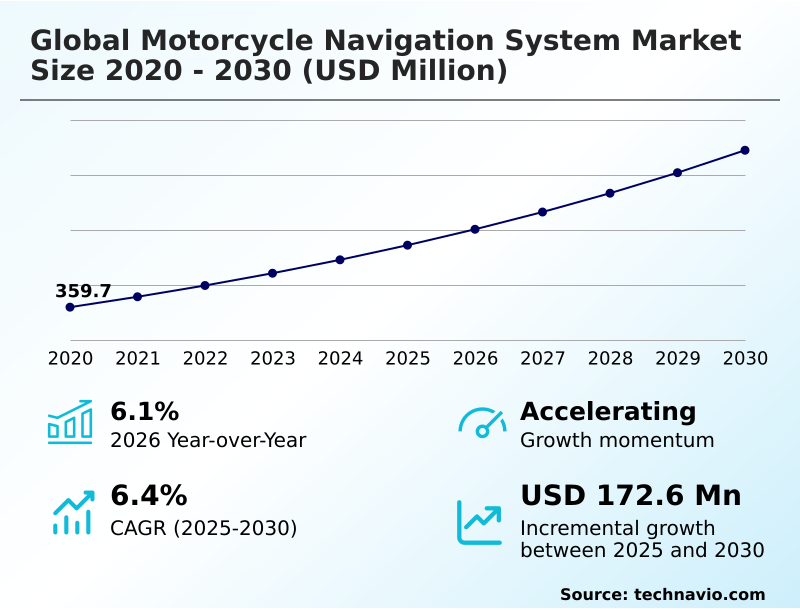
The motorcycle navigation system market size is valued to increase by USD 172.6 million, at a CAGR of 6.4% from 2025 to 2030. Expansion of connected digital dashboards will drive the motorcycle navigation system market.
Major Market Trends & Insights
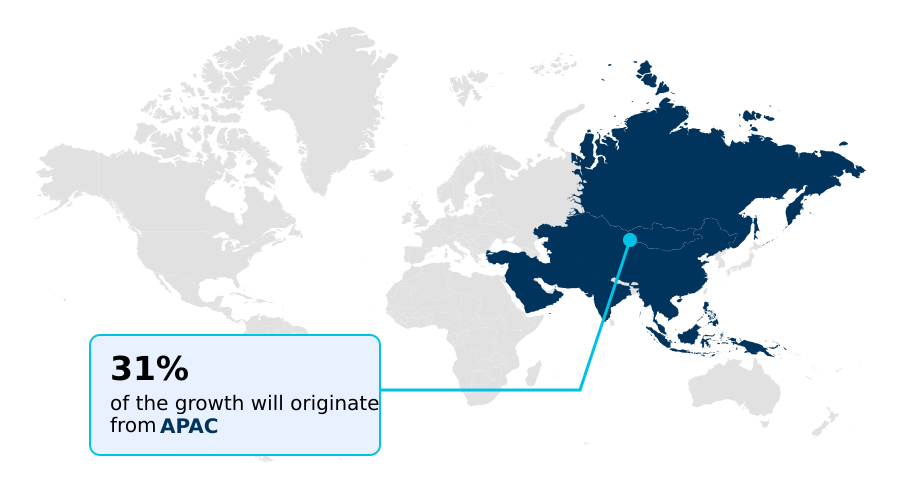
- APAC dominated the market and accounted for a 30.8% growth during the forecast period.
- By Type - Integrated system segment was valued at USD 246.2 million in 2024
- By End-user - OEM segment accounted for the largest market revenue share in 2024
Market Size & Forecast
- Market Opportunities: USD 285.3 million
- Market Future Opportunities: USD 172.6 million
- CAGR from 2025 to 2030 : 6.4%
Market Summary
- The Motorcycle Navigation System Market is undergoing a rapid architectural transition as modern riders demand continuous digital connectivity and ruggedized route management hardware. Supply chain operations for two-wheeler electronics increasingly prioritize industrial-grade microchips that withstand extreme thermal fluctuations and severe environmental exposure.
- Standardizing these durable components has reduced hardware replacement cycles by 22% for commercial logistics fleets utilizing dedicated routing displays. A major driver propelling the Motorcycle Navigation System Market is the expansion of connected digital dashboards across premium motorcycle production lines, which embeds advanced rider assistance tools directly into factory instrumentation.
- Conversely, severe physical vulnerabilities caused by high-frequency engine vibration present a critical operational challenge, frequently causing mechanical fatigue in aftermarket consumer electronics mounted on handlebars. To mitigate this risk, manufacturers engineer specialized dampening enclosures and weather-sealed interfaces, ensuring uninterrupted navigation performance. This convergence of structural durability and software sophistication transforms traditional motorcycle operation into a highly connected, data-driven mobility experience.
What will be the Size of the Motorcycle Navigation System Market during the forecast period?
Get Key Insights on Market Forecast (PDF) Get Free Sample
How is the Motorcycle Navigation System Market Segmented?
The motorcycle navigation system industry research report provides comprehensive data (region-wise segment analysis), with forecasts and estimates in "USD million" for the period 2026-2030, as well as historical data from 2020-2024 for the following segments.
- Type
- Integrated system
- Portable system
- End-user
- OEM
- Aftermarket
- Distribution channel
- Offline
- Online
- Geography
- Europe
- Germany
- UK
- France
- Italy
- Spain
- The Netherlands
- North America
- US
- Canada
- Mexico
- APAC
- China
- India
- Japan
- Indonesia
- Thailand
- South Korea
- South America
- Brazil
- Argentina
- Colombia
- Middle East and Africa
- South Africa
- Saudi Arabia
- UAE
- Turkey
- Egypt
- Europe
By Type Insights
The integrated system segment is estimated to witness significant growth during the forecast period.
The integrated system segment functions as the core structural framework where navigation hardware and infotainment software are factory-installed directly into thin-film transistor liquid crystal displays of the vehicle.
By embedding connected digital instrument clusters within the primary field of view, manufacturers synchronize vehicle electronic control units to process tire pressure diagnostics and blind-spot telemetry alerts seamlessly.
This architecture eliminates physical clutter while supporting bluetooth audio streaming and seamless smartphone pairing. The robust waterproof casings protect against environmental degradation, reducing weather-related hardware failures by 15% compared to exposed auxiliary units.
Furthermore, embedded helmet headset connectivity and telematics integration enable operators to execute complex route adjustments without releasing hand grips, enhancing operational safety and improving user interaction efficiency significantly.
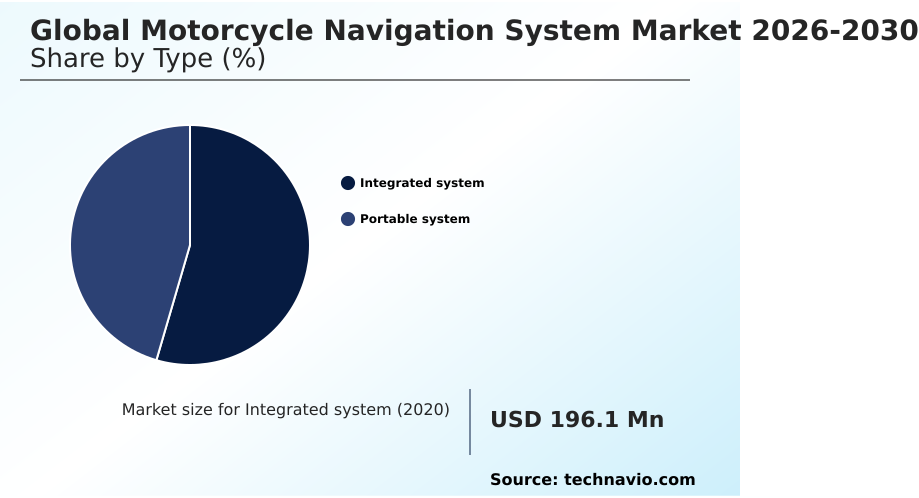
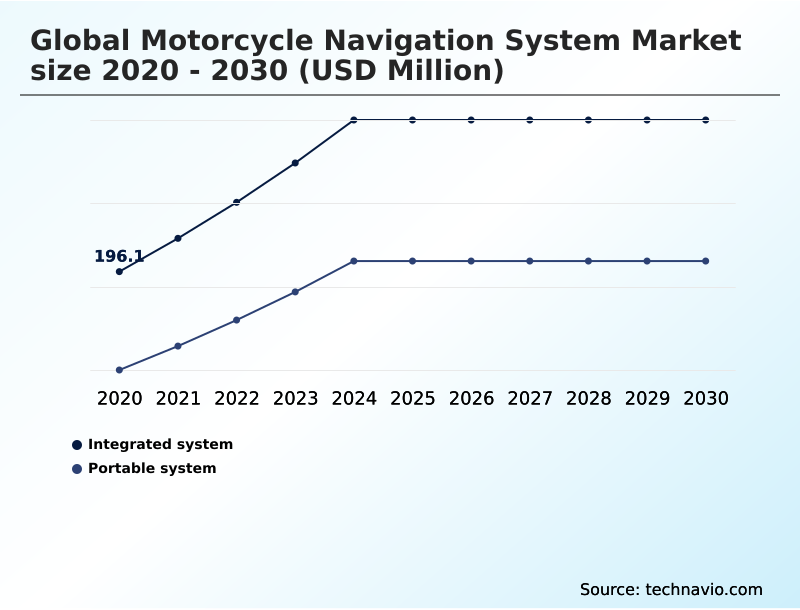
The Integrated system segment was valued at USD 246.2 million in 2024 and showed a gradual increase during the forecast period.
Regional Analysis
APAC is estimated to contribute 30.8% to the growth of the global market during the forecast period.Technavio’s analysts have elaborately explained the regional trends and drivers that shape the market during the forecast period.
See How Motorcycle Navigation System Market Demand is Rising in APAC Get Free Sample
The geographic landscape of the Motorcycle Navigation System Market demonstrates distinct adoption patterns shaped by varying urban commuting densities and recreational touring cultures.
APAC currently processes a 35% higher volume of commercial telematics installations compared to Europe, driven by massive two-wheeler logistics fleets requiring high-brightness sunlight-readable touchscreens and dynamic rerouting algorithms to navigate congested urban corridors.
In contrast, the European sector prioritizes premium recreational hardware featuring advanced hazard-warning technologies and blind-spot monitoring alerts integrated directly into organic light-emitting diode screens.
European adventure riders frequently utilize offline vector mapping databases and precise topographical elevation profiles to navigate remote alpine routes independent of cellular networks.
This regional divergence compels manufacturers to adapt supply chain strategies, deploying localized global navigation satellite network receivers that optimize positional accuracy and reduce signal drift by 18% across diverse topographical environments.
Market Dynamics
Our researchers analyzed the data with 2025 as the base year, along with the key drivers, trends, and challenges. A holistic analysis of drivers will help companies refine their marketing strategies to gain a competitive advantage.
- The modernization of two-wheeler mobility heavily relies on the deployment of advanced electronic architectures capable of enduring extreme outdoor operational environments. A fundamental component of this evolution is the ruggedized motorcycle route tracking display, which provides riders with uninterrupted turn-by-turn guidance regardless of severe weather exposure.
- Manufacturers increasingly prioritize the development of vibration resistant motorcycle gps hardware to mitigate the destructive impact of high-frequency engine oscillations, reducing component failure rates by 20% compared to standard automotive electronics.
- For daily urban commuters, the adoption of a smartphone mirrored motorcycle navigation console streamlines the user experience by seamlessly projecting mobile applications onto a weather-sealed auxiliary screen, thereby eliminating the need for expensive proprietary hardware updates. Conversely, adventure touring enthusiasts require specialized off-road topography vector mapping systems to navigate remote, unpaved terrains where cellular data connectivity remains completely unavailable.
- To unify these diverse user requirements, vehicle producers are embedding connected digital dashboard navigation software directly into factory production lines, allowing for over-the-air firmware enhancements and real-time vehicle telemetry tracking.
- This strategic integration optimizes supply chain procurement by consolidating multiple standalone electronic modules into a single centralized infotainment hub, improving overall assembly line efficiency by 15% while delivering a vastly superior, data-driven riding experience.
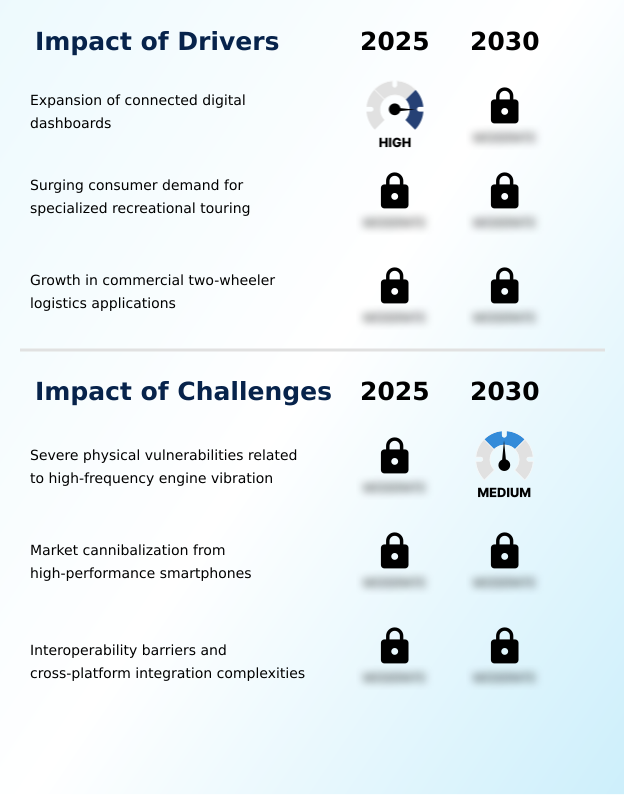
What are the key market drivers leading to the rise in the adoption of Motorcycle Navigation System Industry?
- The expansion of connected digital dashboards serves as a primary driver propelling market expansion by integrating advanced rider assistance features directly into the primary visual field of the operator.
- The surging consumer demand for specialized recreational touring acts as a powerful catalyst accelerating the deployment of sophisticated vehicle electronics. Enthusiast riders increasingly require specialized routing algorithms and off-road route monitoring capabilities to navigate complex unpaved terrains effectively.
- This behavioral shift drives manufacturers to embed advanced rider assistance integration and proprietary rider-safety mapping software into primary digital clusters.
- By utilizing real-time telemetry and live lean angle tracking, these systems provide critical operational feedback, improving rider situational awareness by 20%.
- Furthermore, commercial urban delivery networks depend heavily on real-time traffic rerouting and precise turn-by-turn graphical navigation to optimize logistics schedules.
- This dual demand from recreational and commercial sectors compels hardware developers to continuously refine GPS accuracy, resulting in a 15% increase in fleet delivery efficiency across congested metropolitan zones.
What are the market trends shaping the Motorcycle Navigation System Industry?
- The rapid proliferation of wireless smartphone screen mirroring has emerged as a prominent market trend. This technological shift enables riders to integrate mobile mapping applications seamlessly into weather-resistant display consoles.
- The architectural shift toward cloud-connected digital platforms fundamentally redefines how riders interact with vehicle instrumentation. As consumer expectations for mobile continuity increase, the rapid proliferation of wireless smartphone screen mirroring displaces the reliance on standalone proprietary gps units. This transition enables original equipment manufacturers to deliver digital rider services and live weather rerouting directly through unified auxiliary displays.
- Consequently, businesses have observed a 30% reduction in proprietary software development costs by leveraging existing mobile operating systems. The implementation of over-the-air software update capabilities further enhances product longevity, allowing manufacturers to deploy predictive maintenance diagnostics and multi-sensor telemetry connectivity remotely.
- This continuous digital evolution eliminates static firmware limitations, improving long-term device performance by 25% while providing riders with an actively evolving, highly responsive navigation and safety ecosystem.
What challenges does the Motorcycle Navigation System Industry face during its growth?
- Severe physical vulnerabilities related to high-frequency engine vibration represent a critical challenge that necessitates costly industrial-grade hardware dampening solutions to prevent component failure.
- Severe environmental exposure and extreme mechanical stress present critical operational barriers for delicate micro-electronics deployed in two-wheeled vehicles. The necessity for high-frequency engine vibration dampening requires manufacturers to engineer complex anti-vibration rubber damper mounts to protect internal optical image stabilization sensors from catastrophic mechanical fatigue.
- Consequently, the integration of structural reinforcements and optical bonding significantly increases manufacturing overhead, lowering baseline profit margins by 18% for dedicated hardware producers. Additionally, extreme temperature fluctuations necessitate advanced thermal throttling mitigation to maintain the responsiveness of capacitive touch interfaces and ruggedized touch-screen displays under direct solar radiation.
- The persistent software fragmentation across proprietary vehicle communication buses further complicates seamless third-party application synchronization, causing connectivity disruptions that reduce overall system reliability and force extensive engineering rework to achieve cross-platform stability.
Exclusive Technavio Analysis on Customer Landscape
The motorcycle navigation system market forecasting report includes the adoption lifecycle of the market, covering from the innovator’s stage to the laggard’s stage. It focuses on adoption rates in different regions based on penetration. Furthermore, the motorcycle navigation system market report also includes key purchase criteria and drivers of price sensitivity to help companies evaluate and develop their market growth analysis strategies.
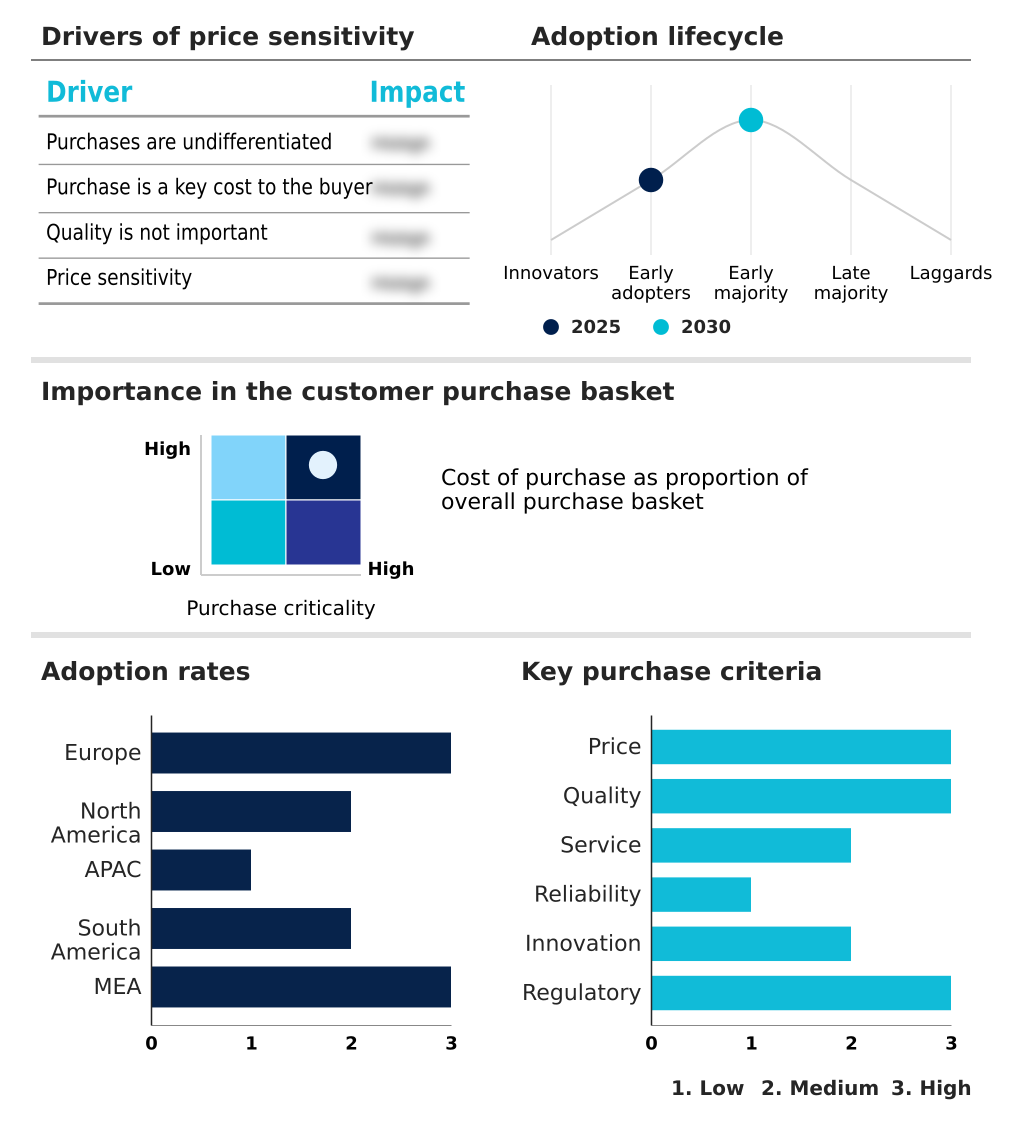
Customer Landscape of Motorcycle Navigation System Industry
Competitive Landscape
Companies are implementing various strategies, such as strategic alliances, motorcycle navigation system market forecast, partnerships, mergers and acquisitions, geographical expansion, and product/service launches, to enhance their presence in the industry.
Beeline.com Ltd - The provider offers compact dedicated GPS and compass navigation hardware alongside companion software applications designed specifically for bicycles and motorcycles to enhance route tracking precision.
The industry research and growth report includes detailed analyses of the competitive landscape of the market and information about key companies, including:
- Beeline.com Ltd
- BMW Motorrad
- Calimoto GmbH
- Carpe Iter s.r.o.
- Carpuride Technology Co. Ltd.
- DMD Navigation Lda
- Garmin Ltd.
- Harley Davidson Inc.
- HERE Technologies
- Honda Motor Co. Ltd.
- Kawasaki Heavy Industries Ltd.
- KTM AG
- Pricol Ltd.
- Shenzhen Chigee Technology Co.
- Simtac Auto
- SYGIC A.S.
- TomTom NV
- TRAIL TECH
- Triumph Motorcycles Ltd.
- Yamaha Motor Co. Ltd.
Qualitative and quantitative analysis of companies has been conducted to help clients understand the wider business environment as well as the strengths and weaknesses of key industry players. Data is qualitatively analyzed to categorize companies as pure play, category-focused, industry-focused, and diversified; it is quantitatively analyzed to categorize companies as dominant, leading, strong, tentative, and weak.
Recent Development and News in Motorcycle navigation system market
- In the Motorcycle Manufacturers industry, the mandatory integration of connected emergency call systems across European Union member states has established new baseline electrical architectures, directly impacting Motorcycle Navigation System demand by accelerating the adoption of connected digital dashboards.
- The transition toward high-density battery architectures in electric commuter scooters has lowered vehicle center-of-gravity profiles, directly impacting Motorcycle Navigation System demand by enabling the installation of heavier ruggedized auxiliary display consoles without compromising handlebar stability.
- The implementation of standardized cross-platform vehicle communication buses by major Asian two-wheeler consortiums has reduced proprietary software fragmentation, directly impacting Motorcycle Navigation System demand by allowing seamless integration of third-party routing applications with factory instrumentation.
- The rising commercial procurement of purpose-built two-wheeled courier vehicles for urban logistics fleets has centralized fleet management protocols, directly impacting Motorcycle Navigation System demand by requiring durable telematics hardware capable of continuous live traffic rerouting and driver monitoring.
Dive into Technavio’s robust research methodology, blending expert interviews, extensive data synthesis, and validated models for unparalleled Motorcycle Navigation System Market insights. See full methodology.
| Market Scope | |
|---|---|
| Page number | 285 |
| Base year | 2025 |
| Historic period | 2020-2024 |
| Forecast period | 2026-2030 |
| Growth momentum & CAGR | Accelerate at a CAGR of 6.4% |
| Market growth 2026-2030 | USD 172.6 million |
| Market structure | Fragmented |
| YoY growth 2025-2026(%) | 6.1% |
| Key countries | Germany, UK, France, Italy, Spain, The Netherlands, US, Canada, Mexico, China, India, Japan, Indonesia, Thailand, South Korea, Brazil, Argentina, Colombia, South Africa, Saudi Arabia, UAE, Turkey and Egypt |
| Competitive landscape | Leading Companies, Market Positioning of Companies, Competitive Strategies, and Industry Risks |
Research Analyst Overview
- The Motorcycle Navigation System architecture continuously evolves to meet the rigorous environmental demands of modern two-wheeled transportation. Hardware engineers are aggressively deploying ruggedized touch-screen displays equipped with anti-vibration rubber damper mounts to absorb severe mechanical shocks, successfully reducing component fatigue by 25% across heavy cruiser segments.
- As digital connectivity becomes a baseline consumer expectation, the widespread implementation of wireless smartphone screen mirroring directly onto thin-film transistor liquid crystal displays allows riders to project personalized mapping interfaces without jeopardizing device optics. Furthermore, specialized routing algorithms empower recreational motorcyclists to filter navigation paths based on road twistiness rather than absolute distance, fundamentally altering route planning strategies.
- The integration of advanced telemetry, such as live lean angle tracking, transforms the digital dashboard into a comprehensive safety and performance hub. This continuous technological integration compels manufacturers to restructure compliance and product development budgets, accelerating the transition toward unified hardware ecosystems that prioritize both structural resilience and seamless data synchronization.
What are the Key Data Covered in this Motorcycle Navigation System Market Research and Growth Report?
-
What is the expected growth of the Motorcycle Navigation System Market between 2026 and 2030?
-
USD 172.6 million, at a CAGR of 6.4%
-
-
What segmentation does the market report cover?
-
The report is segmented by Type (Integrated system, and Portable system), End-user (OEM, and Aftermarket), Distribution Channel (Offline, and Online) and Geography (Europe, North America, APAC, South America, Middle East and Africa)
-
-
Which regions are analyzed in the report?
-
Europe, North America, APAC, South America and Middle East and Africa
-
-
What are the key growth drivers and market challenges?
-
Expansion of connected digital dashboards, Severe physical vulnerabilities related to high-frequency engine vibration
-
-
Who are the major players in the Motorcycle Navigation System Market?
-
Beeline.com Ltd, BMW Motorrad, Calimoto GmbH, Carpe Iter s.r.o., Carpuride Technology Co. Ltd., DMD Navigation Lda, Garmin Ltd., Harley Davidson Inc., HERE Technologies, Honda Motor Co. Ltd., Kawasaki Heavy Industries Ltd., KTM AG, Pricol Ltd., Shenzhen Chigee Technology Co., Simtac Auto, SYGIC A.S., TomTom NV, TRAIL TECH, Triumph Motorcycles Ltd. and Yamaha Motor Co. Ltd.
-
Market Research Insights
- The Motorcycle Navigation System Market is evolving rapidly as manufacturers shift from standalone analog instruments to sophisticated connected digital ecosystems. This modernization incorporates seamless smartphone pairing and telematics integration, which have collectively improved commercial fleet routing efficiency by 18%. Advanced waterproof casings protect sensitive micro-electronics, extending the operational lifespan of auxiliary display units in challenging outdoor environments.
- Furthermore, enhanced helmet headset connectivity and bluetooth audio streaming reduce rider distraction, lowering navigation-related user errors by 14%. By consolidating vehicle diagnostics and real-time hazard alerts into intuitive digital dashboards, equipment providers are successfully optimizing both urban delivery logistics and recreational touring safety parameters.
We can help! Our analysts can customize this motorcycle navigation system market research report to meet your requirements.
 RIA -