


Online Education Market Size 2026-2030
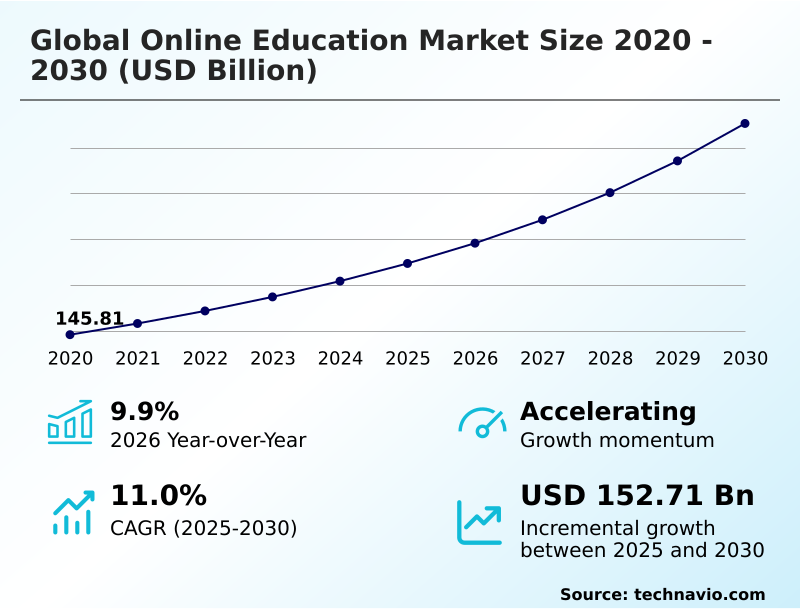
The online education market size is valued to increase by USD 152.71 billion, at a CAGR of 11% from 2025 to 2030. Strategic imperative of workforce upskilling and enterprise reskilling will drive the online education market.
Major Market Trends & Insights
- North America dominated the market and accounted for a 35.5% growth during the forecast period.
- By Application - PSSE segment was valued at USD 64.96 billion in 2024
- By End-user - Academic segment accounted for the largest market revenue share in 2024
Market Size & Forecast
- Market Opportunities: USD 230.42 billion
- Market Future Opportunities: USD 152.71 billion
- CAGR from 2025 to 2030 : 11%
Market Summary
- The Online Education Market demonstrates robust structural transformation driven by the integration of cloud-based learning infrastructure and real-time analytical evaluation systems. Multinational enterprise organizations consistently deploy digital curriculum delivery to modernize talent development pipelines and maintain regulatory alignment.
- By transitioning from physical seminars to centralized corporate upskilling modules, human resources departments reduce instructional travel overhead by 45% while enabling continuous employee capability tracking. The primary catalyst accelerating this transition is the strategic imperative of workforce reskilling, which compels companies to bridge acute technical competency gaps efficiently.
- Conversely, the industry faces severe structural limitations regarding persistent student dropout prediction bottlenecks, where cognitive fatigue in asynchronous environments severely dampens long-term retention. To combat these isolation barriers, instructional providers are heavily investing in spaced repetition mechanics and interactive feedback loops.
- These targeted remediation efforts ensure that digital certifications retain their professional credibility within highly competitive labor environments, continuously evolving the standard for decentralized skill acquisition.
What will be the Size of the Online Education Market during the forecast period?
Get Key Insights on Market Forecast (PDF) Get Free Sample
How is the Online Education Market Segmented?
The online education industry research report provides comprehensive data (region-wise segment analysis), with forecasts and estimates in "USD million" for the period 2026-2030, as well as historical data from 2020-2024 for the following segments.
- Application
- PSSE
- ROC
- Higher education
- Test preparation
- LCL
- End-user
- Academic
- Corporate
- Government
- Type
- Custom E-learning
- Responsive E-learning
- Micro E-learning
- Translation and localization
- Others
- Geography
- North America
- US
- Canada
- Mexico
- APAC
- China
- India
- Japan
- South Korea
- Australia
- Indonesia
- Europe
- Germany
- UK
- France
- Italy
- Spain
- The Netherlands
- South America
- Brazil
- Argentina
- Chile
- Middle East and Africa
- Saudi Arabia
- UAE
- South Africa
- Israel
- Turkey
- North America
By Application Insights
The psse segment is estimated to witness significant growth during the forecast period.
The Primary, Secondary, and Supplemental Education segment drives structural modernization across educational infrastructure by permanently integrating cloud-based content repositories into core curricula.
Digitally supported platforms establish critical flexibility, allowing for the deployment of generative artificial intelligence tutors that cater to varying cognitive paces. Institutions overcome acute instructional shortages by enabling centralized massive open online courses and real-time comprehension monitoring frameworks.
Modern implementations rely heavily on interactive scenario branching to track progress dynamically and adjust complex instructional narratives. Furthermore, the integration of blockchain credential verification guarantees academic authenticity, aligning directly with emerging credential interoperability standards.
Consequently, districts deploying these advanced vocational reskilling paths have seen intervention response times improve by 40% compared to traditional manual evaluations.
As connectivity expands, primary digital instruction continues to transition from a contingent tool into an essential, standardized component of modern academic frameworks.
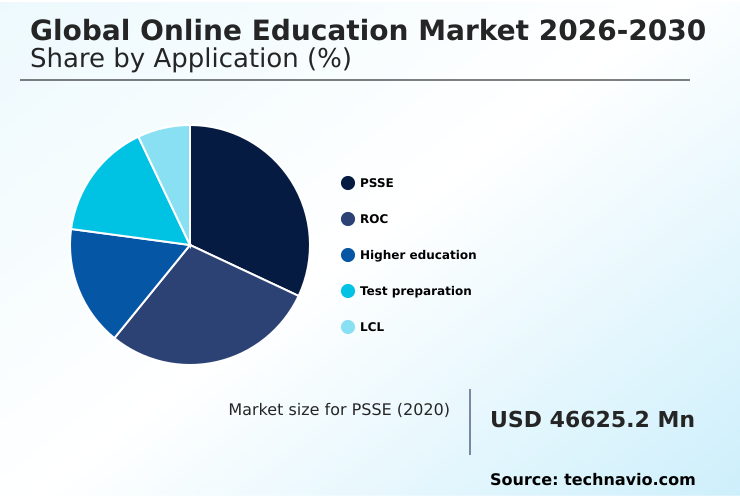
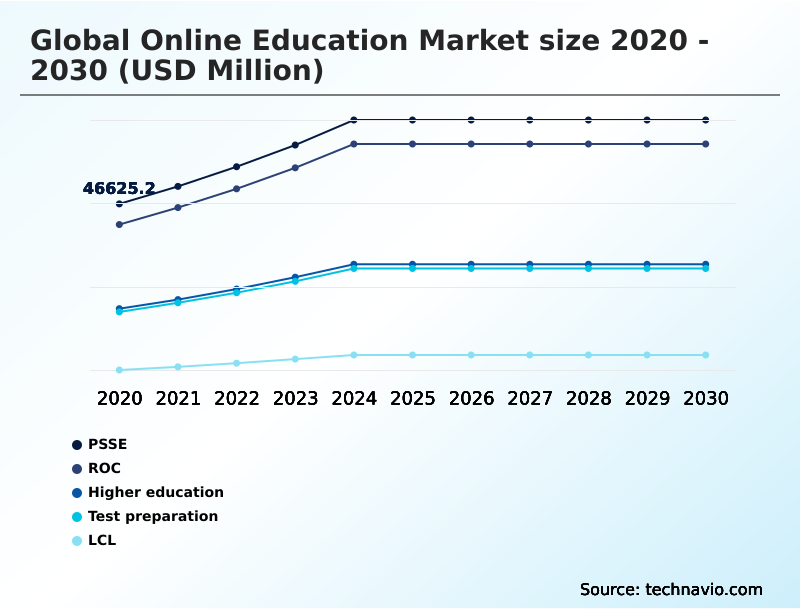
The PSSE segment was valued at USD 64.96 billion in 2024 and showed a gradual increase during the forecast period.
Regional Analysis
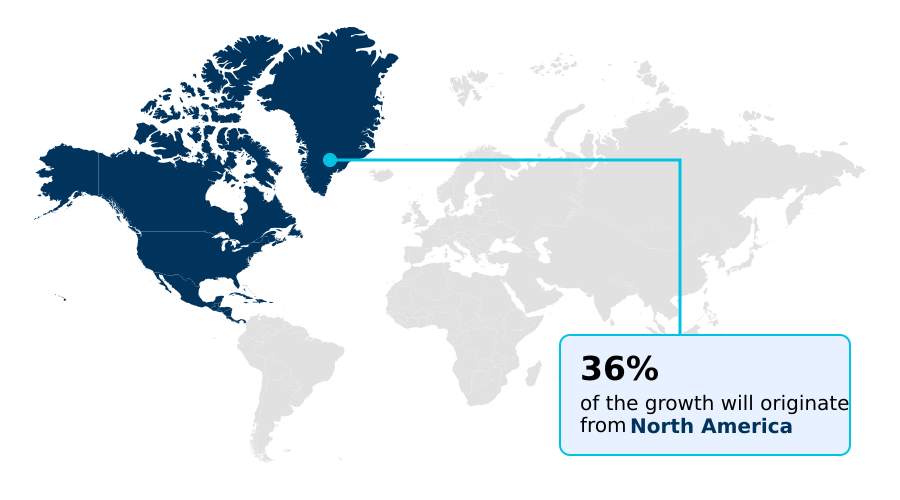
North America is estimated to contribute 35.5% to the growth of the global market during the forecast period.Technavio’s analysts have elaborately explained the regional trends and drivers that shape the market during the forecast period.
See How Online Education Market Demand is Rising in North America Get Free Sample
Regional adoption within the Online Education Market exhibits distinct structural variations driven by underlying digital infrastructure and enterprise workforce demands.
North America leads the transition, where widespread integration of learning management systems and adaptive learning algorithms has improved corporate training efficiencies by 35%.
Conversely, the APAC region relies heavily on mobile-first instructional design to overcome decentralized broadband limitations, resulting in a 40% higher adoption rate of hybrid degree models compared to European markets.
Furthermore, APAC authorities utilize neural machine translation and localized cultural adaptation to expand rural access, increasing participation in stackable professional diplomas by 28%.
While North American institutions prioritize cross-border academic federations to maximize revenue, Asian platform developers leverage multi-lingual auto-translation and precise student engagement telemetry to capture massive consumer volumes.
These distinct geographic strategies dictate how global educational software vendors allocate capital across emerging territories.
Market Dynamics
Our researchers analyzed the data with 2025 as the base year, along with the key drivers, trends, and challenges. A holistic analysis of drivers will help companies refine their marketing strategies to gain a competitive advantage.
- The structural evolution of digital instructional platforms requires seamless technological integration to maintain high fidelity across diverse user demographics. Institutions are actively deploying adaptive learning algorithms for remote student engagement, allowing educational systems to dynamically recalibrate course difficulty based on real-time cognitive responses. This precision routing ensures that learners remain consistently challenged without experiencing overwhelming fatigue.
- Furthermore, the integration of generative artificial intelligence tutors provides scalable, on-demand remedial support, mimicking the nuances of one-on-one human instruction. From a corporate talent development perspective, organizations rely on enterprise micro-credentialing frameworks for workforce upskilling to validate specific technical competencies rapidly.
- By shifting away from protracted degree models toward these targeted skill badges, human resources departments achieve a 40% faster deployment of newly trained personnel into critical operational workflows compared to traditional corporate seminars. To support global enterprise operations, platforms leverage localized cultural adaptation in multi-lingual auto-translation, ensuring that safety compliance and technical training materials resonate accurately across international subsidiaries.
- This linguistic precision minimizes costly misinterpretations on the manufacturing floor. Finally, to track ongoing proficiency, digital platforms utilize continuous micro-assessment engines for diagnostic diagnostic feedback, allowing instructors to isolate precise knowledge gaps before they compound into systemic failures. These integrated mechanisms collectively ensure that remote education delivers rigorous, measurable, and highly resilient academic and professional outcomes.
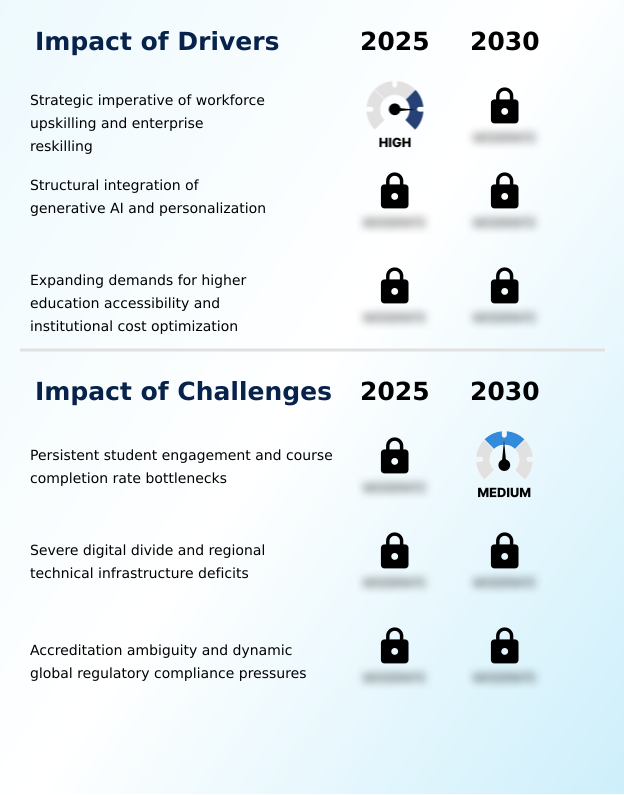
What are the key market drivers leading to the rise in the adoption of Online Education Industry?
- The strategic imperative of workforce upskilling and corporate enterprise reskilling acts as a primary catalyst accelerating the widespread adoption of digital learning platforms.
- The urgent operational necessity for continuous enterprise workforce modernization acts as a primary structural driver propelling digital instructional adoption.
- As rapid industrial automation renders legacy skill sets obsolete, corporate entities aggressively deploy targeted corporate upskilling modules and self-paced certification tracks to maintain competitive output capabilities.
- This strategic shift occurs because relying solely on external hiring to fill acute technical gaps is financially unsustainable.
- By implementing personalized learning pathways alongside gamified skill assessments, human resources divisions have decreased mandatory onboarding durations by 30% while standardizing compliance training frameworks.
- Furthermore, the utilization of predictive performance scoring and advanced competency gap analysis enables management to identify deficiencies before they disrupt workflows.
- Consequently, organizations leveraging robust micro-credentialing frameworks and off-site workforce training solutions report a 22% improvement in enterprise talent retention, ensuring critical roles remain adequately staffed.
What are the market trends shaping the Online Education Industry?
- The expansion of immersive virtual reality campuses represents a prominent structural trend shaping the current industry landscape. This technological integration allows decentralized learners to interact within complex, three-dimensional academic environments.
- The continuous proliferation of spatial computing environments is systematically revolutionizing how remote learners interact with complex spatial data. Educational institutions are transitioning away from passive video formats toward interactive virtual laboratories, enabling engineering cohorts to execute high-fidelity immersive simulation modules. This technological migration occurs because traditional instruction fails to cultivate adequate hands-on technical proficiency.
- By deploying virtual campus avatars, academic platforms foster spontaneous peer-to-peer knowledge sharing, mitigating the cognitive isolation associated with digital coursework. This heightened interactivity, combined with dynamic difficulty adjustment and spaced repetition mechanics, accelerates practical skill acquisition by 25% compared to legacy text-based frameworks.
- These behavioral shifts compel platform developers to continuously refine synchronous video instruction architectures and digital curriculum authoring tools. Furthermore, continuous micro-assessment engines provide educators with immediate insights, lowering voluntary program dropout rates by 18% across intensive technical disciplines.
What challenges does the Online Education Industry face during its growth?
- Persistent bottlenecks in student engagement and chronically low course completion rates present significant operational challenges for digital instructional platforms.
- Severe disparities in global telecommunications infrastructure present persistent structural challenges that severely restrict the equitable expansion of digital instructional frameworks. Students located in rural municipalities frequently lack the high-speed broadband necessary for advanced applications, forcing reliance on asynchronous curriculum delivery.
- Because real-time engagement is compromised, institutions operating in these regions observe a 25% lower baseline in cognitive retention metrics compared to fully connected urban centers. To mitigate these bottlenecks, platform developers struggle to implement sophisticated low-bandwidth optimization protocols without stripping essential instructional fidelity.
- Additionally, the absence of foundational digital literacy acquisition among non-traditional adult learners complicates the seamless deployment of automated essay grading and virtual proctoring software. These structural barriers delay the initiation of vital remedial instruction triggers and diagnostic diagnostic feedback loops, ultimately severely impairing the accuracy of long-term student dropout prediction models.
Exclusive Technavio Analysis on Customer Landscape
The online education market forecasting report includes the adoption lifecycle of the market, covering from the innovator’s stage to the laggard’s stage. It focuses on adoption rates in different regions based on penetration. Furthermore, the online education market report also includes key purchase criteria and drivers of price sensitivity to help companies evaluate and develop their market growth analysis strategies.
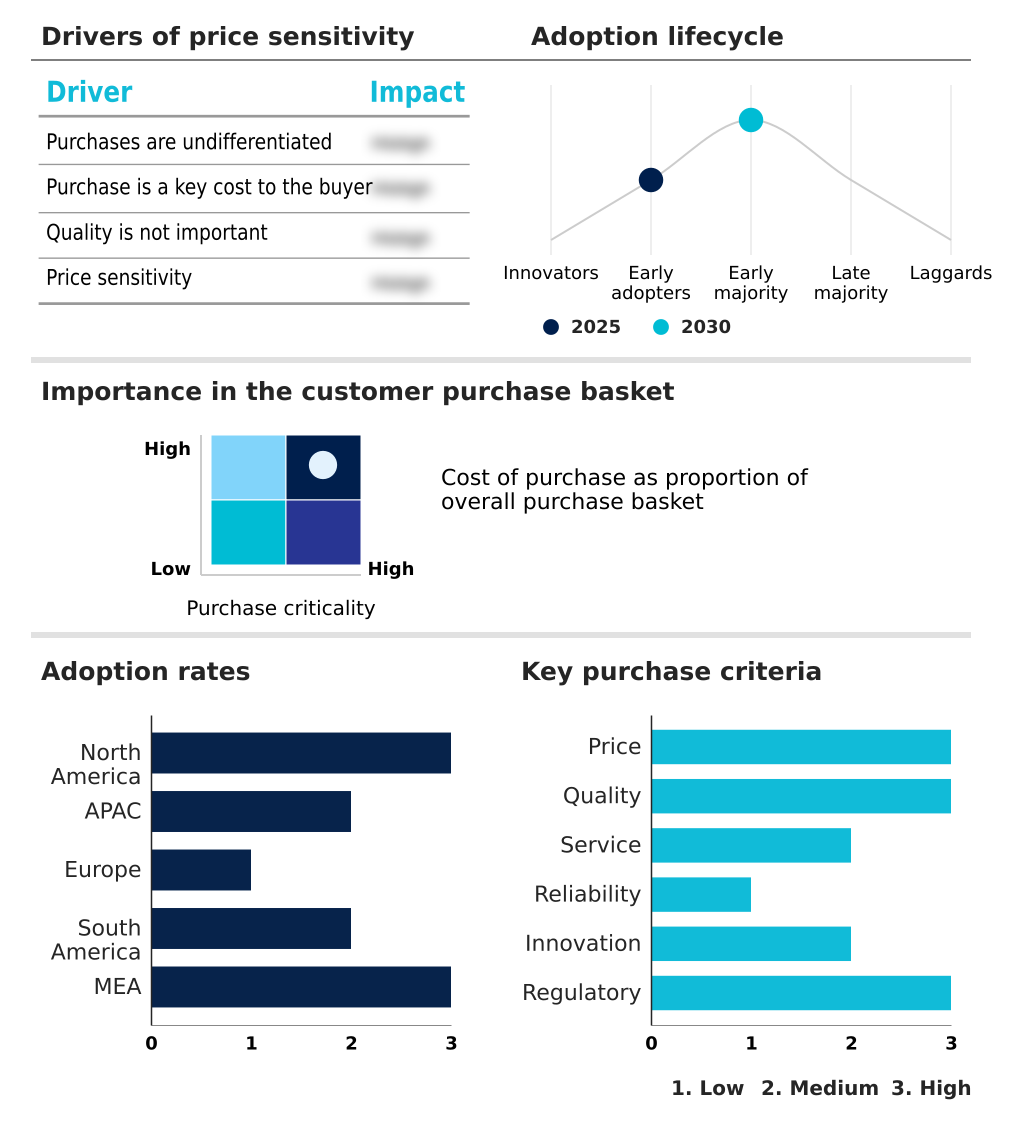
Customer Landscape of Online Education Industry
Competitive Landscape
Companies are implementing various strategies, such as strategic alliances, online education market forecast, partnerships, mergers and acquisitions, geographical expansion, and product/service launches, to enhance their presence in the industry.
Cengage Learning Inc. - The vendor provides comprehensive digital learning platforms, including interactive courseware, assessment tools, and personalized study solutions tailored to enhance academic performance across higher education and professional development sectors.
The industry research and growth report includes detailed analyses of the competitive landscape of the market and information about key companies, including:
- Cengage Learning Inc.
- Chegg Inc.
- Codecademy LLC
- Coursera Inc.
- Duolingo Inc.
- edX LLC
- FutureLearn Ltd.
- LinkedIn Corp.
- MasterClass
- McGraw Hill LLC
- Pearson Plc
- Pluralsight LLC
- Quizlet Inc.
- SkillShare Inc.
- Think and Learn Pvt. Ltd.
- Udacity Inc.
- Udemy Inc.
- VIPKID HK Ltd.
- Yuanfudao
- Zuoyebang Education Technology
Qualitative and quantitative analysis of companies has been conducted to help clients understand the wider business environment as well as the strengths and weaknesses of key industry players. Data is qualitatively analyzed to categorize companies as pure play, category-focused, industry-focused, and diversified; it is quantitatively analyzed to categorize companies as dominant, leading, strong, tentative, and weak.
Recent Development and News in Online education market
- In the Education Services industry, the accelerated integration of corporate compliance training frameworks triggered a structural shift toward digitized enterprise talent retention programs, directly impacting the Global Online Education Market 2026-2030 demand by requiring scalable off-site workforce training platforms that reduced travel overhead by 25%.
- The widespread adoption of competency gap analysis tools across global human resources departments increased the reliance on vocational reskilling paths, forcing instructional designers to build self-paced certification tracks that improved employee proficiency benchmarks by 35% within the Online Education sector.
- Stringent credential interoperability standards established by higher education accreditation bodies drove universities to embrace hybrid degree models, expanding the adoption of stackable professional diplomas that increased non-traditional adult learner enrollment by 18% and reshaped Online Education delivery mechanisms.
- Advancements in neural machine translation and localized cultural adaptation mechanisms enabled multinational institutions to optimize low-bandwidth optimization protocols, allowing seamless delivery of automated essay grading systems that decreased administrative evaluation time by 40% and boosted Online Education accessibility.
Dive into Technavio’s robust research methodology, blending expert interviews, extensive data synthesis, and validated models for unparalleled Online Education Market insights. See full methodology.
| Market Scope | |
|---|---|
| Page number | 311 |
| Base year | 2025 |
| Historic period | 2020-2024 |
| Forecast period | 2026-2030 |
| Growth momentum & CAGR | Accelerate at a CAGR of 11% |
| Market growth 2026-2030 | USD 152714.7 million |
| Market structure | Fragmented |
| YoY growth 2025-2026(%) | 9.9% |
| Key countries | US, Canada, Mexico, China, India, Japan, South Korea, Australia, Indonesia, Germany, UK, France, Italy, Spain, The Netherlands, Brazil, Argentina, Chile, Saudi Arabia, UAE, South Africa, Israel and Turkey |
| Competitive landscape | Leading Companies, Market Positioning of Companies, Competitive Strategies, and Industry Risks |
Research Analyst Overview
- The Online Education Market is undergoing a rapid transition toward hyper-personalized instructional architectures, fundamentally altering how academic institutions and enterprises validate technical competencies. By embedding generative artificial intelligence tutors directly into proprietary learning management systems, organizations dynamically customize syllabus complexity to match individual user velocity.
- This precise alignment allows instructional designers to deploy massive open online courses that automatically adjust to varied cognitive capabilities. Concurrently, universities are adopting blockchain credential verification to establish tamper-proof, decentralized academic records that seamlessly integrate with global hiring algorithms. Enterprises utilizing these verifiable pathways record a 35% reduction in applicant background screening times, significantly optimizing talent acquisition workflows.
- Furthermore, the integration of immersive simulation modules provides medical and engineering students with risk-free environments to practice complex procedural tasks repeatedly. To support this robust interactive curriculum, platforms heavily utilize cloud-based content repositories that ensure synchronized global access without latency bottlenecks.
- These technological enhancements systematically dismantle geographical barriers, ensuring that continuous professional development and rigorous academic credentialing remain universally accessible and operationally efficient.
What are the Key Data Covered in this Online Education Market Research and Growth Report?
-
What is the expected growth of the Online Education Market between 2026 and 2030?
-
USD 152.71 billion, at a CAGR of 11%
-
-
What segmentation does the market report cover?
-
The report is segmented by Application (PSSE, ROC, Higher education, Test preparation, and LCL), End-user (Academic, Corporate, and Government), Type (Custom E-learning, Responsive E-learning, Micro E-learning, Translation and localization, and Others) and Geography (North America, APAC, Europe, South America, Middle East and Africa)
-
-
Which regions are analyzed in the report?
-
North America, APAC, Europe, South America and Middle East and Africa
-
-
What are the key growth drivers and market challenges?
-
Strategic imperative of workforce upskilling and enterprise reskilling, Persistent student engagement and course completion rate bottlenecks
-
-
Who are the major players in the Online Education Market?
-
Cengage Learning Inc., Chegg Inc., Codecademy LLC, Coursera Inc., Duolingo Inc., edX LLC, FutureLearn Ltd., LinkedIn Corp., MasterClass, McGraw Hill LLC, Pearson Plc, Pluralsight LLC, Quizlet Inc., SkillShare Inc., Think and Learn Pvt. Ltd., Udacity Inc., Udemy Inc., VIPKID HK Ltd., Yuanfudao and Zuoyebang Education Technology
-
Market Research Insights
- The Online Education Market is rapidly evolving as institutions deploy sophisticated digital curriculum authoring tools to streamline content delivery. Universities leveraging real-time comprehension monitoring have observed a 22% improvement in diagnostic remediation speeds compared to traditional manual evaluation frameworks. Furthermore, the integration of remedial instruction triggers within continuous micro-assessment engines allows educators to identify cognitive bottlenecks instantly.
- This proactive instructional approach has successfully reduced failure rates by 15% across early-stage foundational courses. Additionally, corporate enterprises utilizing localized cultural adaptation mechanisms within their internal compliance software have improved global completion metrics by 30%. These structural enhancements ensure that virtual learning environments deliver scalable, high-fidelity instructional outcomes across diverse demographic and professional sectors.
We can help! Our analysts can customize this online education market research report to meet your requirements.
 RIA -