


Plasma Lamp Market Size 2026-2030
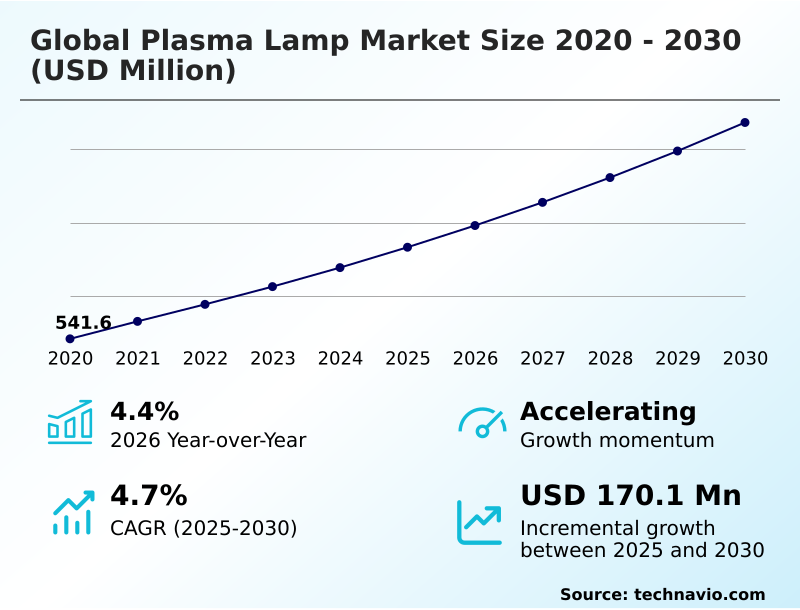
The plasma lamp market size is valued to increase by USD 170.1 million, at a CAGR of 4.7% from 2025 to 2030. Rising integration of plasma technology in controlled environment agriculture will drive the plasma lamp market.
Major Market Trends & Insights
- Europe dominated the market and accounted for a 34.6% growth during the forecast period.
- By Type - 300 Watt segment was valued at USD 345.2 million in 2024
- By Application - Industrial segment accounted for the largest market revenue share in 2024
Market Size & Forecast
- Market Opportunities: USD 295 million
- Market Future Opportunities: USD 170.1 million
- CAGR from 2025 to 2030 : 4.7%
Market Summary
- The Plasma Lamp Market is undergoing a significant transformation, moving beyond niche applications to become a critical component in high-performance sectors. This evolution is driven by the unique capabilities of electrodeless plasma technology, which utilizes radio frequency power to excite a noble gas mixture within a durable quartz bulb.
- The resulting high-intensity discharge produces a continuous spectrum light, closely mimicking natural sunlight. This characteristic is indispensable in fields like controlled environment agriculture, where spectral precision directly impacts crop yield and quality. For example, a large-scale vertical farming operator can leverage this technology for superior canopy penetration, achieving more uniform growth and reducing harvest cycle times, thereby enhancing operational efficiency.
- While high initial costs compared to mainstream LED solutions present a challenge, the extended lifespan, minimal lumen depreciation, and high color rendering index of plasma lamps ensure a strong value proposition for industrial, scientific, and infrastructure applications where performance cannot be compromised. The technology's resilience in harsh environments further solidifies its role in mission-critical systems.
What will be the Size of the Plasma Lamp Market during the forecast period?
Get Key Insights on Market Forecast (PDF) Request Free Sample
How is the Plasma Lamp Market Segmented?
The plasma lamp industry research report provides comprehensive data (region-wise segment analysis), with forecasts and estimates in "USD million" for the period 2026-2030, as well as historical data from 2020-2024 for the following segments.
- Type
- 300 Watt
- Above 300 Watt
- Application
- Industrial
- Roadways and tunnels
- Sports and entertainment
- Horticulture
- Others
- Distribution channel
- Retail
- E-commerce
- Direct sales
- Geography
- Europe
- Germany
- UK
- France
- APAC
- China
- Japan
- India
- North America
- US
- Canada
- Mexico
- Middle East and Africa
- Saudi Arabia
- UAE
- South Africa
- South America
- Brazil
- Argentina
- Rest of World (ROW)
- Europe
By Type Insights
The 300 watt segment is estimated to witness significant growth during the forecast period.
The 300-watt segment is pivotal, characterized by demands for efficient, moderate-intensity illumination balancing energy consumption with light output.
This wattage, utilizing advanced waveguide technologies and electrodeless plasma technology, is optimal for precision agriculture, where it provides a continuous spectrum light for controlled environment agriculture without the excess heat that can damage crops.
This spectral precision promotes vigorous plant growth. In commercial facilities, these units are used for high-bay lighting, enhancing visual clarity, while their electrode-less design extends operational lifespan, reducing replacement frequencies by over 60% compared to legacy systems.
Scientific sectors also rely on this wattage for the luminous efficacy required in precision testing equipment and medical sterilization.
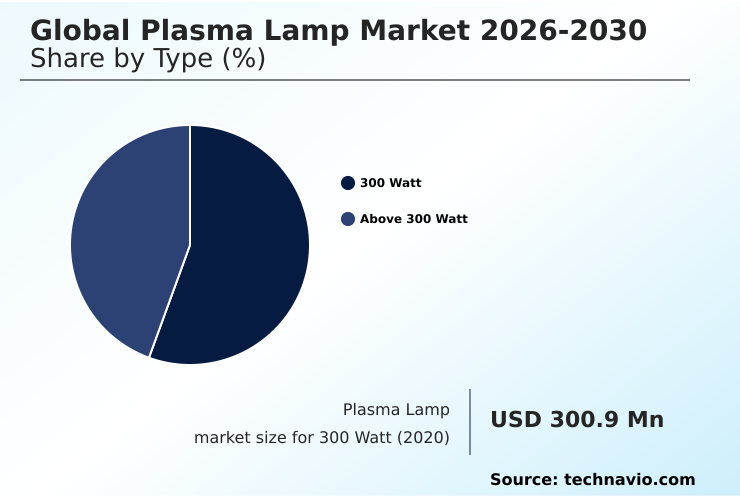
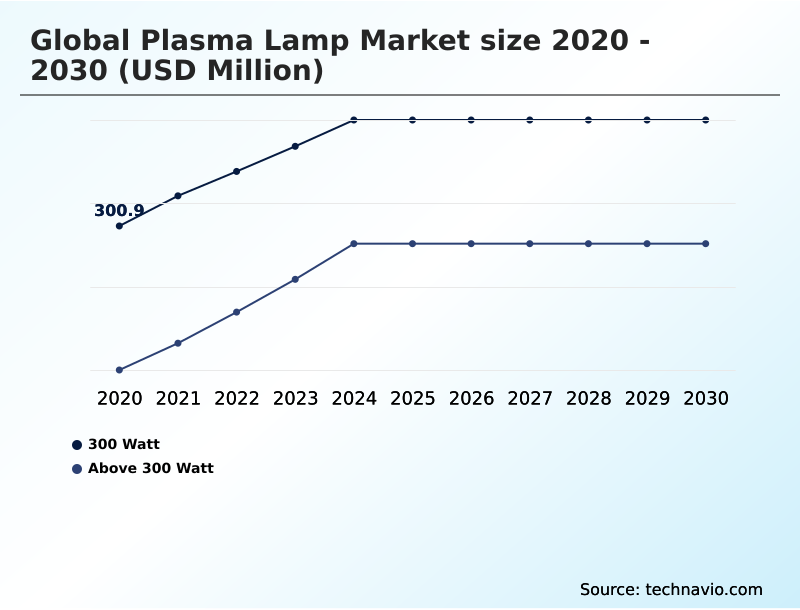
The 300 Watt segment was valued at USD 345.2 million in 2024 and showed a gradual increase during the forecast period.
Regional Analysis
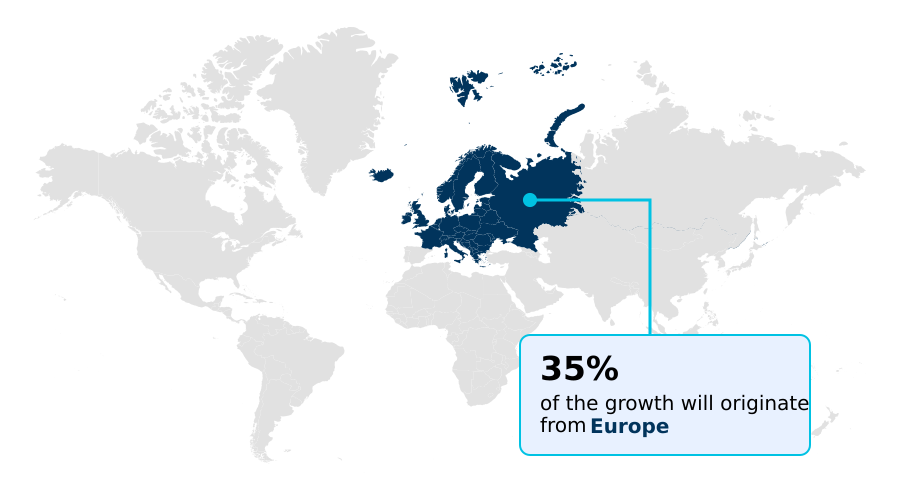
Europe is estimated to contribute 34.6% to the growth of the global market during the forecast period.Technavio’s analysts have elaborately explained the regional trends and drivers that shape the market during the forecast period.
See How Plasma Lamp Market Demand is Rising in Europe Request Free Sample
The geographic landscape of the market is characterized by distinct regional drivers and adoption patterns.
Europe currently leads, accounting for over 34% of the market opportunity, a position reinforced by stringent environmental regulations favoring mercury-free, high-efficacy lighting and early adoption in roadway and tunnel lighting.
The region's focus on gas-discharge physics and advanced scientific instrumentation also supports innovation. In contrast, APAC is the fastest-growing region, driven by rapid industrialization and government-led smart city initiatives.
Manufacturing hubs in the region are integrating plasma for high-bay lighting and industrial process monitoring, achieving an average 20% improvement in energy efficiency.
This dual dynamic of mature, regulation-driven adoption in Europe and rapid, infrastructure-focused growth in APAC defines the market's global trajectory, with specialized applications like UV curing systems gaining traction across both regions.
Market Dynamics
Our researchers analyzed the data with 2025 as the base year, along with the key drivers, trends, and challenges. A holistic analysis of drivers will help companies refine their marketing strategies to gain a competitive advantage.
- Strategic decisions around lighting technology are increasingly complex, weighing the benefits and costs of various advanced systems. The use of plasma lamp for indoor horticulture is a key area of interest, where full-spectrum plasma grow lights offer distinct advantages. When considering plasma lamp vs LED for agriculture, factors like canopy penetration and spectral completeness are critical differentiators.
- Beyond agriculture, high-intensity plasma for stadium lighting is becoming standard for broadcast-quality illumination, while electrode-less plasma industrial lighting offers durability in harsh environments. The inherent benefits of plasma lighting in tunnels include superior visibility and reduced maintenance. Specialized applications continue to expand, from UV plasma for medical disinfection to the use of plasma lamp for scientific research.
- However, adoption is tempered by the high cost of plasma lighting systems and considerations regarding maintenance of plasma lighting systems, which, while infrequent, requires specialized expertise. Facility managers report that maintenance cycles for plasma systems are half as frequent as those for metal halide equivalents, significantly impacting operational budgets.
- Furthermore, plasma lamp electromagnetic interference issues must be addressed through careful engineering to ensure compliance, particularly in sensitive electronic environments.
What are the key market drivers leading to the rise in the adoption of Plasma Lamp Industry?
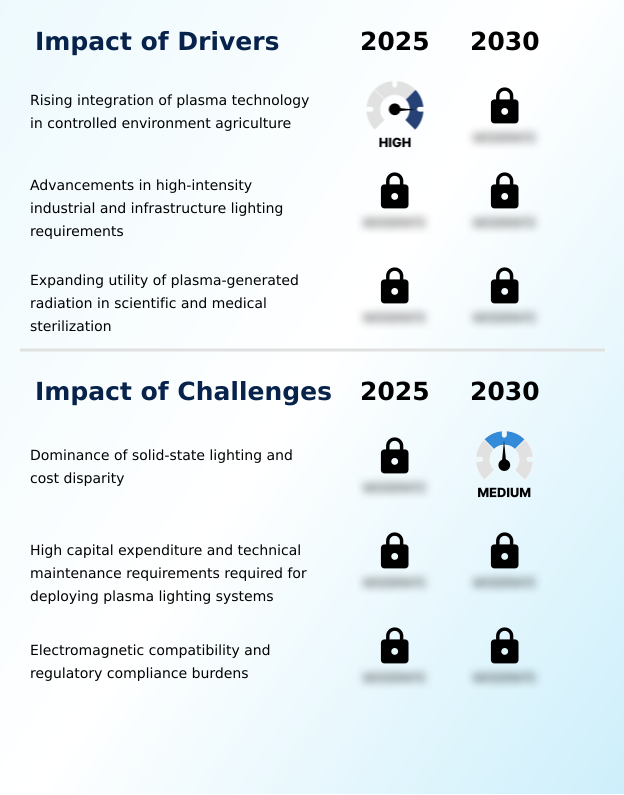
- The rising integration of plasma technology within controlled environment agriculture, particularly for its ability to mimic natural sunlight, stands as a key driver for market growth.
- Market growth is propelled by advancements in high-intensity industrial and infrastructure lighting. In high-mast applications, plasma lamps are enhancing visibility by over 25% compared to traditional metal halide lights, a critical factor for safety in ports and airports.
- The expanding use of plasma-generated radiation in scientific and medical sterilization provides another major driver, with systems achieving 99.9% pathogen neutralization rates. This capability, combined with the technology's mercury-free design, aligns with stringent global hygiene standards.
- Furthermore, the utility of plasma in industrial UV curing systems and as a metrology light source for the semiconductor industry showcases its versatility.
- This cross-industry adoption for specialized technical tasks is cementing its role as an indispensable technology for precision and reliability.
What are the market trends shaping the Plasma Lamp Industry?
- A key market trend is the growing adoption of plasma lighting in commercial horticulture and vertical farming, driven by the technology's ability to enhance crop yields and quality.
- Key market trends are driven by the adoption of high-performance lighting in specialized sectors. The integration of plasma systems in commercial horticulture and vertical farming is accelerating, as these technologies enhance photosynthetic photon flux density by up to 15%, directly improving crop yields.
- Concurrently, their use in urban infrastructure is expanding, particularly for roadway and tunnel lighting, where superior visibility in adverse conditions can reduce accident rates. Within smart city initiatives, these advanced fixtures are reducing maintenance dispatches by 30%.
- This trend is supported by ongoing advancements in specialized UV plasma applications for medical sterilization and industrial process monitoring, where the technology's reliability and high-intensity output are critical. The demand for aquascaping illumination and broadcast-quality lighting for entertainment venues further diversifies the application landscape.
What challenges does the Plasma Lamp Industry face during its growth?
- The market dominance of solid-state lighting, coupled with a significant initial cost disparity, presents a key challenge to the plasma lamp industry's widespread adoption and growth.
- The primary challenge remains the market dominance of solid-state lighting and a significant cost disparity. The initial capital outlay for a plasma lighting system is often 3x higher than for comparable high-output LED fixtures, creating a substantial barrier to entry for many potential users.
- Furthermore, technical complexities related to electromagnetic compatibility and regulatory compliance add to the overall cost and development time. Ensuring systems do not cause interference requires sophisticated engineering, which can add up to 15% to the total unit cost.
- These factors, combined with the high capital expenditure for deployment and the need for specialized maintenance knowledge, confine plasma technology to niche applications where its unique performance characteristics, like its use in satellite component testing, justify the premium investment.
Exclusive Technavio Analysis on Customer Landscape
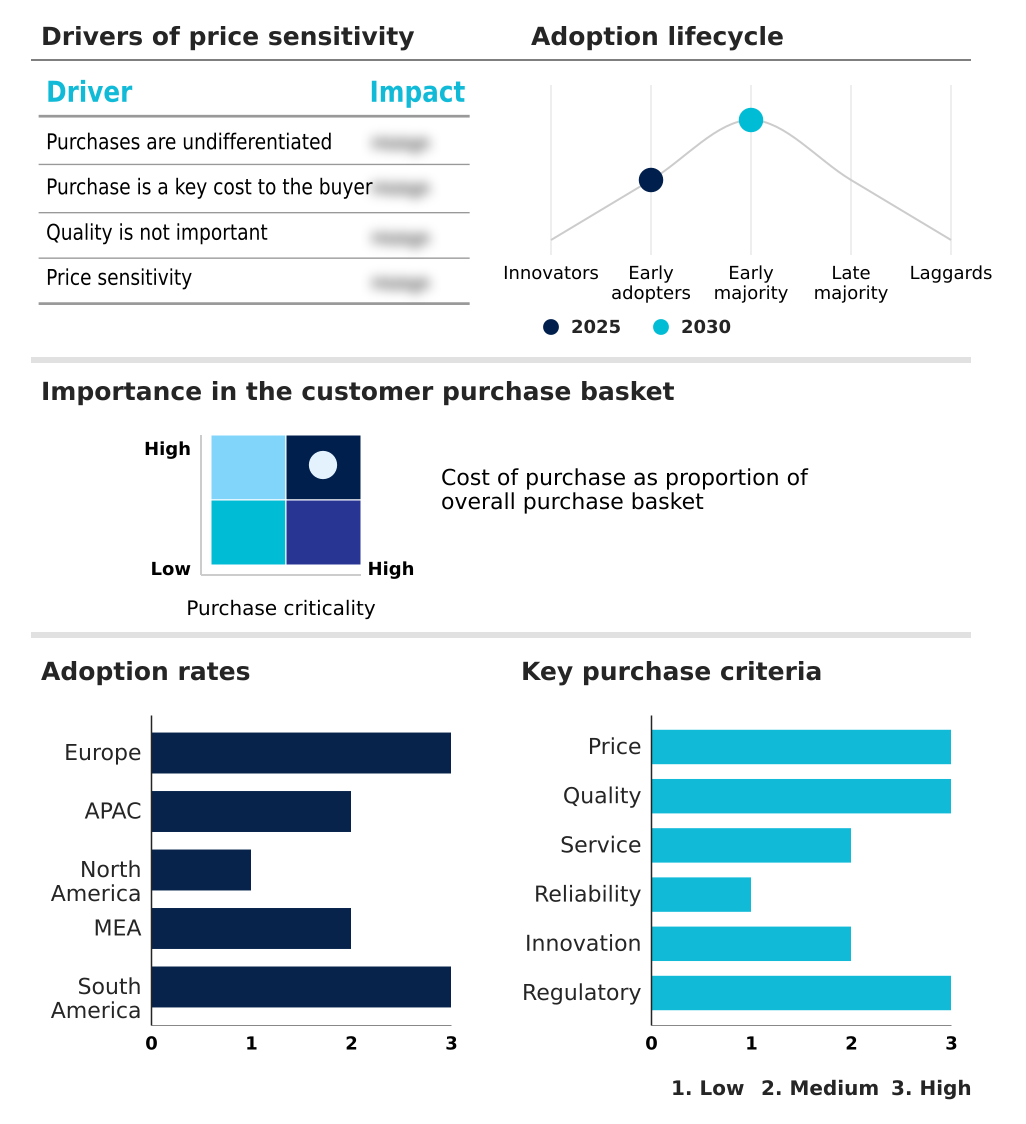
The plasma lamp market forecasting report includes the adoption lifecycle of the market, covering from the innovator’s stage to the laggard’s stage. It focuses on adoption rates in different regions based on penetration. Furthermore, the plasma lamp market report also includes key purchase criteria and drivers of price sensitivity to help companies evaluate and develop their market growth analysis strategies.
Customer Landscape of Plasma Lamp Industry
Competitive Landscape
Companies are implementing various strategies, such as strategic alliances, plasma lamp market forecast, partnerships, mergers and acquisitions, geographical expansion, and product/service launches, to enhance their presence in the industry.
Ceravision Ltd. - Offerings center on high-intensity, full-spectrum illumination systems engineered for specialized industrial, horticultural, and scientific applications where performance and reliability are critical.
The industry research and growth report includes detailed analyses of the competitive landscape of the market and information about key companies, including:
- Ceravision Ltd.
- Endura LED
- Excelitas Technologies Corp.
- Foshan Electrical and Lighting
- Griffin and Ray Inc.
- Hamamatsu Photonics KK
- Heraeus Holding GmbH
- Hive Lighting Inc.
- Ka Shui International Holdings
- LG Electronics Inc.
- Lumileds Holding BV
- Luxim Corp
- Opple Lighting Co. Ltd.
- Panasonic Holdings Corp.
- Plasma International
- PLS GmbH
- Seoul Semiconductor Co. Ltd.
- Signify NV
- Sunle Lighting Co Ltd
- Ushio Inc.
Qualitative and quantitative analysis of companies has been conducted to help clients understand the wider business environment as well as the strengths and weaknesses of key industry players. Data is qualitatively analyzed to categorize companies as pure play, category-focused, industry-focused, and diversified; it is quantitatively analyzed to categorize companies as dominant, leading, strong, tentative, and weak.
Recent Development and News in Plasma lamp market
- In April 2025, Ushio Inc. completed its acquisition of the industrial and entertainment lamp business from ams OSRAM, significantly expanding its production capacity for high-performance plasma systems.
- In March 2025, Musco Lighting announced a strategic partnership with the Bahrain International Circuit to upgrade the motorsport track's lighting to high-intensity plasma fixtures for broadcast-quality illumination.
- In February 2025, Hefei CASM Technology Co., Ltd. launched a new series of light-emitting plasma modules for large-scale greenhouses, featuring a solid-state microwave source that increases photosynthetic photon flux density.
- In December 2024, Energetiq Technology confirmed the successful deployment of its advanced laser-driven plasma light source in a high-precision metrology project, enabling next-generation semiconductor wafer inspection.
Dive into Technavio’s robust research methodology, blending expert interviews, extensive data synthesis, and validated models for unparalleled Plasma Lamp Market insights. See full methodology.
| Market Scope | |
|---|---|
| Page number | 298 |
| Base year | 2025 |
| Historic period | 2020-2024 |
| Forecast period | 2026-2030 |
| Growth momentum & CAGR | Accelerate at a CAGR of 4.7% |
| Market growth 2026-2030 | USD 170.1 million |
| Market structure | Fragmented |
| YoY growth 2025-2026(%) | 4.4% |
| Key countries | Germany, UK, France, Italy, Spain, The Netherlands, China, Japan, India, South Korea, Australia, Indonesia, US, Canada, Mexico, Saudi Arabia, UAE, South Africa, Israel, Turkey, Brazil, Argentina and Chile |
| Competitive landscape | Leading Companies, Market Positioning of Companies, Competitive Strategies, and Industry Risks |
Research Analyst Overview
- The market is defined by a strategic pivot toward applications demanding superior performance metrics, where electrodeless plasma technology provides a distinct advantage. This technology, powered by radio frequency power and sophisticated microwave generators, creates a high-intensity discharge within a noble gas mixture contained in a quartz bulb, resulting in unparalleled spectral precision and a high color rendering index.
- The shift toward integrating UVC spectrum capabilities for industrial and medical sterilization represents a key boardroom-level decision, impacting corporate strategy around safety and compliance. Systems featuring this technology have demonstrated up to a 50% reduction in lumen depreciation over 10,000 hours of continuous operation. The technology's continuous spectrum light offers superior thermal management and luminous efficacy compared to legacy systems.
- This makes light-emitting plasma solutions, which utilize advanced magnetrons and RF drivers, indispensable for applications where light quality and long-term reliability are paramount, including solar simulation and high-stakes industrial inspections.
What are the Key Data Covered in this Plasma Lamp Market Research and Growth Report?
-
What is the expected growth of the Plasma Lamp Market between 2026 and 2030?
-
USD 170.1 million, at a CAGR of 4.7%
-
-
What segmentation does the market report cover?
-
The report is segmented by Type (300 Watt, and Above 300 Watt), Application (Industrial, Roadways and tunnels, Sports and entertainment, Horticulture, and Others), Distribution Channel (Retail, E-commerce, and Direct sales) and Geography (Europe, APAC, North America, Middle East and Africa, South America)
-
-
Which regions are analyzed in the report?
-
Europe, APAC, North America, Middle East and Africa and South America
-
-
What are the key growth drivers and market challenges?
-
Rising integration of plasma technology in controlled environment agriculture, Dominance of solid-state lighting and cost disparity
-
-
Who are the major players in the Plasma Lamp Market?
-
Ceravision Ltd., Endura LED, Excelitas Technologies Corp., Foshan Electrical and Lighting, Griffin and Ray Inc., Hamamatsu Photonics KK, Heraeus Holding GmbH, Hive Lighting Inc., Ka Shui International Holdings, LG Electronics Inc., Lumileds Holding BV, Luxim Corp, Opple Lighting Co. Ltd., Panasonic Holdings Corp., Plasma International, PLS GmbH, Seoul Semiconductor Co. Ltd., Signify NV, Sunle Lighting Co Ltd and Ushio Inc.
-
Market Research Insights
- Market dynamics are shaped by a strategic shift toward high-value applications where performance outweighs initial cost. The integration of plasma systems into smart city infrastructure and public transit corridors is accelerating, as these solutions demonstrate a 40% reduction in required maintenance cycles over legacy high-pressure sodium lamps.
- Simultaneously, adoption in precision agriculture and vertical farming is driven by measurable quality improvements, with some operators reporting a 15% increase in secondary metabolite production in high-value crops. This growth is supported by demand from specialized sectors like scientific instrumentation and automotive materials testing.
- Use in broadcast-quality lighting for sports venues also highlights the technology's superior performance, where its flicker-free operation is a key requirement.
We can help! Our analysts can customize this plasma lamp market research report to meet your requirements.
 RIA -
RIA -