Plastic Decking Market Analysis, Size, and Forecast 2026-2030: North America (US, Canada, and Mexico), Europe (Germany, UK, and France), APAC (China, Japan, and India), South America (Brazil, Argentina, and Chile), Middle East and Africa (Saudi Arabia, UAE, and South Africa), and Rest of World (ROW)

Plastic Decking Market Analysis, Size, and Forecast 2026-2030:
North America (US, Canada, and Mexico), Europe (Germany, UK, and France), APAC (China, Japan, and India), South America (Brazil, Argentina, and Chile), Middle East and Africa (Saudi Arabia, UAE, and South Africa), and Rest of World (ROW)

Published: Oct 2026 293 Pages SKU: IRTNTR80398

Market Overview at a Glance

$1.93 B
Market Opportunity
7.1%
CAGR 2025 - 2030
43.4%
North America Growth
$2.64 B
Capped composite segment 2024

Plastic Decking Market Size 2026-2030

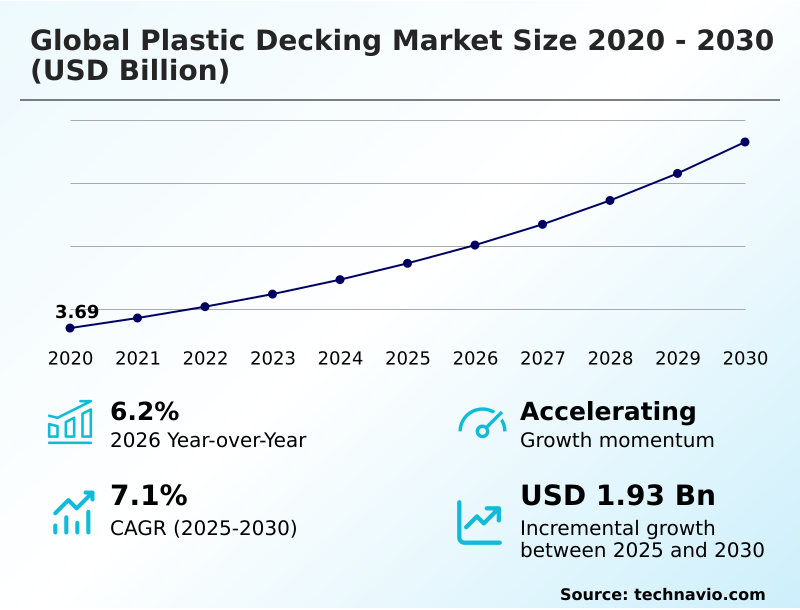
The plastic decking market size is valued to increase by USD 1.93 billion, at a CAGR of 7.1% from 2025 to 2030. Surging consumer preference for low-maintenance outdoor living will drive the plastic decking market.

Major Market Trends & Insights

  • North America dominated the market and accounted for a 43.4% growth during the forecast period.
  • By Type - Capped composite segment was valued at USD 2.64 billion in 2024
  • By End-user - Residential segment accounted for the largest market revenue share in 2024

Market Size & Forecast

  • Market Opportunities: USD 2.96 billion
  • Market Future Opportunities: USD 1.93 billion
  • CAGR from 2025 to 2030 : 7.1%

Market Summary

  • The Plastic Decking Market exhibits robust operational momentum as commercial developers and residential homeowners systematically replace traditional timber with advanced synthetic alternatives. Driven by an accelerating consumer preference for low-maintenance outdoor living spaces, property managers are rapidly adopting weather-resistant composite boards that eliminate the need for routine chemical sealing and sanding.
  • This behavioral shift significantly optimizes lifecycle expenditures, as commercial hospitality venues deploying synthetic decking have recorded a 35% reduction in annual exterior maintenance labor compared to natural wood installations. In modern supply chain scenarios, procurement teams prioritize manufacturers utilizing high percentages of recycled polymer feedstocks, enabling real estate developers to achieve strict green building compliance targets seamlessly.
  • However, the industry faces substantial friction from elevated upfront material acquisition and specialized installation costs, which deter immediate conversion among budget-conscious regional contractors. Despite this capital-intensive barrier, continuous innovations in polymer capping chemistry and heat-mitigating surface technologies ensure that durable, rot-proof outdoor flooring remains a structural imperative across contemporary building projects.

What will be the Size of the Plastic Decking Market during the forecast period?
Get Key Insights on Market Forecast (PDF) Get Free Sample

How is the Plastic Decking Market Segmented?

The plastic decking industry research report provides comprehensive data (region-wise segment analysis), with forecasts and estimates in "USD million" for the period 2026-2030, as well as historical data from 2020-2024 for the following segments.

  • Type
    • Capped composite
    • Uncapped composite
  • End-user
    • Residential
    • Non-residential
  • Material
    • WPC
    • PVC
    • HDPE
    • PP
    • Others
  • Geography
    • North America
      • US
      • Canada
      • Mexico
    • Europe
      • Germany
      • UK
      • France
      • Italy
      • Spain
      • The Netherlands
    • APAC
      • China
      • Japan
      • India
      • South Korea
      • Australia
      • Indonesia
    • South America
      • Brazil
      • Argentina
      • Chile
    • Middle East and Africa
      • Saudi Arabia
      • UAE
      • South Africa
      • Turkey
      • Israel

By Type Insights

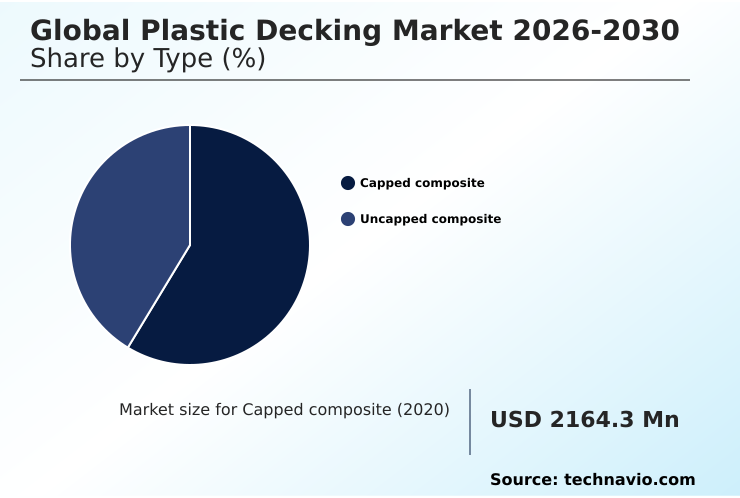
The capped composite segment is estimated to witness significant growth during the forecast period.

Capped composite decking platforms dominate modern commercial and residential infrastructure by encasing a dense bio-based wood-plastic matrix within an impermeable polymer shell.

This architectural configuration addresses the critical vulnerability of traditional lumber by deploying a scratch-resistant protective shell engineered with advanced antioxidant stabilizers.

Manufacturers increasingly utilize acrylic-capped polymers and impact-resistant polypropylene to significantly enhance weatherability, resulting in a 40% reduction in long-term maintenance labor for property managers compared to untreated timber.

The integration of modular interlocking deck tiles and concealed fastening mechanisms streamlines installation logistics, directly reducing project deployment times.

By delivering high flexural strength under severe environmental stressors, this material configuration effectively eliminates rot and UV degradation, fundamentally shifting outdoor flooring procurement strategies toward lifecycle cost optimization.
Get Free Sample

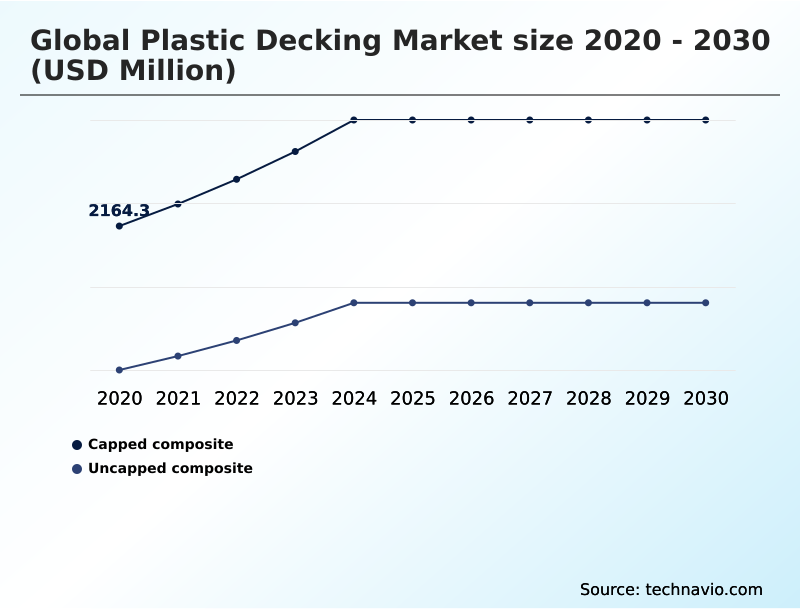
The Capped composite segment was valued at USD 2.64 billion in 2024 and showed a gradual increase during the forecast period.
Get Free Sample

Regional Analysis

North America is estimated to contribute 43.4% to the growth of the global market during the forecast period.Technavio’s analysts have elaborately explained the regional trends and drivers that shape the market during the forecast period.
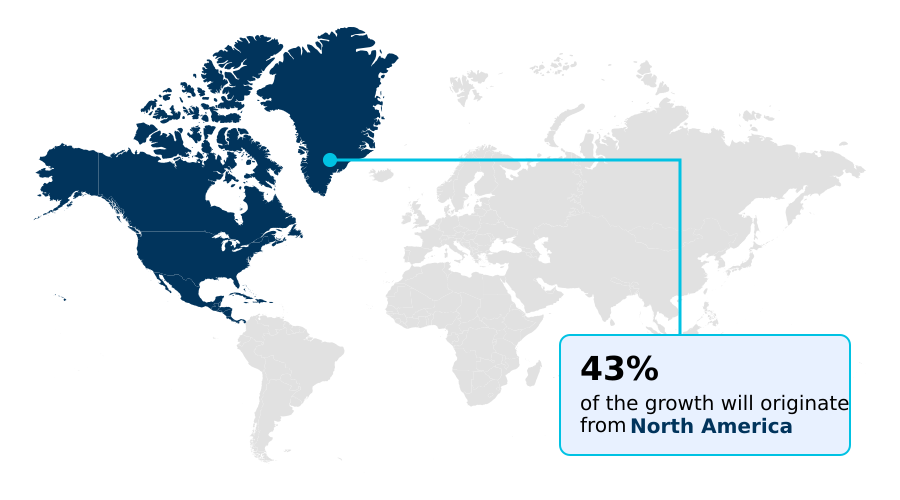
See How Plastic Decking Market Demand is Rising in North America Get Free Sample

The geographic adoption of structural synthetic materials highlights distinct regional priorities within the Plastic Decking Market. North America leads the transition toward cellular polyvinyl chloride and advanced polypropylene formulations, driven by stringent fire codes and vast residential renovation pipelines.

This regulatory alignment has yielded a 25% faster adoption rate for synthetic profiles in North America compared to Europe. Conversely, the European sector heavily mandates eco-certified architectural cladding systems and zinc borate fungicides for public infrastructure, optimizing lifecycle durability.

Asian markets are experiencing rapid commercial expansion in marine dock construction and state-sponsored urban greening projects, where contractors demand heavy-duty fiberglass-reinforced planks to ensure high structural load-bearing capacity.

Across all regions, the integration of slip-resistant micro-textures has improved pedestrian safety metrics by 30% in wet environments. Ultimately, prioritizing extreme moisture absorption resistance allows international developers to bypass the structural limitations of organic timber entirely.

Market Dynamics

Our researchers analyzed the data with 2025 as the base year, along with the key drivers, trends, and challenges. A holistic analysis of drivers will help companies refine their marketing strategies to gain a competitive advantage.

  • The continuous evolution of exterior building materials highlights a decisive shift toward advanced synthetic solutions that prioritize lifecycle durability and operational efficiency. Central to this transformation is the integration of capped polymer surface co-extrusion technology, which enables manufacturers to produce highly resilient decking profiles that resist deep staining and surface scratching.
  • By leveraging post-consumer recycled plastic waste utilization, leading producers not only align with global sustainability mandates but also mitigate raw material procurement risks, achieving up to a 20% reduction in polymer sourcing volatility compared to virgin resin dependency.
  • In regions prone to extreme seasonal temperature variations, maintaining dimensional stability under thermal expansion remains a critical engineering priority to prevent structural fastener failure and board warping. Furthermore, as municipal authorities increasingly enforce strict safety regulations in drought-prone areas, the deployment of mineral-added composite flame-retardant formulations has become essential for securing commercial building permits.
  • To address end-user discomfort in high-temperature environments, developers are specifying infrared reflective cool-deck surface technology, which dramatically lowers surface heat absorption during peak solar exposure. These highly engineered material advancements allow property managers and residential contractors to streamline long-term maintenance logistics, ultimately delivering a superior outdoor living experience while adhering to rigorous modern building standards.
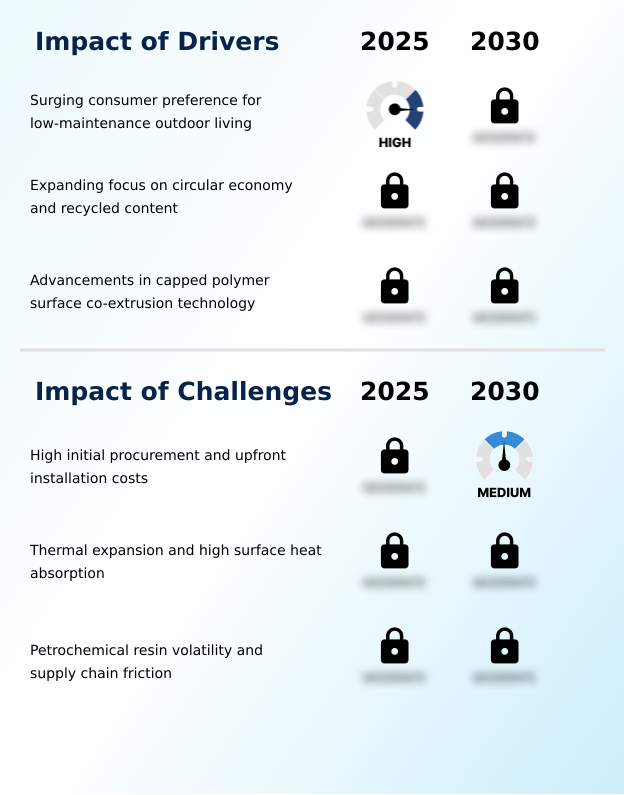
What are the key market drivers leading to the rise in the adoption of Plastic Decking Industry?

  • Surging consumer preference for low-maintenance outdoor living environments remains a primary driver accelerating the adoption of weather-resistant structural materials.

  • Accelerating investments in low-maintenance outdoor living spaces serve as a powerful macroeconomic driver propelling the widespread adoption of advanced synthetic building materials.
  • Property owners and commercial developers consistently specify wood-plastic composite systems to avoid the labor-intensive upkeep associated with natural timber, driving a 40% reduction in lifetime exterior maintenance expenditures.
  • To meet stringent environmental mandates, manufacturers heavily incorporate reclaimed wood fibers and post-consumer recycled plastics, seamlessly supplying the market with eco-certified building materials.
  • This strategic material substitution directly satisfies corporate green building procurement targets while diverting millions of pounds of waste from landfills.
  • Additionally, continuous innovations in polymer capping chemistry and specialized ultraviolet inhibitors drastically enhance color permanence retention, ensuring that structural deck profiles retain pristine visual aesthetics despite decades of intense environmental exposure.

What are the market trends shaping the Plastic Decking Industry?

  • The integration of infrared-reflective pigments for advanced cool-deck technology constitutes a significant development in outdoor architectural materials. This innovation substantially reduces surface heat retention, enhancing barefoot comfort and driving higher adoption across commercial and residential applications.

  • The rapid commercial integration of heat-mitigating surface technology and infrared-reflective pigments represents a transformative engineering trend within outdoor architectural infrastructure. Manufacturers are fundamentally altering polymer cap formulations to reflect near-infrared solar energy, which effectively reduces board surface heat retention by up to 30% during peak summer exposure.
  • This critical innovation drastically improves barefoot comfort across high-traffic hospitality and residential pool environments. Simultaneously, an industry-wide transition toward multi-tonal wood variegation leverages advanced digital embossing technology to deliver hyper-realistic matte finishes that rival exotic hardwoods. Furthermore, the development of mineral-added composites and fire-rated synthetic materials ensures strict compliance with stringent wildland-urban interface standards.
  • By upgrading co-extrusion technology, extrusion facilities have improved long-term scratch resistance by 25%, allowing developers to deploy aesthetically superior, ultra-durable decking systems that completely eliminate the cosmetic limitations of early-generation synthetics.

What challenges does the Plastic Decking Industry face during its growth?

  • Elevated initial procurement expenses and high upfront installation costs represent a persistent challenge constraining broader product adoption among budget-conscious contractors.

  • Extreme petrochemical feedstock volatility heavily constraints the profit margins of synthetic outdoor flooring manufacturers, acting as a persistent operational challenge. Sudden price spikes in virgin high-density polyethylene and thermoplastic resins directly inflate raw material acquisition budgets by up to 15%, forcing extruders to absorb costs or raise wholesale prices.
  • Additionally, managing the high thermal expansion coefficient of synthetic polymers under direct sunlight remains a complex material science hurdle. Inadequate dimensional stability can strain structural fasteners and induce board warping during severe seasonal temperature shifts. To mitigate these structural failures, formulators must integrate expensive hydrophobic additives and deploy capital-intensive melt-filtration processing to ensure consistent board density.
  • Balancing these advanced formulations with cost-effective continuous profile extrusion practices limits production scalability across regional manufacturing networks.

Exclusive Technavio Analysis on Customer Landscape

The plastic decking market forecasting report includes the adoption lifecycle of the market, covering from the innovator’s stage to the laggard’s stage. It focuses on adoption rates in different regions based on penetration. Furthermore, the plastic decking market report also includes key purchase criteria and drivers of price sensitivity to help companies evaluate and develop their market growth analysis strategies.
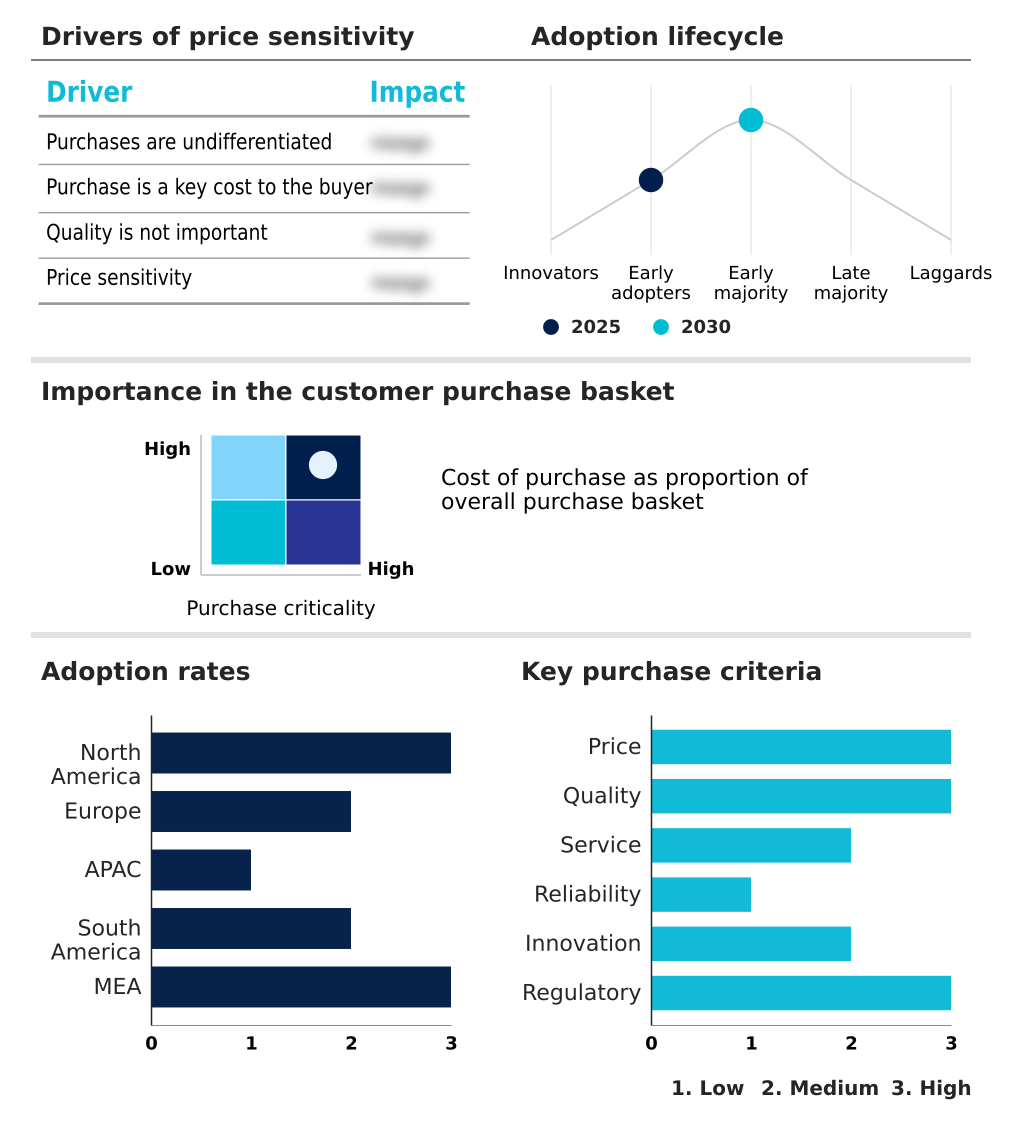
Customer Landscape of Plastic Decking Industry

Competitive Landscape

Companies are implementing various strategies, such as strategic alliances, plastic decking market forecast, partnerships, mergers and acquisitions, geographical expansion, and product/service launches, to enhance their presence in the industry.

BSW Timber Group Ltd - The entity provides structural timber and landscaping solutions featuring advanced wood-plastic composite decking boards engineered for sustainable outdoor applications requiring enhanced moisture resistance and low-maintenance durability.

The industry research and growth report includes detailed analyses of the competitive landscape of the market and information about key companies, including:

  • BSW Timber Group Ltd
  • Cali Bamboo LLC
  • Composite Prime Ltd
  • Ecotech WPC
  • Eva Last Hong Kong Ltd.
  • Fiberdeck
  • Fiberon LLC
  • Fortress Iron LP
  • Green Bay Decking
  • Himalaya Global Holdings Ltd.
  • IHT Group
  • James Hardie Industries plc
  • MoistureShield
  • NewTechWood America Inc.
  • Oakio Plastic Materials Co.
  • The Millboard Co Ltd.
  • Totall Wood Plastic Composite Co.
  • Treeplast Industries
  • Trex Co. Inc.
  • UFP Industries Inc.

Qualitative and quantitative analysis of companies has been conducted to help clients understand the wider business environment as well as the strengths and weaknesses of key industry players. Data is qualitatively analyzed to categorize companies as pure play, category-focused, industry-focused, and diversified; it is quantitatively analyzed to categorize companies as dominant, leading, strong, tentative, and weak.

Recent Development and News in Plastic decking market

  • In the Building Products industry, tightening environmental product declaration requirements across commercial real estate have accelerated the adoption of eco-certified building materials, directly impacting global plastic decking market 2026-2030 demand by incentivizing the use of post-industrial plastic waste in extrusion lines.
  • The widespread implementation of wildland-urban interface standards in high-risk regional zones has mandated the procurement of fire-rated synthetic materials, driving developers to transition toward flame-retardant polymer formulations for outdoor infrastructure.
  • Advancements in continuous profile extrusion technology have improved the structural dimensional stability of recycled composites, expanding the deployment of heavy-duty fiberglass-reinforced planks in demanding marine dock construction projects.
  • Rising municipal investments in large-scale urban greening projects have prioritized the integration of slip-resistant micro-textures in outdoor flooring, propelling the specification of advanced synthetic deck boards over traditional hardwood lumber.

Dive into Technavio’s robust research methodology, blending expert interviews, extensive data synthesis, and validated models for unparalleled Plastic Decking Market insights. See full methodology.

Market Scope
Page number 293
Base year 2025
Historic period 2020-2024
Forecast period 2026-2030
Growth momentum & CAGR Accelerate at a CAGR of 7.1%
Market growth 2026-2030 USD 1925.8 million
Market structure Fragmented
YoY growth 2025-2026(%) 6.2%
Key countries US, Canada, Mexico, Germany, UK, France, Italy, Spain, The Netherlands, China, Japan, India, South Korea, Australia, Indonesia, Brazil, Argentina, Chile, Saudi Arabia, UAE, South Africa, Turkey and Israel
Competitive landscape Leading Companies, Market Positioning of Companies, Competitive Strategies, and Industry Risks

Request Free Sample

Research Analyst Overview

  • The operational landscape of exterior architectural products is fundamentally shifting as commercial developers phase out organic timber in favor of highly engineered synthetic profiles. This transition is heavily supported by continuous advancements in co-extrusion technology and melt-filtration processing, allowing manufacturers to seamlessly blend recycled thermoplastic resins into dense, moisture-proof core structures.
  • Strategic boardroom decisions now prioritize lifecycle maintenance reductions, steering procurement teams toward impact-resistant polypropylene and acrylic-capped polymers that drastically outperform traditional lumber. Utilizing digital embossing technology, modern manufacturing lines replicate authentic hardwood aesthetics while rendering the substrate impervious to insect damage and fungal decay.
  • Consequently, commercial property managers have documented a 40% reduction in annual exterior upkeep costs by eliminating routine chemical sealing protocols. Furthermore, the integration of specialized flame-retardant polymer formulations directly addresses stringent regional fire compliance mandates, securing project approvals in high-risk residential zones.
  • By systematically eliminating the structural vulnerabilities inherent to natural wood, these advanced composite decking solutions redefine long-term real estate asset valuation and outdoor infrastructure durability.

What are the Key Data Covered in this Plastic Decking Market Research and Growth Report?

  • What is the expected growth of the Plastic Decking Market between 2026 and 2030?

    • USD 1.93 billion, at a CAGR of 7.1%

  • What segmentation does the market report cover?

    • The report is segmented by Type (Capped composite, and Uncapped composite), End-user (Residential, and Non-residential), Material (WPC, PVC, HDPE, PP, and Others) and Geography (North America, Europe, APAC, South America, Middle East and Africa)

  • Which regions are analyzed in the report?

    • North America, Europe, APAC, South America and Middle East and Africa

  • What are the key growth drivers and market challenges?

    • Surging consumer preference for low-maintenance outdoor living, High initial procurement and upfront installation costs

  • Who are the major players in the Plastic Decking Market?

    • BSW Timber Group Ltd, Cali Bamboo LLC, Composite Prime Ltd, Ecotech WPC, Eva Last Hong Kong Ltd., Fiberdeck, Fiberon LLC, Fortress Iron LP, Green Bay Decking, Himalaya Global Holdings Ltd., IHT Group, James Hardie Industries plc, MoistureShield, NewTechWood America Inc., Oakio Plastic Materials Co., The Millboard Co Ltd., Totall Wood Plastic Composite Co., Treeplast Industries, Trex Co. Inc. and UFP Industries Inc.

Market Research Insights

  • The Plastic Decking Market is experiencing a structural evolution fueled by stringent green building certification frameworks and a massive consumer shift toward low-maintenance outdoor living. To align with broader circular economy initiatives, extruders are aggressively repurposing post-industrial plastic waste, achieving up to a 45% increase in recycled material utilization across premium board lines.
  • This eco-conscious manufacturing approach directly enhances corporate compliance metrics while improving long-term material resilience. Furthermore, advanced surface cap technologies have reduced moisture-induced delamination by nearly 60% compared to conventional treated lumber. By mitigating rot and minimizing lifecycle maintenance dependencies, these highly engineered composite profiles deliver superior operational value for commercial property developers and municipal landscaping contractors.

We can help! Our analysts can customize this plastic decking market research report to meet your requirements.

Get in touch

1. Executive Summary

1.1 Market overview

Executive Summary - Chart on Market Overview
Executive Summary - Data Table on Market Overview
Executive Summary - Chart on Global Market Characteristics
Executive Summary - Chart on Market by Geography
Executive Summary - Chart on Market Segmentation by Type
Executive Summary - Chart on Market Segmentation by End-user
Executive Summary - Chart on Market Segmentation by Material
Executive Summary - Chart on Incremental Growth
Executive Summary - Data Table on Incremental Growth
Executive Summary - Chart on Company Market Positioning

2. Technavio Analysis

2.1 Analysis of price sensitivity, lifecycle, customer purchase basket, adoption rates, and purchase criteria

2.2 Criticality of inputs and Factors of differentiation

Chart on Overview on criticality of inputs and factors of differentiation

2.3 Factors of disruption

Chart on Overview on factors of disruption

2.4 Impact of drivers and challenges

Chart on Impact of drivers and challenges in 2025 and 2030

3. Market Landscape

3.1 Market ecosystem

Chart on Parent Market
Data Table on - Parent Market

3.2 Market characteristics

Chart on Market characteristics analysis

3.3 Value chain analysis

Chart on Value chain analysis

4. Market Sizing

4.1 Market definition

Data Table on Offerings of companies included in the market definition

4.2 Market segment analysis

Market segments

4.3 Market size 2025

4.4 Market outlook: Forecast for 2025-2030

Chart on Global - Market size and forecast 2025-2030 ($ million)
Data Table on Global - Market size and forecast 2025-2030 ($ million)
Chart on Global Market: Year-over-year growth 2025-2030 (%)
Data Table on Global Market: Year-over-year growth 2025-2030 (%)

5. Historic Market Size

5.1 Global Plastic Decking Market 2020 - 2024

Historic Market Size - Data Table on Global Plastic Decking Market 2020 - 2024 ($ million)

5.2 Type segment analysis 2020 - 2024

Historic Market Size - Type Segment 2020 - 2024 ($ million)

5.3 End-user segment analysis 2020 - 2024

Historic Market Size - End-user Segment 2020 - 2024 ($ million)

5.4 Material segment analysis 2020 - 2024

Historic Market Size - Material Segment 2020 - 2024 ($ million)

5.5 Geography segment analysis 2020 - 2024

Historic Market Size - Geography Segment 2020 - 2024 ($ million)

5.6 Country segment analysis 2020 - 2024

Historic Market Size - Country Segment 2020 - 2024 ($ million)

6. Qualitative Analysis

6.1 Impact of AI on global plastic decking market

6.2 Impact of geopolitical conflicts on global plastic decking market

7. Five Forces Analysis

7.1 Five forces summary

Five forces analysis - Comparison between 2025 and 2030

7.2 Bargaining power of buyers

Bargaining power of buyers - Impact of key factors 2025 and 2030

7.3 Bargaining power of suppliers

Bargaining power of suppliers - Impact of key factors in 2025 and 2030

7.4 Threat of new entrants

Threat of new entrants - Impact of key factors in 2025 and 2030

7.5 Threat of substitutes

Threat of substitutes - Impact of key factors in 2025 and 2030

7.6 Threat of rivalry

Threat of rivalry - Impact of key factors in 2025 and 2030

7.7 Market condition

Chart on Market condition - Five forces 2025 and 2030

8. Market Segmentation by Type

8.1 Market segments

Chart on Type - Market share 2025-2030 (%)
Data Table on Type - Market share 2025-2030 (%)

8.2 Comparison by Type

Chart on Comparison by Type
Data Table on Comparison by Type

8.3 Capped composite - Market size and forecast 2025-2030

Chart on Capped composite - Market size and forecast 2025-2030 ($ million)
Data Table on Capped composite - Market size and forecast 2025-2030 ($ million)
Chart on Capped composite - Year-over-year growth 2025-2030 (%)
Data Table on Capped composite - Year-over-year growth 2025-2030 (%)

8.4 Uncapped composite - Market size and forecast 2025-2030

Chart on Uncapped composite - Market size and forecast 2025-2030 ($ million)
Data Table on Uncapped composite - Market size and forecast 2025-2030 ($ million)
Chart on Uncapped composite - Year-over-year growth 2025-2030 (%)
Data Table on Uncapped composite - Year-over-year growth 2025-2030 (%)

8.5 Market opportunity by Type

Market opportunity by Type ($ million)
Data Table on Market opportunity by Type ($ million)

9. Market Segmentation by End-user

9.1 Market segments

Chart on End-user - Market share 2025-2030 (%)
Data Table on End-user - Market share 2025-2030 (%)

9.2 Comparison by End-user

Chart on Comparison by End-user
Data Table on Comparison by End-user

9.3 Residential - Market size and forecast 2025-2030

Chart on Residential - Market size and forecast 2025-2030 ($ million)
Data Table on Residential - Market size and forecast 2025-2030 ($ million)
Chart on Residential - Year-over-year growth 2025-2030 (%)
Data Table on Residential - Year-over-year growth 2025-2030 (%)

9.4 Non-residential - Market size and forecast 2025-2030

Chart on Non-residential - Market size and forecast 2025-2030 ($ million)
Data Table on Non-residential - Market size and forecast 2025-2030 ($ million)
Chart on Non-residential - Year-over-year growth 2025-2030 (%)
Data Table on Non-residential - Year-over-year growth 2025-2030 (%)

9.5 Market opportunity by End-user

Market opportunity by End-user ($ million)
Data Table on Market opportunity by End-user ($ million)

10. Market Segmentation by Material

10.1 Market segments

Chart on Material - Market share 2025-2030 (%)
Data Table on Material - Market share 2025-2030 (%)

10.2 Comparison by Material

Chart on Comparison by Material
Data Table on Comparison by Material

10.3 WPC - Market size and forecast 2025-2030

Chart on WPC - Market size and forecast 2025-2030 ($ million)
Data Table on WPC - Market size and forecast 2025-2030 ($ million)
Chart on WPC - Year-over-year growth 2025-2030 (%)
Data Table on WPC - Year-over-year growth 2025-2030 (%)

10.4 PVC - Market size and forecast 2025-2030

Chart on PVC - Market size and forecast 2025-2030 ($ million)
Data Table on PVC - Market size and forecast 2025-2030 ($ million)
Chart on PVC - Year-over-year growth 2025-2030 (%)
Data Table on PVC - Year-over-year growth 2025-2030 (%)

10.5 HDPE - Market size and forecast 2025-2030

Chart on HDPE - Market size and forecast 2025-2030 ($ million)
Data Table on HDPE - Market size and forecast 2025-2030 ($ million)
Chart on HDPE - Year-over-year growth 2025-2030 (%)
Data Table on HDPE - Year-over-year growth 2025-2030 (%)

10.6 PP - Market size and forecast 2025-2030

Chart on PP - Market size and forecast 2025-2030 ($ million)
Data Table on PP - Market size and forecast 2025-2030 ($ million)
Chart on PP - Year-over-year growth 2025-2030 (%)
Data Table on PP - Year-over-year growth 2025-2030 (%)

10.7 Others - Market size and forecast 2025-2030

Chart on Others - Market size and forecast 2025-2030 ($ million)
Data Table on Others - Market size and forecast 2025-2030 ($ million)
Chart on Others - Year-over-year growth 2025-2030 (%)
Data Table on Others - Year-over-year growth 2025-2030 (%)

10.8 Market opportunity by Material

Market opportunity by Material ($ million)
Data Table on Market opportunity by Material ($ million)

11. Customer Landscape

11.1 Customer landscape overview

Analysis of price sensitivity, lifecycle, customer purchase basket, adoption rates, and purchase criteria

12. Geographic Landscape

12.1 Geographic segmentation

Chart on Market share by geography 2025-2030 (%)
Data Table on Market share by geography 2025-2030 (%)

12.2 Geographic comparison

Chart on Geographic comparison
Data Table on Geographic comparison

12.3 North America - Market size and forecast 2025-2030

Chart on North America - Market size and forecast 2025-2030 ($ million)
Data Table on North America - Market size and forecast 2025-2030 ($ million)
Chart on North America - Year-over-year growth 2025-2030 (%)
Data Table on North America - Year-over-year growth 2025-2030 (%)
Chart on Regional Comparison - North America
Data Table on Regional Comparison - North America

12.3.1 US - Market size and forecast 2025-2030

Chart on US - Market size and forecast 2025-2030 ($ million)
Data Table on US - Market size and forecast 2025-2030 ($ million)
Chart on US - Year-over-year growth 2025-2030 (%)
Data Table on US - Year-over-year growth 2025-2030 (%)

12.3.2 Canada - Market size and forecast 2025-2030

Chart on Canada - Market size and forecast 2025-2030 ($ million)
Data Table on Canada - Market size and forecast 2025-2030 ($ million)
Chart on Canada - Year-over-year growth 2025-2030 (%)
Data Table on Canada - Year-over-year growth 2025-2030 (%)

12.3.3 Mexico - Market size and forecast 2025-2030

Chart on Mexico - Market size and forecast 2025-2030 ($ million)
Data Table on Mexico - Market size and forecast 2025-2030 ($ million)
Chart on Mexico - Year-over-year growth 2025-2030 (%)
Data Table on Mexico - Year-over-year growth 2025-2030 (%)

12.4 Europe - Market size and forecast 2025-2030

Chart on Europe - Market size and forecast 2025-2030 ($ million)
Data Table on Europe - Market size and forecast 2025-2030 ($ million)
Chart on Europe - Year-over-year growth 2025-2030 (%)
Data Table on Europe - Year-over-year growth 2025-2030 (%)
Chart on Regional Comparison - Europe
Data Table on Regional Comparison - Europe

12.4.1 Germany - Market size and forecast 2025-2030

Chart on Germany - Market size and forecast 2025-2030 ($ million)
Data Table on Germany - Market size and forecast 2025-2030 ($ million)
Chart on Germany - Year-over-year growth 2025-2030 (%)
Data Table on Germany - Year-over-year growth 2025-2030 (%)

12.4.2 UK - Market size and forecast 2025-2030

Chart on UK - Market size and forecast 2025-2030 ($ million)
Data Table on UK - Market size and forecast 2025-2030 ($ million)
Chart on UK - Year-over-year growth 2025-2030 (%)
Data Table on UK - Year-over-year growth 2025-2030 (%)

12.4.3 France - Market size and forecast 2025-2030

Chart on France - Market size and forecast 2025-2030 ($ million)
Data Table on France - Market size and forecast 2025-2030 ($ million)
Chart on France - Year-over-year growth 2025-2030 (%)
Data Table on France - Year-over-year growth 2025-2030 (%)

12.4.4 Italy - Market size and forecast 2025-2030

Chart on Italy - Market size and forecast 2025-2030 ($ million)
Data Table on Italy - Market size and forecast 2025-2030 ($ million)
Chart on Italy - Year-over-year growth 2025-2030 (%)
Data Table on Italy - Year-over-year growth 2025-2030 (%)

12.4.5 Spain - Market size and forecast 2025-2030

Chart on Spain - Market size and forecast 2025-2030 ($ million)
Data Table on Spain - Market size and forecast 2025-2030 ($ million)
Chart on Spain - Year-over-year growth 2025-2030 (%)
Data Table on Spain - Year-over-year growth 2025-2030 (%)

12.4.6 The Netherlands - Market size and forecast 2025-2030

Chart on The Netherlands - Market size and forecast 2025-2030 ($ million)
Data Table on The Netherlands - Market size and forecast 2025-2030 ($ million)
Chart on The Netherlands - Year-over-year growth 2025-2030 (%)
Data Table on The Netherlands - Year-over-year growth 2025-2030 (%)

12.5 APAC - Market size and forecast 2025-2030

Chart on APAC - Market size and forecast 2025-2030 ($ million)
Data Table on APAC - Market size and forecast 2025-2030 ($ million)
Chart on APAC - Year-over-year growth 2025-2030 (%)
Data Table on APAC - Year-over-year growth 2025-2030 (%)
Chart on Regional Comparison - APAC
Data Table on Regional Comparison - APAC

12.5.1 China - Market size and forecast 2025-2030

Chart on China - Market size and forecast 2025-2030 ($ million)
Data Table on China - Market size and forecast 2025-2030 ($ million)
Chart on China - Year-over-year growth 2025-2030 (%)
Data Table on China - Year-over-year growth 2025-2030 (%)

12.5.2 Japan - Market size and forecast 2025-2030

Chart on Japan - Market size and forecast 2025-2030 ($ million)
Data Table on Japan - Market size and forecast 2025-2030 ($ million)
Chart on Japan - Year-over-year growth 2025-2030 (%)
Data Table on Japan - Year-over-year growth 2025-2030 (%)

12.5.3 India - Market size and forecast 2025-2030

Chart on India - Market size and forecast 2025-2030 ($ million)
Data Table on India - Market size and forecast 2025-2030 ($ million)
Chart on India - Year-over-year growth 2025-2030 (%)
Data Table on India - Year-over-year growth 2025-2030 (%)

12.5.4 South Korea - Market size and forecast 2025-2030

Chart on South Korea - Market size and forecast 2025-2030 ($ million)
Data Table on South Korea - Market size and forecast 2025-2030 ($ million)
Chart on South Korea - Year-over-year growth 2025-2030 (%)
Data Table on South Korea - Year-over-year growth 2025-2030 (%)

12.5.5 Australia - Market size and forecast 2025-2030

Chart on Australia - Market size and forecast 2025-2030 ($ million)
Data Table on Australia - Market size and forecast 2025-2030 ($ million)
Chart on Australia - Year-over-year growth 2025-2030 (%)
Data Table on Australia - Year-over-year growth 2025-2030 (%)

12.5.6 Indonesia - Market size and forecast 2025-2030

Chart on Indonesia - Market size and forecast 2025-2030 ($ million)
Data Table on Indonesia - Market size and forecast 2025-2030 ($ million)
Chart on Indonesia - Year-over-year growth 2025-2030 (%)
Data Table on Indonesia - Year-over-year growth 2025-2030 (%)

12.6 South America - Market size and forecast 2025-2030

Chart on South America - Market size and forecast 2025-2030 ($ million)
Data Table on South America - Market size and forecast 2025-2030 ($ million)
Chart on South America - Year-over-year growth 2025-2030 (%)
Data Table on South America - Year-over-year growth 2025-2030 (%)
Chart on Regional Comparison - South America
Data Table on Regional Comparison - South America

12.6.1 Brazil - Market size and forecast 2025-2030

Chart on Brazil - Market size and forecast 2025-2030 ($ million)
Data Table on Brazil - Market size and forecast 2025-2030 ($ million)
Chart on Brazil - Year-over-year growth 2025-2030 (%)
Data Table on Brazil - Year-over-year growth 2025-2030 (%)

12.6.2 Argentina - Market size and forecast 2025-2030

Chart on Argentina - Market size and forecast 2025-2030 ($ million)
Data Table on Argentina - Market size and forecast 2025-2030 ($ million)
Chart on Argentina - Year-over-year growth 2025-2030 (%)
Data Table on Argentina - Year-over-year growth 2025-2030 (%)

12.6.3 Chile - Market size and forecast 2025-2030

Chart on Chile - Market size and forecast 2025-2030 ($ million)
Data Table on Chile - Market size and forecast 2025-2030 ($ million)
Chart on Chile - Year-over-year growth 2025-2030 (%)
Data Table on Chile - Year-over-year growth 2025-2030 (%)

12.7 Middle East and Africa - Market size and forecast 2025-2030

Chart on Middle East and Africa - Market size and forecast 2025-2030 ($ million)
Data Table on Middle East and Africa - Market size and forecast 2025-2030 ($ million)
Chart on Middle East and Africa - Year-over-year growth 2025-2030 (%)
Data Table on Middle East and Africa - Year-over-year growth 2025-2030 (%)
Chart on Regional Comparison - Middle East and Africa
Data Table on Regional Comparison - Middle East and Africa

12.7.1 Saudi Arabia - Market size and forecast 2025-2030

Chart on Saudi Arabia - Market size and forecast 2025-2030 ($ million)
Data Table on Saudi Arabia - Market size and forecast 2025-2030 ($ million)
Chart on Saudi Arabia - Year-over-year growth 2025-2030 (%)
Data Table on Saudi Arabia - Year-over-year growth 2025-2030 (%)

12.7.2 UAE - Market size and forecast 2025-2030

Chart on UAE - Market size and forecast 2025-2030 ($ million)
Data Table on UAE - Market size and forecast 2025-2030 ($ million)
Chart on UAE - Year-over-year growth 2025-2030 (%)
Data Table on UAE - Year-over-year growth 2025-2030 (%)

12.7.3 South Africa - Market size and forecast 2025-2030

Chart on South Africa - Market size and forecast 2025-2030 ($ million)
Data Table on South Africa - Market size and forecast 2025-2030 ($ million)
Chart on South Africa - Year-over-year growth 2025-2030 (%)
Data Table on South Africa - Year-over-year growth 2025-2030 (%)

12.7.4 Turkey - Market size and forecast 2025-2030

Chart on Turkey - Market size and forecast 2025-2030 ($ million)
Data Table on Turkey - Market size and forecast 2025-2030 ($ million)
Chart on Turkey - Year-over-year growth 2025-2030 (%)
Data Table on Turkey - Year-over-year growth 2025-2030 (%)

12.7.5 Israel - Market size and forecast 2025-2030

Chart on Israel - Market size and forecast 2025-2030 ($ million)
Data Table on Israel - Market size and forecast 2025-2030 ($ million)
Chart on Israel - Year-over-year growth 2025-2030 (%)
Data Table on Israel - Year-over-year growth 2025-2030 (%)

12.8 Market opportunity by geography

Market opportunity by geography ($ million)
Data Tables on Market opportunity by geography ($ million)

13. Drivers, Challenges, and Opportunity

13.1 Market drivers

Surging consumer preference for low-maintenance outdoor living
Expanding focus on circular economy and recycled content
Advancements in capped polymer surface co-extrusion technology

13.2 Market challenges

High initial procurement and upfront installation costs
Thermal expansion and high surface heat absorption
Petrochemical resin volatility and supply chain friction

13.3 Impact of drivers and challenges

Impact of drivers and challenges in 2025 and 2030

13.4 Market opportunities

Integration of infrared reflective pigments for cool-deck technology
Expansion of fire-resistant and mineral-added composite formulations
Transition toward matte finishes and authentic wood variegation

14. Competitive Landscape

14.1 Overview

14.2

Overview on criticality of inputs and factors of differentiation

14.3 Landscape disruption

Overview on factors of disruption

14.4 Industry risks

Impact of key risks on business

15. Competitive Analysis

15.1 Companies profiled

Companies covered

15.2 Company ranking index

15.3 Market positioning of companies

Matrix on companies position and classification

15.4 BSW Timber Group Ltd

BSW Timber Group Ltd - Overview
BSW Timber Group Ltd - Product / Service
BSW Timber Group Ltd - Key offerings
SWOT

15.5 Cali Bamboo LLC

Cali Bamboo LLC - Overview
Cali Bamboo LLC - Product / Service
Cali Bamboo LLC - Key offerings
SWOT

15.6 Composite Prime Ltd

Composite Prime Ltd - Overview
Composite Prime Ltd - Product / Service
Composite Prime Ltd - Key offerings
SWOT

15.7 Eva Last Hong Kong Ltd.

Eva Last Hong Kong Ltd. - Overview
Eva Last Hong Kong Ltd. - Product / Service
Eva Last Hong Kong Ltd. - Key offerings
SWOT

15.8 Fiberon LLC

Fiberon LLC - Overview
Fiberon LLC - Product / Service
Fiberon LLC - Key offerings
SWOT

15.9 Fortress Iron LP

Fortress Iron LP - Overview
Fortress Iron LP - Product / Service
Fortress Iron LP - Key offerings
SWOT

15.10 Himalaya Global Holdings Ltd.

Himalaya Global Holdings Ltd. - Overview
Himalaya Global Holdings Ltd. - Product / Service
Himalaya Global Holdings Ltd. - Key offerings
SWOT

15.11 IHT Group

IHT Group - Overview
IHT Group - Product / Service
IHT Group - Key offerings
SWOT

15.12 James Hardie Industries plc

James Hardie Industries plc - Overview
James Hardie Industries plc - Business segments
James Hardie Industries plc - Key offerings
James Hardie Industries plc - Segment focus
SWOT

15.13 MoistureShield

MoistureShield - Overview
MoistureShield - Product / Service
MoistureShield - Key offerings
SWOT

15.14 Oakio Plastic Materials Co.

Oakio Plastic Materials Co. - Overview
Oakio Plastic Materials Co. - Product / Service
Oakio Plastic Materials Co. - Key offerings
SWOT

15.15 The Millboard Co Ltd.

The Millboard Co Ltd. - Overview
The Millboard Co Ltd. - Product / Service
The Millboard Co Ltd. - Key offerings
SWOT

15.16 Totall Wood Plastic Composite Co.

Totall Wood Plastic Composite Co. - Overview
Totall Wood Plastic Composite Co. - Product / Service
Totall Wood Plastic Composite Co. - Key offerings
SWOT

15.17 Trex Co. Inc.

Trex Co. Inc. - Overview
Trex Co. Inc. - Business segments
Trex Co. Inc. - Key offerings
Trex Co. Inc. - Segment focus
SWOT

15.18 UFP Industries Inc.

UFP Industries Inc. - Overview
UFP Industries Inc. - Business segments
UFP Industries Inc. - Key offerings
UFP Industries Inc. - Segment focus
SWOT

16. Appendix

16.1 Scope of the report

Market definition
Objectives
Notes and caveats

16.2 Inclusions and exclusions checklist

Inclusions checklist
Exclusions checklist

16.3 Currency conversion rates for US$

16.4 Research methodology

16.5 Data procurement

Information sources

16.6 Data validation

16.7 Validation techniques employed for market sizing

16.8 Data synthesis

16.9 360 degree market analysis

16.10 List of abbreviations

Research Methodology

Technavio presents a detailed picture of the market by way of study, synthesis, and summation of data from multiple sources. The analysts have presented the various facets of the market with a particular focus on identifying the key industry influencers. The data thus presented is comprehensive, reliable, and the result of extensive research, both primary and secondary.

INFORMATION SOURCES

Primary sources

  • Manufacturers and suppliers
  • Channel partners
  • Industry experts
  • Strategic decision makers

Secondary sources

  • Industry journals and periodicals
  • Government data
  • Financial reports of key industry players
  • Historical data
  • Press releases

DATA ANALYSIS

Data Synthesis

  • Collation of data
  • Estimation of key figures
  • Analysis of derived insights

Data Validation

  • Triangulation with data models
  • Reference against proprietary databases
  • Corroboration with industry experts

REPORT WRITING

Qualitative

  • Market drivers
  • Market challenges
  • Market trends
  • Five forces analysis

Quantitative

  • Market size and forecast
  • Market segmentation
  • Geographical insights
  • Competitive landscape

Interested in this report?

Get your sample now to see our research methodology and insights!

Download Now

Frequently Asked Questions

Plastic Decking market growth will increase by USD 1925.8 million during 2026-2030.

The Plastic Decking market is expected to grow at a CAGR of 7.1% during 2026-2030.

Plastic Decking market is segmented by Type (Capped composite, Uncapped composite) End-user (Residential, Non-residential) Material (WPC, PVC, HDPE, PP, Others)

BSW Timber Group Ltd, Cali Bamboo LLC, Composite Prime Ltd, Ecotech WPC, Eva Last Hong Kong Ltd., Fiberdeck, Fiberon LLC, Fortress Iron LP, Green Bay Decking, Himalaya Global Holdings Ltd., IHT Group, James Hardie Industries plc, MoistureShield, NewTechWood America Inc., Oakio Plastic Materials Co., The Millboard Co Ltd., Totall Wood Plastic Composite Co., Treeplast Industries, Trex Co. Inc., UFP Industries Inc. are a few of the key vendors in the Plastic Decking market.

North America will register the highest growth rate of 43.4% among the other regions. Therefore, the Plastic Decking market in North America is expected to garner significant business opportunities for the vendors during the forecast period.

US, Canada, Mexico, Germany, UK, France, Italy, Spain, The Netherlands, China, Japan, India, South Korea, Australia, Indonesia, Brazil, Argentina, Chile, Saudi Arabia, UAE, South Africa, Turkey, Israel

  • Surging consumer preference for low-maintenance outdoor living is the driving factor this market.

The Plastic Decking market vendors should focus on grabbing business opportunities from the Type segment as it accounted for the largest market share in the base year.
RIA - Research AI Assistant
Ask RIA
