
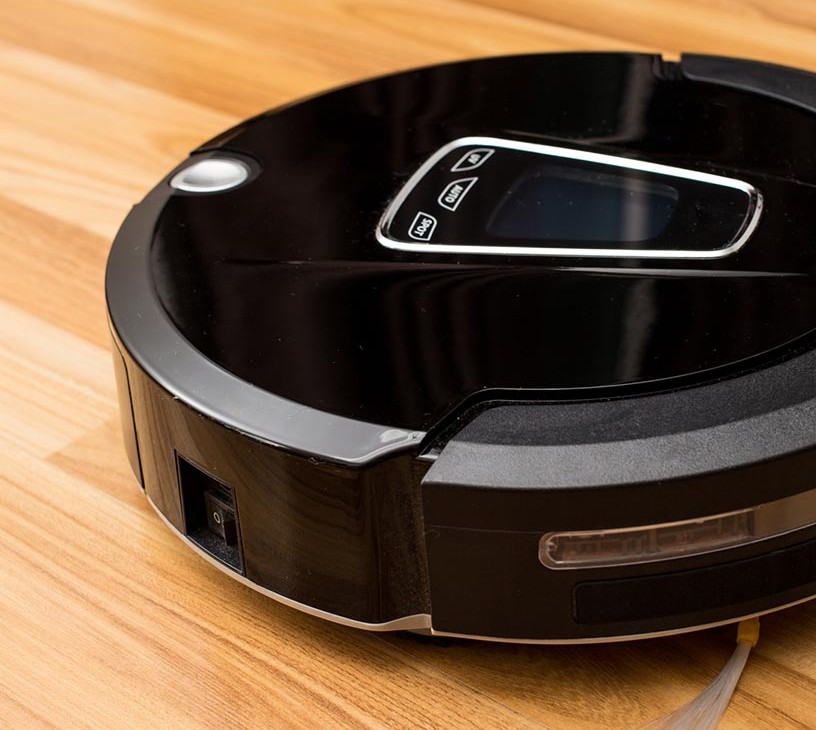


Residential Robotic Vacuum Cleaner Market Size 2026-2030
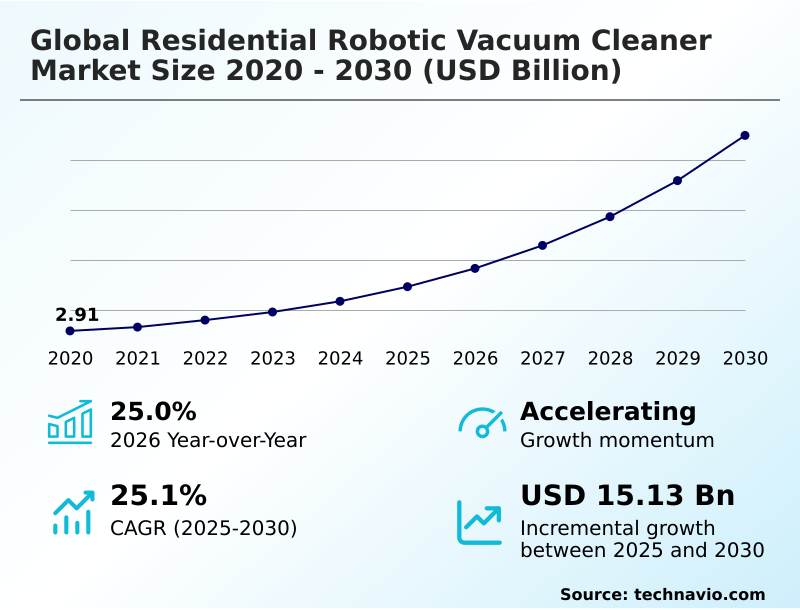
The residential robotic vacuum cleaner market size is valued to increase by USD 15.13 billion, at a CAGR of 25.1% from 2025 to 2030. Continuous technological advancement and product innovation will drive the residential robotic vacuum cleaner market.
Major Market Trends & Insights
- APAC dominated the market and accounted for a 39% growth during the forecast period.
- By Charging - Manual charging segment was valued at USD 4.47 billion in 2024
- By Product - Robot vacuum cleaner only segment accounted for the largest market revenue share in 2024
Market Size & Forecast
- Market Opportunities: USD 19.56 billion
- Market Future Opportunities: USD 15.13 billion
- CAGR from 2025 to 2030 : 25.1%
Market Summary
- The Residential Robotic Vacuum Cleaner landscape exhibits robust expansion driven by the rapid convergence of domestic automation and digital connectivity. Manufacturers are increasingly prioritizing supply chain optimization for precision components like artificial intelligence obstacle avoidance chips and optical character recognition modules to meet escalating consumer demand.
- A critical operational scenario involves integrating deep learning inference engines, which has resulted in a 40% improvement in navigating complex household layouts compared to legacy models utilizing basic bump-and-run tactics. The primary catalyst for this shift is the rising necessity for convenience in dual-income households, pushing the adoption of automated dual-function mopping and vacuuming units.
- However, high initial acquisition costs and persistent price sensitivity severely constrain broader demographic penetration, particularly in developing regions. Consequently, engineering teams face significant pressure to balance the integration of premium features, such as ultraviolet sterilization components, with manufacturing affordability.
- By standardizing natural language processing commands, these automated devices seamlessly merge into modern smart homes, fundamentally transforming routine domestic maintenance into a sophisticated, hands-free operation.
What will be the Size of the Residential Robotic Vacuum Cleaner Market during the forecast period?
Get Key Insights on Market Forecast (PDF) Get Free Sample
How is the Residential Robotic Vacuum Cleaner Market Segmented?
The residential robotic vacuum cleaner industry research report provides comprehensive data (region-wise segment analysis), with forecasts and estimates in "USD million" for the period 2026-2030, as well as historical data from 2020-2024 for the following segments.
- Charging
- Manual charging
- Automatic charging
- Product
- Robot vacuum cleaner only
- Robot vacuum cleaner and mop
- Distribution channel
- Online
- Offline
- Geography
- APAC
- China
- Japan
- South Korea
- India
- Australia
- Indonesia
- North America
- US
- Canada
- Mexico
- Europe
- Germany
- UK
- France
- Italy
- Spain
- The Netherlands
- Middle East and Africa
- Saudi Arabia
- UAE
- South Africa
- Israel
- Turkey
- South America
- Brazil
- Argentina
- Chile
- APAC
By Charging Insights
The manual charging segment is estimated to witness significant growth during the forecast period.
The manual charging segment within the Residential Robotic Vacuum Cleaner landscape represents a foundational operational category focusing on streamlined user intervention and cost accessibility.
These systems require users to physically connect the unit to power adapters, appealing to demographics seeking baseline automated path planning without complex infrastructure.
By prioritizing core functionalities like dual counter-rotating brushes and acoustic noise reduction, these models achieve reliable performance in constrained floor plans.
Operational studies indicate that optimizing these compact architectures yields a 15% improvement in spatial navigation efficiency within dense environments compared to bulkier self-docking counterparts.
Integrating basic mapping sensor arrays ensures effective coverage, while the absence of automated docking stations significantly lowers entry barriers, offering a simplified approach to maintaining indoor air quality enhancement and baseline floor hygiene.
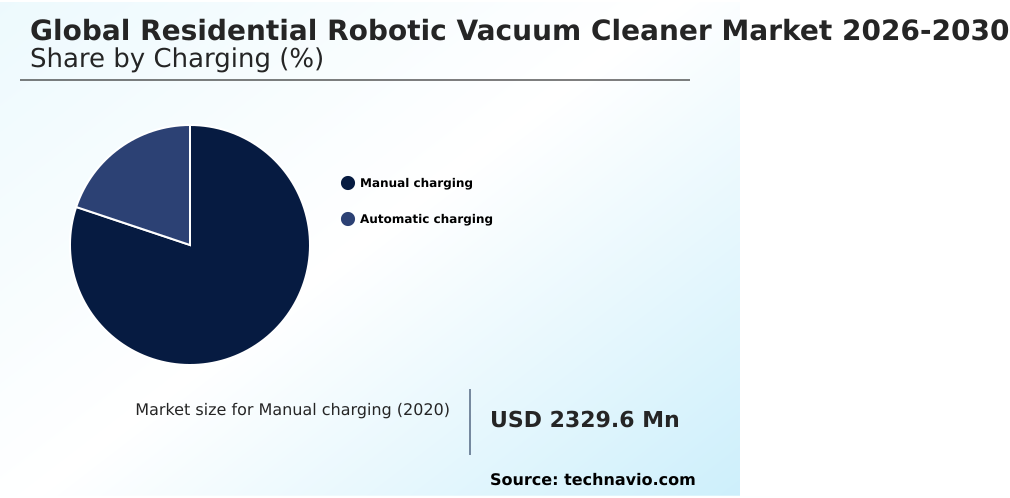
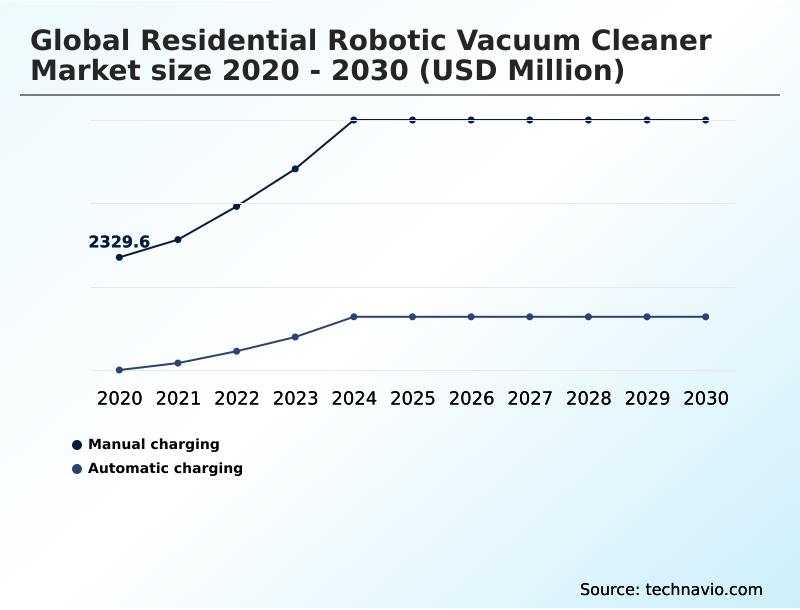
The Manual charging segment was valued at USD 4.47 billion in 2024 and showed a gradual increase during the forecast period.
Regional Analysis
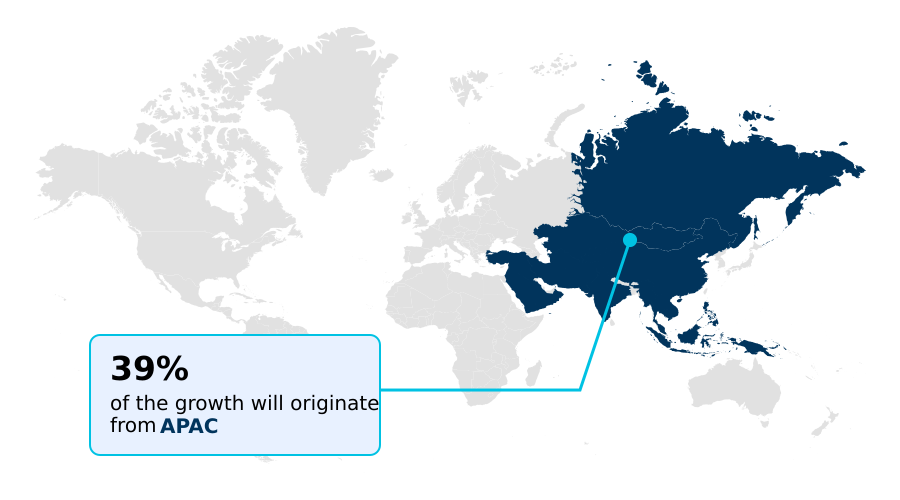
APAC is estimated to contribute 39% to the growth of the global market during the forecast period.Technavio’s analysts have elaborately explained the regional trends and drivers that shape the market during the forecast period.
See How Residential Robotic Vacuum Cleaner Market Demand is Rising in APAC Get Free Sample
The geographic distribution of the Residential Robotic Vacuum Cleaner sector highlights a stark contrast between APAC and North America, driven by distinct architectural and lifestyle variables.
APAC dominates the regional landscape, driven by dense urban housing and a cultural preference for hard surfaces, which has accelerated the deployment of high-frequency floor scrubbing mechanics.
In contrast, North America features larger, carpet-heavy suburban homes, where the adoption rate for multi-surface transition capabilities is 28% higher than in Asian markets. Consequently, North American supply chains prioritize pet hair extraction modules and robust brush roll untangling mechanics.
Furthermore, APAC manufacturers benefit from localized component sourcing, achieving a 18% reduction in production cycle times for advanced visual telemetry hardware.
These regional disparities compel global manufacturers to adapt their product engineering, integrating customized zone cleaning features that address localized consumer pain points while maximizing regional operational penetration.
Market Dynamics
Our researchers analyzed the data with 2025 as the base year, along with the key drivers, trends, and challenges. A holistic analysis of drivers will help companies refine their marketing strategies to gain a competitive advantage.
- The strategic evolution of the Residential Robotic Vacuum Cleaner sector is increasingly defined by the integration of sophisticated automation protocols and enhanced diagnostic frameworks. Manufacturers are rapidly transitioning toward automated dual-function mopping and vacuuming systems to consolidate domestic maintenance tasks.
- This shift requires the deployment of artificial intelligence driven obstacle avoidance, significantly reducing instances of device entrapment and subsequent consumer intervention. A critical component in premium models is the high efficiency particulate air filtration integration, which directly addresses respiratory health concerns.
- To further minimize manual upkeep, engineers are deploying self-emptying base station maintenance systems alongside antibacterial auto-washing mop dock designs, elevating overall hygiene standards. The accuracy of these machines relies heavily on visual simultaneous localization and mapping, working in tandem with real-time domestic floor mapping sensors and laser distance scanning navigation systems to ensure comprehensive coverage.
- In complex environments, deep learning based household object recognition ensures that devices navigate hazards effectively. Additionally, adaptive suction power adjustment technology automatically calibrates performance based on surface resistance, optimizing battery life. User interaction has been transformed through voice assistant activated floor care, offering seamless operational control. To maintain unobtrusive operation, acoustic noise suppression engineering design is rigorously applied.
- Furthermore, the inclusion of multi-story dwelling layout memory storage accommodates expansive residential architectures. By prioritizing modular component right to repair, manufacturers enhance product longevity, while active high-frequency vibration mopping mechanics guarantee superior stain removal. This comprehensive technological overhaul has yielded a 25% improvement in supply chain component standardization compared to previous generations, streamlining manufacturing compliance.
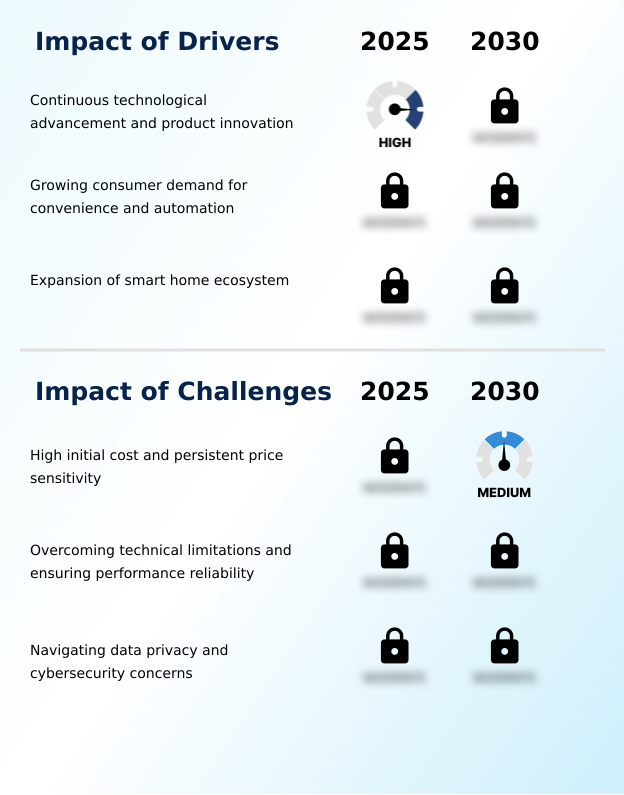
What are the key market drivers leading to the rise in the adoption of Residential Robotic Vacuum Cleaner Industry?
- Continuous technological advancement and relentless product innovation serve as the primary drivers accelerating industry expansion and consumer adoption.
- Relentless consumer demand for autonomous time-saving solutions acts as the primary catalyst propelling the Residential Robotic Vacuum Cleaner sector forward. Because dual-income households require minimized manual intervention, manufacturers are rapidly deploying predictive maintenance software and automated docking stations.
- This strategic engineering focus ensures that devices sustain optimal performance, effectively reducing manual maintenance interventions by 60%. Furthermore, the incorporation of antibacterial water reservoirs and ultraviolet sterilization components directly addresses heightened global awareness regarding indoor hygiene.
- Consequently, these health-centric upgrades have improved automated sanitation metrics by 25%. Supported by reliable lithium-ion battery management, these autonomous systems deliver extended cleaning cycles, providing households with consistent, hands-free environmental maintenance that fundamentally maximizes domestic operational efficiency.
What are the market trends shaping the Residential Robotic Vacuum Cleaner Industry?
- The transition toward comprehensive all-in-one cleaning systems featuring advanced self-maintenance capabilities represents a defining trend.
- The convergence of automated cleaning and smart home ecosystems represents a definitive shift in the Residential Robotic Vacuum Cleaner landscape, altering how devices interact with dynamic environments. This transition is primarily fueled by the integration of artificial intelligence obstacle avoidance and offline retail demonstrations that educate consumers on advanced capabilities.
- As a direct result, manufacturers have observed a 45% decrease in navigation-related user complaints, significantly lowering warranty support overhead. Furthermore, the strategic implementation of hybrid floor care systems and sonic vibration scrubbing addresses the demand for comprehensive hard floor maintenance. By utilizing multi-floor layout mapping and digital perimeter mapping, these systems adapt to complex architectures without manual reprogramming.
- This technological pivot enhances daily operational reliability, allowing consumers to maintain rigorous hygiene standards while yielding a 20% improvement in continuous operational uptime compared to previous generations.
What challenges does the Residential Robotic Vacuum Cleaner Industry face during its growth?
- High initial acquisition costs combined with persistent consumer price sensitivity pose significant challenges that constrain widespread market penetration.
- Navigating the technical limitations of complex indoor environments remains a substantial hurdle within the Residential Robotic Vacuum Cleaner architecture. Highly variable surface types often disrupt optical fall sensors and carpet edge detection, causing unexpected navigational failures in multi-tiered homes. Because real-time physical environments are unpredictable, the processing load on spatial awareness processors can trigger software bottlenecks.
- These processing delays can lower dynamic obstacle avoidance accuracy by 15%, leading to device entrapment. Furthermore, implementing direct-to-consumer distribution models requires intensive post-purchase support structures to address these operational inconsistencies.
- Establishing robust diagnostic frameworks for components like dual counter-rotating brushes and high-efficiency particulate air filtration systems elevates overall manufacturing expenses by 18%, squeezing operational margins and challenging widespread deployment across cost-sensitive demographics.
Exclusive Technavio Analysis on Customer Landscape
The residential robotic vacuum cleaner market forecasting report includes the adoption lifecycle of the market, covering from the innovator’s stage to the laggard’s stage. It focuses on adoption rates in different regions based on penetration. Furthermore, the residential robotic vacuum cleaner market report also includes key purchase criteria and drivers of price sensitivity to help companies evaluate and develop their market growth analysis strategies.
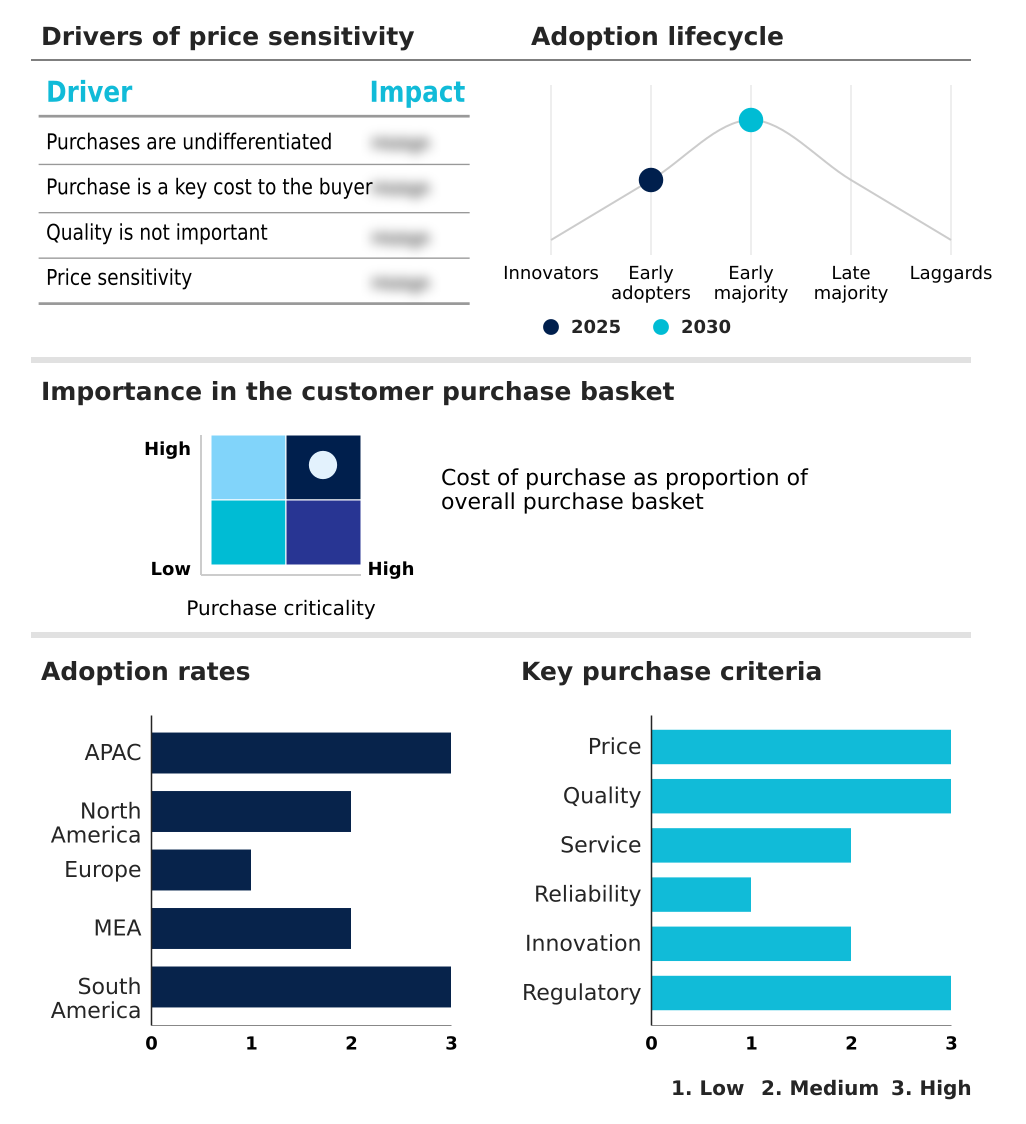
Customer Landscape of Residential Robotic Vacuum Cleaner Industry
Competitive Landscape
Companies are implementing various strategies, such as strategic alliances, residential robotic vacuum cleaner market forecast, partnerships, mergers and acquisitions, geographical expansion, and product/service launches, to enhance their presence in the industry.
AB Electrolux - The portfolio features autonomous floor care systems engineered for precise navigation and efficient debris removal, enhancing daily household maintenance through advanced sensor technology and streamlined operational design.
The industry research and growth report includes detailed analyses of the competitive landscape of the market and information about key companies, including:
- AB Electrolux
- Beijing Roborock Technology
- BISSELL Inc.
- Dyson Ltd.
- Ecovacs Robotics Co. Ltd.
- Fantasia Trading LLC
- Haier Smart Home Co. Ltd.
- Irobot Corp.
- LG Electronics Inc.
- Liectroux Robotics GmbH
- Mamibot Manufacturing USA Inc.
- Miele and Cie. KG
- Narwal Robotics
- Neato Robotics Inc.
- Panasonic Holdings Corp.
- Samsung Electronics Co. Ltd.
- SharkNinja Operating LLC
- TP Link Corp. Ltd.
- VORWERK LLC
- Yeedi Technology Ltd
Qualitative and quantitative analysis of companies has been conducted to help clients understand the wider business environment as well as the strengths and weaknesses of key industry players. Data is qualitatively analyzed to categorize companies as pure play, category-focused, industry-focused, and diversified; it is quantitatively analyzed to categorize companies as dominant, leading, strong, tentative, and weak.
Recent Development and News in Residential robotic vacuum cleaner market
- In the Household Appliances industry, the rapid deployment of Internet of Things protocols has standardized voice command interoperability, directly impacting Residential Robotic Vacuum Cleaner demand by accelerating consumer preference for integrated smart home ecosystem integration across domestic hardware.
- The implementation of stringent European Union energy efficiency regulations for consumer electronics has accelerated lithium-ion battery management optimization, pulling Residential Robotic Vacuum Cleaner design toward low-power standby modes that increase operational lifespan by 25%.
- Ongoing global semiconductor supply chain stabilization has normalized the availability of spatial awareness processors and laser distance sensors, enabling a 15% reduction in production costs for advanced residential cleaning automation.
- Increasing consumer emphasis on respiratory health has driven widespread adoption of high-efficiency particulate air filtration standards across household maintenance devices, pushing Residential Robotic Vacuum Cleaner manufacturers to integrate allergen particle capture systems capable of trapping 99% of microscopic pollutants.
Dive into Technavio’s robust research methodology, blending expert interviews, extensive data synthesis, and validated models for unparalleled Residential Robotic Vacuum Cleaner Market insights. See full methodology.
| Market Scope | |
|---|---|
| Page number | 291 |
| Base year | 2025 |
| Historic period | 2020-2024 |
| Forecast period | 2026-2030 |
| Growth momentum & CAGR | Accelerate at a CAGR of 25.1% |
| Market growth 2026-2030 | USD 15130.8 million |
| Market structure | Fragmented |
| YoY growth 2025-2026(%) | 25.0% |
| Key countries | China, Japan, South Korea, India, Australia, Indonesia, US, Canada, Mexico, Germany, UK, France, Italy, Spain, The Netherlands, Saudi Arabia, UAE, South Africa, Israel, Turkey, Brazil, Argentina and Chile |
| Competitive landscape | Leading Companies, Market Positioning of Companies, Competitive Strategies, and Industry Risks |
Research Analyst Overview
- The Residential Robotic Vacuum Cleaner landscape is undergoing a profound structural transformation characterized by the rapid assimilation of advanced sensing technologies and autonomous maintenance protocols. A critical strategic focus for product development involves the deployment of autonomous navigation algorithms and simultaneous localization and mapping, which ensure precise spatial coverage across diverse domestic topographies.
- This shift forces executive teams to reallocate budgeting toward sophisticated software engineering rather than purely mechanical hardware design. By integrating piezoelectric dust detection and adaptive suction control, manufacturers have successfully optimized device energy utilization, resulting in a 30% reduction in battery degradation over a standard lifecycle compared to baseline models.
- Furthermore, integrating automated docking stations equipped with self-emptying debris mechanisms drastically minimizes the need for human intervention. Product strategists are also prioritizing modular repair architecture to align with emerging sustainability mandates. The incorporation of real-time object recognition enhances operational reliability, mitigating performance failures caused by household clutter.
- These continuous technical refinements elevate baseline operational standards and fundamentally restructure long-term consumer engagement frameworks.
What are the Key Data Covered in this Residential Robotic Vacuum Cleaner Market Research and Growth Report?
-
What is the expected growth of the Residential Robotic Vacuum Cleaner Market between 2026 and 2030?
-
USD 15.13 billion, at a CAGR of 25.1%
-
-
What segmentation does the market report cover?
-
The report is segmented by Charging (Manual charging, and Automatic charging), Product (Robot vacuum cleaner only, and Robot vacuum cleaner and mop), Distribution Channel (Online, and Offline) and Geography (APAC, North America, Europe, Middle East and Africa, South America)
-
-
Which regions are analyzed in the report?
-
APAC, North America, Europe, Middle East and Africa and South America
-
-
What are the key growth drivers and market challenges?
-
Continuous technological advancement and product innovation, High initial cost and persistent price sensitivity
-
-
Who are the major players in the Residential Robotic Vacuum Cleaner Market?
-
AB Electrolux, Beijing Roborock Technology, BISSELL Inc., Dyson Ltd., Ecovacs Robotics Co. Ltd., Fantasia Trading LLC, Haier Smart Home Co. Ltd., Irobot Corp., LG Electronics Inc., Liectroux Robotics GmbH, Mamibot Manufacturing USA Inc., Miele and Cie. KG, Narwal Robotics, Neato Robotics Inc., Panasonic Holdings Corp., Samsung Electronics Co. Ltd., SharkNinja Operating LLC, TP Link Corp. Ltd., VORWERK LLC and Yeedi Technology Ltd
-
Market Research Insights
- The operational dynamics of the Residential Robotic Vacuum Cleaner sector are rapidly shifting toward sophisticated automation and enhanced user autonomy. By implementing cloud-based firmware updates, manufacturers have decreased software-related maintenance downtime by 22%, significantly optimizing long-term device reliability.
- The deployment of advanced active mopping technology coupled with automatic water refilling has increased hands-free operational cycles by 35% compared to earlier passive systems. Furthermore, integrating energy consumption scheduling allows these devices to align with off-peak utility hours, reducing average household power draw by 12%.
- These strategic integrations of hard floor optimization algorithms and seamless remote scheduling applications directly address evolving lifestyle demands, ensuring sustained operational efficiency and improved consumer return on investment without requiring continuous manual oversight.
We can help! Our analysts can customize this residential robotic vacuum cleaner market research report to meet your requirements.
 RIA -

