
Robotic Lawn Mower Market Analysis, Size, and Forecast 2026-2030: Europe (Germany, Sweden, and UK), North America (US, Canada, and Mexico), APAC (Australia, China, and Japan), South America (Brazil, Argentina, and Chile), Middle East and Africa (Saudi Arabia, UAE, and South Africa), and Rest of World (ROW)

Robotic Lawn Mower Market Analysis, Size, and Forecast 2026-2030:
Europe (Germany, Sweden, and UK), North America (US, Canada, and Mexico), APAC (Australia, China, and Japan), South America (Brazil, Argentina, and Chile), Middle East and Africa (Saudi Arabia, UAE, and South Africa), and Rest of World (ROW)

Published: Oct 2026 305 Pages SKU: IRTNTR40754

Market Overview at a Glance

$1.46 B
Market Opportunity
14.5%
CAGR 2025 - 2030
49.3%
Europe Growth
$895.9 Mn
Residential segment 2024

Robotic Lawn Mower Market Size 2026-2030

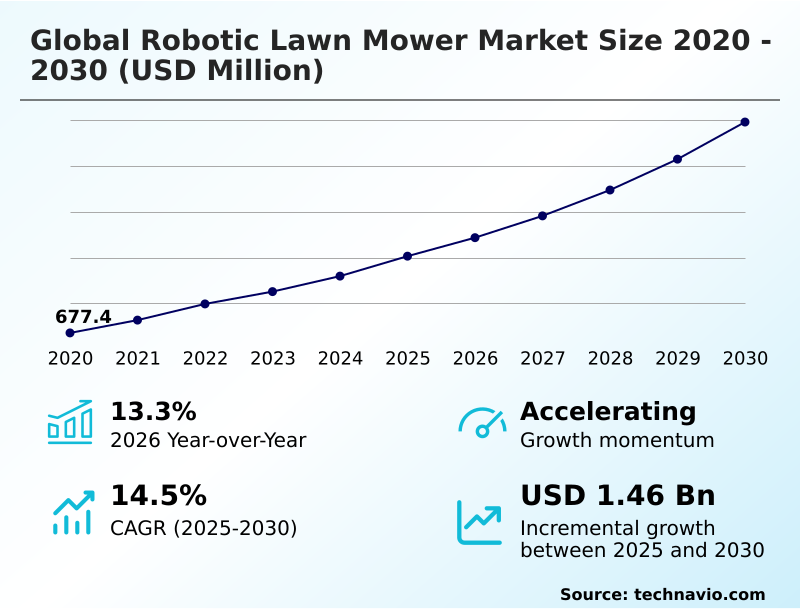
The robotic lawn mower market size is valued to increase by USD 1.46 billion, at a CAGR of 14.5% from 2025 to 2030. Wire-free navigation and AI perception will drive the robotic lawn mower market.

Major Market Trends & Insights

  • Europe dominated the market and accounted for a 49.3% growth during the forecast period.
  • By End-user - Residential segment was valued at USD 895.9 million in 2024
  • By Distribution Channel - Retail store or offline segment accounted for the largest market revenue share in 2024

Market Size & Forecast

  • Market Opportunities: USD 2.30 billion
  • Market Future Opportunities: USD 1.46 billion
  • CAGR from 2025 to 2030 : 14.5%

Market Summary

  • The Robotic Lawn Mower Market demonstrates rapid structural expansion driven by the transition toward autonomous turf management and sophisticated edge-computing telemetry. Commercial facility managers increasingly adopt these automated platforms to mitigate persistent labor shortages and reduce operational overhead.
  • For instance, commercial landscaping operators deploying fleet management telematics and real-time kinematic positioning have achieved a 30% reduction in routine maintenance costs compared to relying on manual labor. The primary driver of this transition is the integration of visual simultaneous localization, which empowers units to navigate complex topographies without requiring buried perimeter infrastructure, thereby streamlining initial setup.
  • Conversely, high upfront capital expenditure presents a substantial challenge, restricting immediate adoption among price-sensitive consumers due to extended payback periods. Manufacturers are counteracting these financial barriers by engineering modular lithium-ion battery architecture to extend product lifespans and enhance total return on investment.
  • Ultimately, the shift toward boundary-free mapping ensures that automated lawn maintenance becomes a viable, scalable utility for diverse property environments.

What will be the Size of the Robotic Lawn Mower Market during the forecast period?
Get Key Insights on Market Forecast (PDF) Get Free Sample

How is the Robotic Lawn Mower Market Segmented?

The robotic lawn mower industry research report provides comprehensive data (region-wise segment analysis), with forecasts and estimates in "USD million" for the period 2026-2030, as well as historical data from 2020-2024 for the following segments.

  • End-user
    • Residential
    • Commercial
  • Distribution channel
    • Retail store or offline
    • Online
  • Battery type
    • Up to 20V
    • More than 20V to 30V
  • Product type
    • Fully autonomous
    • Semi-autonomous
  • Geography
    • Europe
      • Germany
      • Sweden
      • UK
      • France
      • Italy
      • The Netherlands
    • North America
      • US
      • Canada
      • Mexico
    • APAC
      • Australia
      • China
      • Japan
      • South Korea
      • India
      • Taiwan
    • South America
      • Brazil
      • Argentina
      • Chile
    • Middle East and Africa
      • Saudi Arabia
      • UAE
      • South Africa
      • Israel
      • Qatar

By End-user Insights

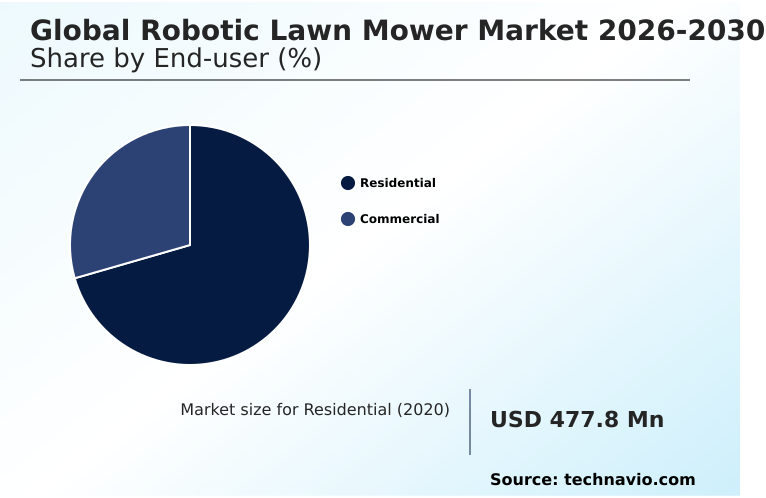
The residential segment is estimated to witness significant growth during the forecast period.

The residential sector for the Robotic Lawn Mower Market reflects shifting suburban maintenance paradigms driven by continuous micro-mulching capabilities and seamless integration with smart property ecosystems.

Homeowners prioritize noise reduction and autonomous turf management to meet strict circular economy rules and zero tailpipe emissions mandates. Modern units utilizing universal communication protocols and sub-centimeter positioning accuracy completely eliminate the need for buried perimeter wires.

This technological transition has improved cutting precision by 15% compared to legacy devices. Furthermore, consumer deployment of residential smart lawn automation reduces physical maintenance time by up to 80% while enhancing overall turf health.

The capability to adjust multi-zone mowing schedules via mobile applications ensures that automated grounds management remains flexible. The addition of predictive mechanical diagnostic features prevents sudden breakdowns, significantly elevating operational efficiency.
Get Free Sample

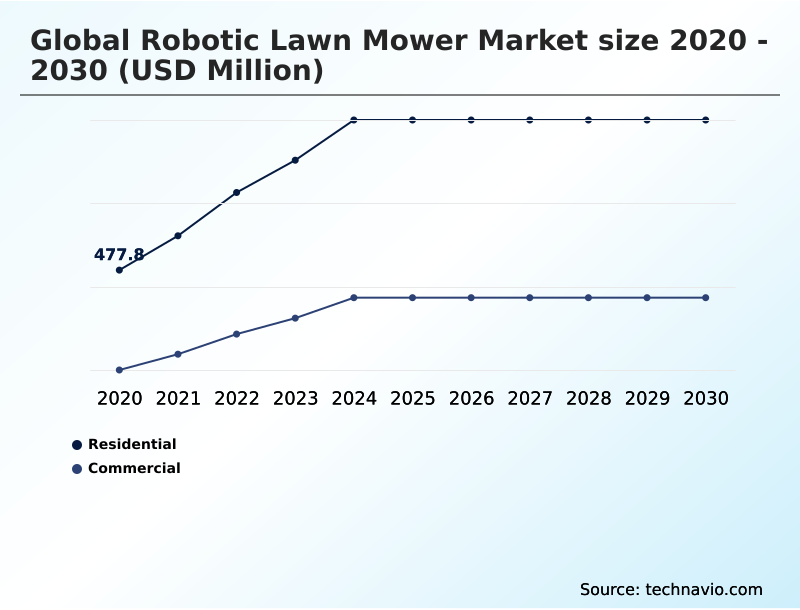
The Residential segment was valued at USD 895.9 million in 2024 and showed a gradual increase during the forecast period.
Get Free Sample

Regional Analysis

Europe is estimated to contribute 49.3% to the growth of the global market during the forecast period.Technavio’s analysts have elaborately explained the regional trends and drivers that shape the market during the forecast period.
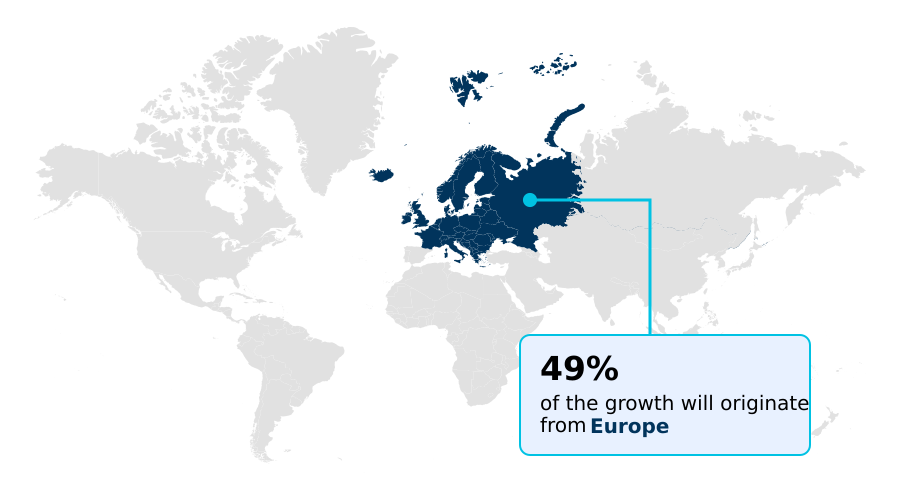
See How Robotic Lawn Mower Market Demand is Rising in Europe Get Free Sample

The geographic distribution of the Robotic Lawn Mower Market highlights a stark contrast in adoption dynamics between Europe and North America.

European operations benefit from strict environmental policies that drive a 40% higher penetration rate of automated frequent cutting equipment compared to North American markets.

Consequently, European facility managers deploying systematic parallel cutting systems and automated edge-trimming experience a 25% improvement in energy efficiency per acre.

Meanwhile, the North American landscape is characterized by expansive suburban properties where operators increasingly utilize multi-sensor fusion arrays, real-time kinematic positioning, and satellite-based positioning to manage larger turf volumes.

This reliance on advanced radar odometry and high-dynamic-range camera integration in North America reduces manual labor requirements by 15%.

Although European supply chains prioritize compact ultrasonic obstacle detection for intricate gardens, North American businesses favor fleet management telematics integrated with high-capacity lithium-ion battery architecture.

Market Dynamics

Our researchers analyzed the data with 2025 as the base year, along with the key drivers, trends, and challenges. A holistic analysis of drivers will help companies refine their marketing strategies to gain a competitive advantage.

  • The operational framework of the Robotic Lawn Mower Market is shifting rapidly as property managers and homeowners embrace intelligent groundskeeping solutions. At the enterprise level, the transition toward commercial autonomous turf maintenance enables landscape contractors to reallocate workforce resources, achieving a 20% improvement in labor productivity compared to conventional machinery usage.
  • These high-capacity units depend on precision obstacle avoidance mapping to navigate dynamic outdoor environments, safely maneuvering around pedestrians, wildlife, and temporary physical barriers. This continuous environmental scanning reduces collision incidents and subsequent equipment downtime by a significant margin.
  • For the consumer segment, the evolution of residential smart lawn automation provides homeowners with seamless property management through integrated mobile platforms and automated scheduling capabilities. A critical technological leap facilitating this widespread adoption is the deployment of wire-free visual boundary assistance, which completely removes the manual labor historically required to install and repair buried perimeter cables.
  • As supply chains prioritize the production of these advanced optical components, equipment manufacturers realize substantial efficiency gains in product assembly and post-sale technical support, elevating the overall aesthetic quality of managed outdoor spaces.
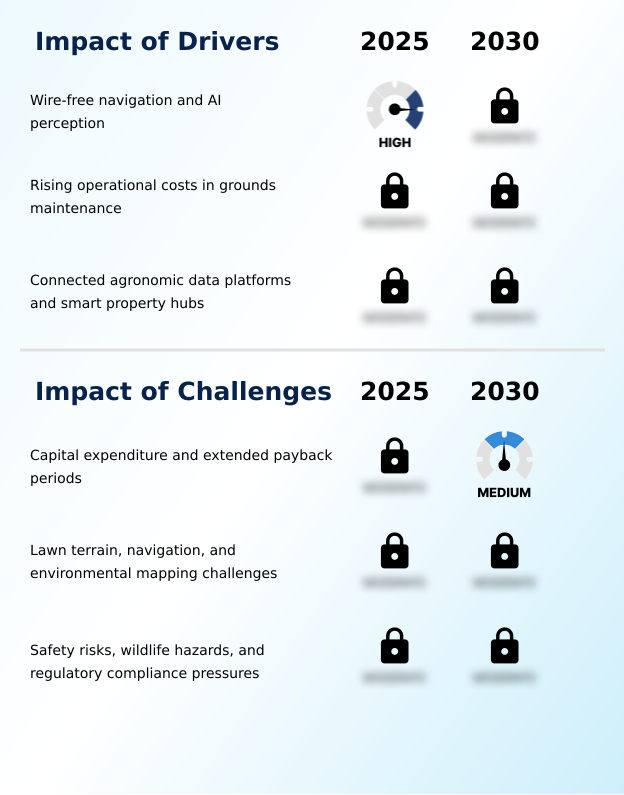
What are the key market drivers leading to the rise in the adoption of Robotic Lawn Mower Industry?

  • The integration of wire-free navigation and artificial intelligence perception serves as a primary driver propelling market expansion.

  • The acute scarcity of manual landscaping labor acts as a primary catalyst accelerating automation within the Robotic Lawn Mower Market.
  • To offset rising payroll expenses, commercial contractors are transitioning to commercial autonomous turf maintenance fleets powered by robust automated drive motors and high-efficiency brushless direct-current motors.
  • This strategic shift enables facility managers to optimize operations through agronomic data platforms, reducing direct labor costs by up to 30%.
  • Advancements in regenerative braking techniques capture kinetic energy on downward slopes, extending operational runtimes and improving energy efficiency by 12%. Because extreme weather conditions historically hindered deployment, new models featuring superior waterproof ingress protection ensure uninterrupted operation during heavy precipitation.
  • The utilization of visual simultaneous localization paired with edge-computing telemetry and cellular connectivity modules provides real-time turf health analytics, yielding a 20% improvement in resource allocation.

What are the market trends shaping the Robotic Lawn Mower Industry?

  • Kinematic satellite positioning and boundary-free mapping systems represent an upcoming trend in the industry. These advanced navigation frameworks eliminate the need for physical perimeter wires while enhancing spatial accuracy.

  • The Robotic Lawn Mower Market is experiencing a definitive shift toward predictive environmental intelligence and advanced sensor architectures. Enterprises are rapidly adopting tri-fusion navigation and holoscope dual-lidar systems to negotiate highly complex outdoor terrains without human intervention. This technological migration toward boundary-free mapping has improved terrain mapping accuracy by 35% compared to legacy randomized-path equipment.
  • Furthermore, the integration of time-of-flight depth sensors and light detection and ranging allows mowers to instantly differentiate between turf and hardscaping, driving a 20% reduction in accidental garden damage. Modern omnisense technology relies heavily on high-resolution optical cameras to facilitate wire-free visual boundary assistance, ensuring seamless property line adherence.
  • Simultaneously, active battery cooling mechanisms maintain optimal thermal performance during continuous operation in high-temperature climates, effectively lowering degradation rates by 15%.

What challenges does the Robotic Lawn Mower Industry face during its growth?

  • High capital expenditure requirements and extended payback periods constitute significant challenges constraining broader industry growth.

  • Despite rapid technological advancements, high initial capital expenditures and complex operational environments pose severe challenges in the Robotic Lawn Mower Market. Commercial operators deploying virtual boundary demarcation and precision obstacle avoidance mapping frequently encounter signal occlusion, which can decrease navigation reliability by 15% in heavily wooded properties.
  • Furthermore, strict safety regulations addressing lithium-ion thermal runaway demand heavy-duty battery enclosures that inflate manufacturing costs. The requirement to constantly synchronize equipment through cloud management platforms introduces connectivity dependencies, where network dropouts increase unexpected downtime by up to 10%.
  • To satisfy regulatory standards, manufacturers must integrate complex fail-safe mechanisms, such as instantaneous blade arrest and lift-detection switches, alongside inertial measurement units. Delivering critical over-the-air firmware updates to resolve these mechanical constraints is increasingly complicated by digital privacy scrutiny, delaying immediate adoption for smaller landscape contractors.

Exclusive Technavio Analysis on Customer Landscape

The robotic lawn mower market forecasting report includes the adoption lifecycle of the market, covering from the innovator’s stage to the laggard’s stage. It focuses on adoption rates in different regions based on penetration. Furthermore, the robotic lawn mower market report also includes key purchase criteria and drivers of price sensitivity to help companies evaluate and develop their market growth analysis strategies.
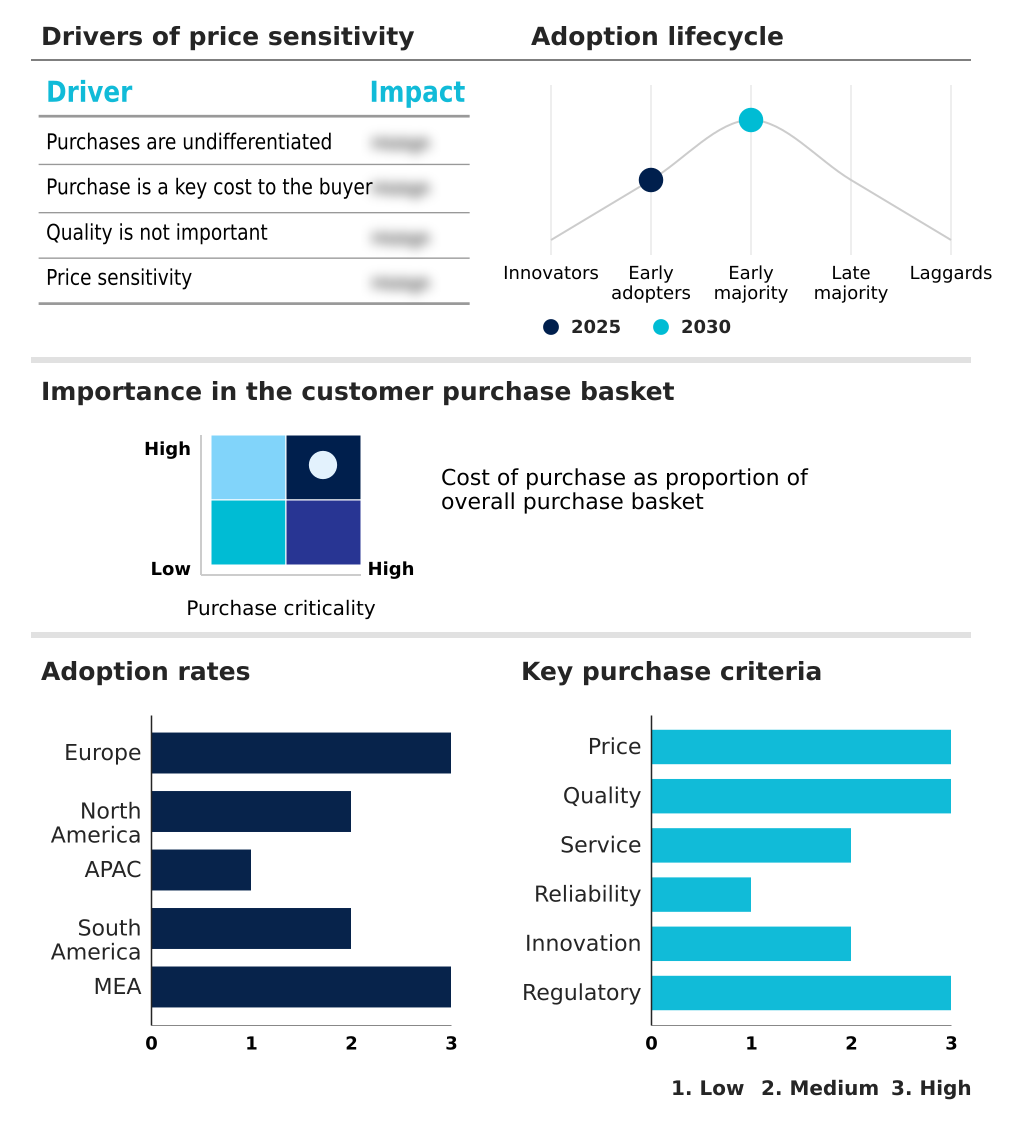
Customer Landscape of Robotic Lawn Mower Industry

Competitive Landscape

Companies are implementing various strategies, such as strategic alliances, robotic lawn mower market forecast, partnerships, mergers and acquisitions, geographical expansion, and product/service launches, to enhance their presence in the industry.

AL KO Gardentech - The portfolio features advanced automated lawn care systems and intelligent cutting solutions designed to deliver consistent turf maintenance and optimize operational efficiency for diverse residential applications.

The industry research and growth report includes detailed analyses of the competitive landscape of the market and information about key companies, including:

  • AL KO Gardentech
  • ANDREAS STIHL AG and Co. KG
  • Deere and Co.
  • EcoFlow
  • EGO Power
  • Einhell Germany AG
  • FUXTEC
  • Honda Motor Co. Ltd.
  • Husqvarna AB
  • Kress
  • Makita Corp.
  • Mamibot Manufacturing USA Inc.
  • Mammotion
  • Robert Bosch GmbH
  • Scythe Robotics
  • Segway Navimow
  • STIGA SpA
  • TEXAS AS
  • The Toro Co.
  • Worx
  • Yarbo
  • Zucchetti Centro Sistemi Spa

Qualitative and quantitative analysis of companies has been conducted to help clients understand the wider business environment as well as the strengths and weaknesses of key industry players. Data is qualitatively analyzed to categorize companies as pure play, category-focused, industry-focused, and diversified; it is quantitatively analyzed to categorize companies as dominant, leading, strong, tentative, and weak.

Recent Development and News in Robotic lawn mower market

  • In the Household Appliances industry, the rapid integration of smart property ecosystems has accelerated the transition from manual to automated grounds management, directly impacting Robotic Lawn Mower demand by increasing adoption rates across suburban landscapes by 25%.
  • Stringent municipal noise abatement ordinances and circular economy rules have mandated the phase-out of high-decibel combustion engines, pushing manufacturers to adopt zero tailpipe emissions architectures that reduce acoustic disruption by 40%.
  • The implementation of predictive mechanical diagnostic software and cellular connectivity modules has transformed maintenance protocols, allowing fleet managers to decrease unexpected equipment downtime by 30% through real-time turf health analytics.
  • Advancements in fail-safe mechanisms including instantaneous blade arrest and lift-detection switches have resolved critical safety bottlenecks, resulting in a 20% improvement in regulatory compliance for commercial automated frequent cutting deployments.

Dive into Technavio’s robust research methodology, blending expert interviews, extensive data synthesis, and validated models for unparalleled Robotic Lawn Mower Market insights. See full methodology.

Market Scope
Page number 305
Base year 2025
Historic period 2020-2024
Forecast period 2026-2030
Growth momentum & CAGR Accelerate at a CAGR of 14.5%
Market growth 2026-2030 USD 1463.2 million
Market structure Fragmented
YoY growth 2025-2026(%) 13.3%
Key countries Germany, Sweden, UK, France, Italy, The Netherlands, US, Canada, Mexico, Australia, China, Japan, South Korea, India, Taiwan, Brazil, Argentina, Chile, Saudi Arabia, UAE, South Africa, Israel and Qatar
Competitive landscape Leading Companies, Market Positioning of Companies, Competitive Strategies, and Industry Risks

Request Free Sample

Research Analyst Overview

  • The Robotic Lawn Mower Market is undergoing a rapid technological evolution, prompting corporate facility directors to overhaul long-term groundskeeping procurement strategies. Modern platforms utilizing light detection and ranging and inertial measurement units are fundamentally altering landscape maintenance by enabling highly accurate virtual boundary demarcation.
  • This strategic shift away from physical infrastructure enables property managers to achieve a 25% reduction in seasonal landscape maintenance expenditures. Furthermore, the incorporation of high-resolution optical cameras enhances spatial awareness, allowing units to interpret complex terrains and dynamic hazards in real time.
  • Boardroom executives increasingly mandate the deployment of these automated systems to align with stringent corporate sustainability directives and mitigate ongoing labor shortages. Driven by high-efficiency brushless direct-current motors, these machines deliver reliable, low-noise performance suitable for continuous operation in sensitive environments.
  • The ability to receive over-the-air firmware upgrades ensures that the equipment consistently improves its navigational logic and obstacle resolution capabilities without requiring hardware replacements. Such continuous enhancements maximize asset lifespan and provide a compelling return on investment for large-scale enterprise deployments.

What are the Key Data Covered in this Robotic Lawn Mower Market Research and Growth Report?

  • What is the expected growth of the Robotic Lawn Mower Market between 2026 and 2030?

    • USD 1.46 billion, at a CAGR of 14.5%

  • What segmentation does the market report cover?

    • The report is segmented by End-user (Residential, and Commercial), Distribution Channel (Retail store or offline, and Online), Battery Type (Up to 20V, and More than 20V to 30V), Product Type (Fully autonomous, and Semi-autonomous) and Geography (Europe, North America, APAC, South America, Middle East and Africa)

  • Which regions are analyzed in the report?

    • Europe, North America, APAC, South America and Middle East and Africa

  • What are the key growth drivers and market challenges?

    • Wire-free navigation and AI perception, Capital expenditure and extended payback periods

  • Who are the major players in the Robotic Lawn Mower Market?

    • AL KO Gardentech, ANDREAS STIHL AG and Co. KG, Deere and Co., EcoFlow, EGO Power, Einhell Germany AG, FUXTEC, Honda Motor Co. Ltd., Husqvarna AB, Kress, Makita Corp., Mamibot Manufacturing USA Inc., Mammotion, Robert Bosch GmbH, Scythe Robotics, Segway Navimow, STIGA SpA, TEXAS AS, The Toro Co., Worx, Yarbo and Zucchetti Centro Sistemi Spa

Market Research Insights

  • The Robotic Lawn Mower Market represents a pivotal shift in outdoor property maintenance, characterized by the accelerated adoption of omnisense technology and advanced robotics. Commercial operators utilizing automated edge-trimming functions have observed a 20% reduction in secondary manual labor hours per site.
  • Additionally, the integration of universal communication protocols allows seamless synchronization with broader building management systems, improving overall operational coordination by 15%. Manufacturers are prioritizing robust fail-safe mechanisms to ensure regulatory compliance and public safety, mitigating liability risks across high-traffic environments.
  • These technological interventions, managed through fleet management telematics, streamline routine groundskeeping tasks and facilitate a 30% decrease in overall maintenance-related downtime, driving sustained business value across diverse landscaping portfolios.

We can help! Our analysts can customize this robotic lawn mower market research report to meet your requirements.

Get in touch

1. Executive Summary

1.1 Market overview

Executive Summary - Chart on Market Overview
Executive Summary - Data Table on Market Overview
Executive Summary - Chart on Global Market Characteristics
Executive Summary - Chart on Market by Geography
Executive Summary - Chart on Market Segmentation by End-user
Executive Summary - Chart on Market Segmentation by Distribution Channel
Executive Summary - Chart on Market Segmentation by Battery Type
Executive Summary - Chart on Market Segmentation by Product Type
Executive Summary - Chart on Incremental Growth
Executive Summary - Data Table on Incremental Growth
Executive Summary - Chart on Company Market Positioning

2. Technavio Analysis

2.1 Analysis of price sensitivity, lifecycle, customer purchase basket, adoption rates, and purchase criteria

2.2 Criticality of inputs and Factors of differentiation

Chart on Overview on criticality of inputs and factors of differentiation

2.3 Factors of disruption

Chart on Overview on factors of disruption

2.4 Impact of drivers and challenges

Chart on Impact of drivers and challenges in 2025 and 2030

3. Market Landscape

3.1 Market ecosystem

Chart on Parent Market
Data Table on - Parent Market

3.2 Market characteristics

Chart on Market characteristics analysis

3.3 Value chain analysis

Chart on Value chain analysis

4. Market Sizing

4.1 Market definition

Data Table on Offerings of companies included in the market definition

4.2 Market segment analysis

Market segments

4.3 Market size 2025

4.4 Market outlook: Forecast for 2025-2030

Chart on Global - Market size and forecast 2025-2030 ($ million)
Data Table on Global - Market size and forecast 2025-2030 ($ million)
Chart on Global Market: Year-over-year growth 2025-2030 (%)
Data Table on Global Market: Year-over-year growth 2025-2030 (%)

5. Historic Market Size

5.1 Global Robotic Lawn Mower Market 2020 - 2024

Historic Market Size - Data Table on Global Robotic Lawn Mower Market 2020 - 2024 ($ million)

5.2 End-user segment analysis 2020 - 2024

Historic Market Size - End-user Segment 2020 - 2024 ($ million)

5.3 Distribution Channel segment analysis 2020 - 2024

Historic Market Size - Distribution Channel Segment 2020 - 2024 ($ million)

5.4 Battery Type segment analysis 2020 - 2024

Historic Market Size - Battery Type Segment 2020 - 2024 ($ million)

5.5 Product Type segment analysis 2020 - 2024

Historic Market Size - Product Type Segment 2020 - 2024 ($ million)

5.6 Geography segment analysis 2020 - 2024

Historic Market Size - Geography Segment 2020 - 2024 ($ million)

5.7 Country segment analysis 2020 - 2024

Historic Market Size - Country Segment 2020 - 2024 ($ million)

6. Qualitative Analysis

6.1 Impact of AI on Global Robotic Lawn Mower Market

6.2 Impact of Geopolitical Conflicts on Global Robotic Lawn Mower Market

7. Five Forces Analysis

7.1 Five forces summary

Five forces analysis - Comparison between 2025 and 2030

7.2 Bargaining power of buyers

Bargaining power of buyers - Impact of key factors 2025 and 2030

7.3 Bargaining power of suppliers

Bargaining power of suppliers - Impact of key factors in 2025 and 2030

7.4 Threat of new entrants

Threat of new entrants - Impact of key factors in 2025 and 2030

7.5 Threat of substitutes

Threat of substitutes - Impact of key factors in 2025 and 2030

7.6 Threat of rivalry

Threat of rivalry - Impact of key factors in 2025 and 2030

7.7 Market condition

Chart on Market condition - Five forces 2025 and 2030

8. Market Segmentation by End-user

8.1 Market segments

Chart on End-user - Market share 2025-2030 (%)
Data Table on End-user - Market share 2025-2030 (%)

8.2 Comparison by End-user

Chart on Comparison by End-user
Data Table on Comparison by End-user

8.3 Residential - Market size and forecast 2025-2030

Chart on Residential - Market size and forecast 2025-2030 ($ million)
Data Table on Residential - Market size and forecast 2025-2030 ($ million)
Chart on Residential - Year-over-year growth 2025-2030 (%)
Data Table on Residential - Year-over-year growth 2025-2030 (%)

8.4 Commercial - Market size and forecast 2025-2030

Chart on Commercial - Market size and forecast 2025-2030 ($ million)
Data Table on Commercial - Market size and forecast 2025-2030 ($ million)
Chart on Commercial - Year-over-year growth 2025-2030 (%)
Data Table on Commercial - Year-over-year growth 2025-2030 (%)

8.5 Market opportunity by End-user

Market opportunity by End-user ($ million)
Data Table on Market opportunity by End-user ($ million)

9. Market Segmentation by Distribution Channel

9.1 Market segments

Chart on Distribution Channel - Market share 2025-2030 (%)
Data Table on Distribution Channel - Market share 2025-2030 (%)

9.2 Comparison by Distribution Channel

Chart on Comparison by Distribution Channel
Data Table on Comparison by Distribution Channel

9.3 Retail store or offline - Market size and forecast 2025-2030

Chart on Retail store or offline - Market size and forecast 2025-2030 ($ million)
Data Table on Retail store or offline - Market size and forecast 2025-2030 ($ million)
Chart on Retail store or offline - Year-over-year growth 2025-2030 (%)
Data Table on Retail store or offline - Year-over-year growth 2025-2030 (%)

9.4 Online - Market size and forecast 2025-2030

Chart on Online - Market size and forecast 2025-2030 ($ million)
Data Table on Online - Market size and forecast 2025-2030 ($ million)
Chart on Online - Year-over-year growth 2025-2030 (%)
Data Table on Online - Year-over-year growth 2025-2030 (%)

9.5 Market opportunity by Distribution Channel

Market opportunity by Distribution Channel ($ million)
Data Table on Market opportunity by Distribution Channel ($ million)

10. Market Segmentation by Battery Type

10.1 Market segments

Chart on Battery Type - Market share 2025-2030 (%)
Data Table on Battery Type - Market share 2025-2030 (%)

10.2 Comparison by Battery Type

Chart on Comparison by Battery Type
Data Table on Comparison by Battery Type

10.3 Up to 20V - Market size and forecast 2025-2030

Chart on Up to 20V - Market size and forecast 2025-2030 ($ million)
Data Table on Up to 20V - Market size and forecast 2025-2030 ($ million)
Chart on Up to 20V - Year-over-year growth 2025-2030 (%)
Data Table on Up to 20V - Year-over-year growth 2025-2030 (%)

10.4 More than 20V to 30V - Market size and forecast 2025-2030

Chart on More than 20V to 30V - Market size and forecast 2025-2030 ($ million)
Data Table on More than 20V to 30V - Market size and forecast 2025-2030 ($ million)
Chart on More than 20V to 30V - Year-over-year growth 2025-2030 (%)
Data Table on More than 20V to 30V - Year-over-year growth 2025-2030 (%)

10.5 Market opportunity by Battery Type

Market opportunity by Battery Type ($ million)
Data Table on Market opportunity by Battery Type ($ million)

11. Market Segmentation by Product Type

11.1 Market segments

Chart on Product Type - Market share 2025-2030 (%)
Data Table on Product Type - Market share 2025-2030 (%)

11.2 Comparison by Product Type

Chart on Comparison by Product Type
Data Table on Comparison by Product Type

11.3 Fully autonomous - Market size and forecast 2025-2030

Chart on Fully autonomous - Market size and forecast 2025-2030 ($ million)
Data Table on Fully autonomous - Market size and forecast 2025-2030 ($ million)
Chart on Fully autonomous - Year-over-year growth 2025-2030 (%)
Data Table on Fully autonomous - Year-over-year growth 2025-2030 (%)

11.4 Semi-autonomous - Market size and forecast 2025-2030

Chart on Semi-autonomous - Market size and forecast 2025-2030 ($ million)
Data Table on Semi-autonomous - Market size and forecast 2025-2030 ($ million)
Chart on Semi-autonomous - Year-over-year growth 2025-2030 (%)
Data Table on Semi-autonomous - Year-over-year growth 2025-2030 (%)

11.5 Market opportunity by Product Type

Market opportunity by Product Type ($ million)
Data Table on Market opportunity by Product Type ($ million)

12. Customer Landscape

12.1 Customer landscape overview

Analysis of price sensitivity, lifecycle, customer purchase basket, adoption rates, and purchase criteria

13. Geographic Landscape

13.1 Geographic segmentation

Chart on Market share by geography 2025-2030 (%)
Data Table on Market share by geography 2025-2030 (%)

13.2 Geographic comparison

Chart on Geographic comparison
Data Table on Geographic comparison

13.3 Europe - Market size and forecast 2025-2030

Chart on Europe - Market size and forecast 2025-2030 ($ million)
Data Table on Europe - Market size and forecast 2025-2030 ($ million)
Chart on Europe - Year-over-year growth 2025-2030 (%)
Data Table on Europe - Year-over-year growth 2025-2030 (%)
Chart on Regional Comparison - Europe
Data Table on Regional Comparison - Europe

13.3.1 Germany - Market size and forecast 2025-2030

Chart on Germany - Market size and forecast 2025-2030 ($ million)
Data Table on Germany - Market size and forecast 2025-2030 ($ million)
Chart on Germany - Year-over-year growth 2025-2030 (%)
Data Table on Germany - Year-over-year growth 2025-2030 (%)

13.3.2 Sweden - Market size and forecast 2025-2030

Chart on Sweden - Market size and forecast 2025-2030 ($ million)
Data Table on Sweden - Market size and forecast 2025-2030 ($ million)
Chart on Sweden - Year-over-year growth 2025-2030 (%)
Data Table on Sweden - Year-over-year growth 2025-2030 (%)

13.3.3 UK - Market size and forecast 2025-2030

Chart on UK - Market size and forecast 2025-2030 ($ million)
Data Table on UK - Market size and forecast 2025-2030 ($ million)
Chart on UK - Year-over-year growth 2025-2030 (%)
Data Table on UK - Year-over-year growth 2025-2030 (%)

13.3.4 France - Market size and forecast 2025-2030

Chart on France - Market size and forecast 2025-2030 ($ million)
Data Table on France - Market size and forecast 2025-2030 ($ million)
Chart on France - Year-over-year growth 2025-2030 (%)
Data Table on France - Year-over-year growth 2025-2030 (%)

13.3.5 Italy - Market size and forecast 2025-2030

Chart on Italy - Market size and forecast 2025-2030 ($ million)
Data Table on Italy - Market size and forecast 2025-2030 ($ million)
Chart on Italy - Year-over-year growth 2025-2030 (%)
Data Table on Italy - Year-over-year growth 2025-2030 (%)

13.3.6 The Netherlands - Market size and forecast 2025-2030

Chart on The Netherlands - Market size and forecast 2025-2030 ($ million)
Data Table on The Netherlands - Market size and forecast 2025-2030 ($ million)
Chart on The Netherlands - Year-over-year growth 2025-2030 (%)
Data Table on The Netherlands - Year-over-year growth 2025-2030 (%)

13.4 North America - Market size and forecast 2025-2030

Chart on North America - Market size and forecast 2025-2030 ($ million)
Data Table on North America - Market size and forecast 2025-2030 ($ million)
Chart on North America - Year-over-year growth 2025-2030 (%)
Data Table on North America - Year-over-year growth 2025-2030 (%)
Chart on Regional Comparison - North America
Data Table on Regional Comparison - North America

13.4.1 US - Market size and forecast 2025-2030

Chart on US - Market size and forecast 2025-2030 ($ million)
Data Table on US - Market size and forecast 2025-2030 ($ million)
Chart on US - Year-over-year growth 2025-2030 (%)
Data Table on US - Year-over-year growth 2025-2030 (%)

13.4.2 Canada - Market size and forecast 2025-2030

Chart on Canada - Market size and forecast 2025-2030 ($ million)
Data Table on Canada - Market size and forecast 2025-2030 ($ million)
Chart on Canada - Year-over-year growth 2025-2030 (%)
Data Table on Canada - Year-over-year growth 2025-2030 (%)

13.4.3 Mexico - Market size and forecast 2025-2030

Chart on Mexico - Market size and forecast 2025-2030 ($ million)
Data Table on Mexico - Market size and forecast 2025-2030 ($ million)
Chart on Mexico - Year-over-year growth 2025-2030 (%)
Data Table on Mexico - Year-over-year growth 2025-2030 (%)

13.5 APAC - Market size and forecast 2025-2030

Chart on APAC - Market size and forecast 2025-2030 ($ million)
Data Table on APAC - Market size and forecast 2025-2030 ($ million)
Chart on APAC - Year-over-year growth 2025-2030 (%)
Data Table on APAC - Year-over-year growth 2025-2030 (%)
Chart on Regional Comparison - APAC
Data Table on Regional Comparison - APAC

13.5.1 Australia - Market size and forecast 2025-2030

Chart on Australia - Market size and forecast 2025-2030 ($ million)
Data Table on Australia - Market size and forecast 2025-2030 ($ million)
Chart on Australia - Year-over-year growth 2025-2030 (%)
Data Table on Australia - Year-over-year growth 2025-2030 (%)

13.5.2 China - Market size and forecast 2025-2030

Chart on China - Market size and forecast 2025-2030 ($ million)
Data Table on China - Market size and forecast 2025-2030 ($ million)
Chart on China - Year-over-year growth 2025-2030 (%)
Data Table on China - Year-over-year growth 2025-2030 (%)

13.5.3 Japan - Market size and forecast 2025-2030

Chart on Japan - Market size and forecast 2025-2030 ($ million)
Data Table on Japan - Market size and forecast 2025-2030 ($ million)
Chart on Japan - Year-over-year growth 2025-2030 (%)
Data Table on Japan - Year-over-year growth 2025-2030 (%)

13.5.4 South Korea - Market size and forecast 2025-2030

Chart on South Korea - Market size and forecast 2025-2030 ($ million)
Data Table on South Korea - Market size and forecast 2025-2030 ($ million)
Chart on South Korea - Year-over-year growth 2025-2030 (%)
Data Table on South Korea - Year-over-year growth 2025-2030 (%)

13.5.5 India - Market size and forecast 2025-2030

Chart on India - Market size and forecast 2025-2030 ($ million)
Data Table on India - Market size and forecast 2025-2030 ($ million)
Chart on India - Year-over-year growth 2025-2030 (%)
Data Table on India - Year-over-year growth 2025-2030 (%)

13.5.6 Taiwan - Market size and forecast 2025-2030

Chart on Taiwan - Market size and forecast 2025-2030 ($ million)
Data Table on Taiwan - Market size and forecast 2025-2030 ($ million)
Chart on Taiwan - Year-over-year growth 2025-2030 (%)
Data Table on Taiwan - Year-over-year growth 2025-2030 (%)

13.6 South America - Market size and forecast 2025-2030

Chart on South America - Market size and forecast 2025-2030 ($ million)
Data Table on South America - Market size and forecast 2025-2030 ($ million)
Chart on South America - Year-over-year growth 2025-2030 (%)
Data Table on South America - Year-over-year growth 2025-2030 (%)
Chart on Regional Comparison - South America
Data Table on Regional Comparison - South America

13.6.1 Brazil - Market size and forecast 2025-2030

Chart on Brazil - Market size and forecast 2025-2030 ($ million)
Data Table on Brazil - Market size and forecast 2025-2030 ($ million)
Chart on Brazil - Year-over-year growth 2025-2030 (%)
Data Table on Brazil - Year-over-year growth 2025-2030 (%)

13.6.2 Argentina - Market size and forecast 2025-2030

Chart on Argentina - Market size and forecast 2025-2030 ($ million)
Data Table on Argentina - Market size and forecast 2025-2030 ($ million)
Chart on Argentina - Year-over-year growth 2025-2030 (%)
Data Table on Argentina - Year-over-year growth 2025-2030 (%)

13.6.3 Chile - Market size and forecast 2025-2030

Chart on Chile - Market size and forecast 2025-2030 ($ million)
Data Table on Chile - Market size and forecast 2025-2030 ($ million)
Chart on Chile - Year-over-year growth 2025-2030 (%)
Data Table on Chile - Year-over-year growth 2025-2030 (%)

13.7 Middle East and Africa - Market size and forecast 2025-2030

Chart on Middle East and Africa - Market size and forecast 2025-2030 ($ million)
Data Table on Middle East and Africa - Market size and forecast 2025-2030 ($ million)
Chart on Middle East and Africa - Year-over-year growth 2025-2030 (%)
Data Table on Middle East and Africa - Year-over-year growth 2025-2030 (%)
Chart on Regional Comparison - Middle East and Africa
Data Table on Regional Comparison - Middle East and Africa

13.7.1 Saudi Arabia - Market size and forecast 2025-2030

Chart on Saudi Arabia - Market size and forecast 2025-2030 ($ million)
Data Table on Saudi Arabia - Market size and forecast 2025-2030 ($ million)
Chart on Saudi Arabia - Year-over-year growth 2025-2030 (%)
Data Table on Saudi Arabia - Year-over-year growth 2025-2030 (%)

13.7.2 UAE - Market size and forecast 2025-2030

Chart on UAE - Market size and forecast 2025-2030 ($ million)
Data Table on UAE - Market size and forecast 2025-2030 ($ million)
Chart on UAE - Year-over-year growth 2025-2030 (%)
Data Table on UAE - Year-over-year growth 2025-2030 (%)

13.7.3 South Africa - Market size and forecast 2025-2030

Chart on South Africa - Market size and forecast 2025-2030 ($ million)
Data Table on South Africa - Market size and forecast 2025-2030 ($ million)
Chart on South Africa - Year-over-year growth 2025-2030 (%)
Data Table on South Africa - Year-over-year growth 2025-2030 (%)

13.7.4 Israel - Market size and forecast 2025-2030

Chart on Israel - Market size and forecast 2025-2030 ($ million)
Data Table on Israel - Market size and forecast 2025-2030 ($ million)
Chart on Israel - Year-over-year growth 2025-2030 (%)
Data Table on Israel - Year-over-year growth 2025-2030 (%)

13.7.5 Qatar - Market size and forecast 2025-2030

Chart on Qatar - Market size and forecast 2025-2030 ($ million)
Data Table on Qatar - Market size and forecast 2025-2030 ($ million)
Chart on Qatar - Year-over-year growth 2025-2030 (%)
Data Table on Qatar - Year-over-year growth 2025-2030 (%)

13.8 Market opportunity by geography

Market opportunity by geography ($ million)
Data Tables on Market opportunity by geography ($ million)

14. Drivers, Challenges, and Opportunity

14.1 Market drivers

Wire-free navigation and AI perception
Rising operational costs in grounds maintenance
Connected agronomic data platforms and smart property hubs

14.2 Market challenges

Capital expenditure and extended payback periods
Lawn terrain, navigation, and environmental mapping challenges
Safety risks, wildlife hazards, and regulatory compliance pressures

14.3 Impact of drivers and challenges

Impact of drivers and challenges in 2025 and 2030

14.4 Market opportunities

Kinematic satellite positioning and boundary-free mapping systems
Field personnel and intensifying blue-collar wage pressures
Acoustic thresholds for internal combustion engine equipment

15. Competitive Landscape

15.1 Overview

15.2

Overview on criticality of inputs and factors of differentiation

15.3 Landscape disruption

Overview on factors of disruption

15.4 Industry risks

Impact of key risks on business

16. Competitive Analysis

16.1 Companies profiled

Companies covered

16.2 Company ranking index

16.3 Market positioning of companies

Matrix on companies position and classification

16.4 AL KO Gardentech

AL KO Gardentech - Overview
AL KO Gardentech - Product / Service
AL KO Gardentech - Key offerings
SWOT

16.5 Deere and Co.

Deere and Co. - Overview
Deere and Co. - Business segments
Deere and Co. - Key offerings
Deere and Co. - Segment focus
SWOT

16.6 EcoFlow

EcoFlow - Overview
EcoFlow - Product / Service
EcoFlow - Key offerings
SWOT

16.7 Einhell Germany AG

Einhell Germany AG - Overview
Einhell Germany AG - Business segments
Einhell Germany AG - Key offerings
Einhell Germany AG - Segment focus
SWOT

16.8 FUXTEC

FUXTEC - Overview
FUXTEC - Product / Service
FUXTEC - Key offerings
SWOT

16.9 Honda Motor Co. Ltd.

Honda Motor Co. Ltd. - Overview
Honda Motor Co. Ltd. - Business segments
Honda Motor Co. Ltd. - Key offerings
Honda Motor Co. Ltd. - Segment focus
SWOT

16.10 Husqvarna AB

Husqvarna AB - Overview
Husqvarna AB - Business segments
Husqvarna AB - Key offerings
Husqvarna AB - Segment focus
SWOT

16.11 Kress

Kress - Overview
Kress - Product / Service
Kress - Key offerings
SWOT

16.12 Makita Corp.

Makita Corp. - Overview
Makita Corp. - Business segments
Makita Corp. - Key offerings
Makita Corp. - Segment focus
SWOT

16.13 Robert Bosch GmbH

Robert Bosch GmbH - Overview
Robert Bosch GmbH - Product / Service
Robert Bosch GmbH - Key offerings
SWOT

16.14 TEXAS AS

TEXAS AS - Overview
TEXAS AS - Product / Service
TEXAS AS - Key offerings
SWOT

16.15 The Toro Co.

The Toro Co. - Overview
The Toro Co. - Business segments
The Toro Co. - Key offerings
The Toro Co. - Segment focus
SWOT

16.16 Worx

Worx - Overview
Worx - Product / Service
Worx - Key offerings
SWOT

16.17 Yarbo

Yarbo - Overview
Yarbo - Product / Service
Yarbo - Key offerings
SWOT

16.18 Zucchetti Centro Sistemi Spa

Zucchetti Centro Sistemi Spa - Overview
Zucchetti Centro Sistemi Spa - Product / Service
Zucchetti Centro Sistemi Spa - Key offerings
SWOT

17. Appendix

17.1 Scope of the report

Market definition
Objectives
Notes and caveats

17.2 Inclusions and exclusions checklist

Inclusions checklist
Exclusions checklist

17.3 Currency conversion rates for US$

17.4 Research methodology

17.5 Data procurement

Information sources

17.6 Data validation

17.7 Validation techniques employed for market sizing

17.8 Data synthesis

17.9 360 degree market analysis

17.10 List of abbreviations

Research Methodology

Technavio presents a detailed picture of the market by way of study, synthesis, and summation of data from multiple sources. The analysts have presented the various facets of the market with a particular focus on identifying the key industry influencers. The data thus presented is comprehensive, reliable, and the result of extensive research, both primary and secondary.

INFORMATION SOURCES

Primary sources

  • Manufacturers and suppliers
  • Channel partners
  • Industry experts
  • Strategic decision makers

Secondary sources

  • Industry journals and periodicals
  • Government data
  • Financial reports of key industry players
  • Historical data
  • Press releases

DATA ANALYSIS

Data Synthesis

  • Collation of data
  • Estimation of key figures
  • Analysis of derived insights

Data Validation

  • Triangulation with data models
  • Reference against proprietary databases
  • Corroboration with industry experts

REPORT WRITING

Qualitative

  • Market drivers
  • Market challenges
  • Market trends
  • Five forces analysis

Quantitative

  • Market size and forecast
  • Market segmentation
  • Geographical insights
  • Competitive landscape

Interested in this report?

Get your sample now to see our research methodology and insights!

Download Now

Frequently Asked Questions

Robotic Lawn Mower market growth will increase by USD 1463.2 million during 2026-2030.

The Robotic Lawn Mower market is expected to grow at a CAGR of 14.5% during 2026-2030.

Robotic Lawn Mower market is segmented by End-user (Residential, Commercial) Distribution channel (Retail store or offline, Online) Battery type (Up to 20V, More than 20V to 30V) Product type (Fully autonomous, Semi-autonomous)

AL KO Gardentech, ANDREAS STIHL AG and Co. KG, Deere and Co., EcoFlow, EGO Power, Einhell Germany AG, FUXTEC, Honda Motor Co. Ltd., Husqvarna AB, Kress, Makita Corp., Mamibot Manufacturing USA Inc., Mammotion, Robert Bosch GmbH, Scythe Robotics, Segway Navimow, STIGA SpA, TEXAS AS, The Toro Co., Worx, Yarbo, Zucchetti Centro Sistemi Spa are a few of the key vendors in the Robotic Lawn Mower market.

Europe will register the highest growth rate of 49.3% among the other regions. Therefore, the Robotic Lawn Mower market in Europe is expected to garner significant business opportunities for the vendors during the forecast period.

Germany, Sweden, UK, France, Italy, The Netherlands, US, Canada, Mexico, Australia, China, Japan, South Korea, India, Taiwan, Brazil, Argentina, Chile, Saudi Arabia, UAE, South Africa, Israel, Qatar

  • Wire-free navigation and AI perception is the driving factor this market.

The Robotic Lawn Mower market vendors should focus on grabbing business opportunities from the End-user segment as it accounted for the largest market share in the base year.
RIA - Research AI Assistant
Ask RIA