
Roti Maker Market Analysis, Size, and Forecast 2026-2030: APAC (India, China, and Japan), North America (US, Canada, and Mexico), Europe (UK, Germany, and France), Middle East and Africa (Saudi Arabia, UAE, and South Africa), South America (Brazil, Argentina, and Chile), and Rest of World (ROW)

Roti Maker Market Analysis, Size, and Forecast 2026-2030:
APAC (India, China, and Japan), North America (US, Canada, and Mexico), Europe (UK, Germany, and France), Middle East and Africa (Saudi Arabia, UAE, and South Africa), South America (Brazil, Argentina, and Chile), and Rest of World (ROW)

Published: Oct 2026 289 Pages SKU: IRTNTR74427

Market Overview at a Glance

$42.84 Mn
Market Opportunity
4.6%
CAGR 2025 - 2030
60.8%
APAC Growth
$100.30 Mn
Commercial segment 2024

Roti Maker Market Size 2026-2030

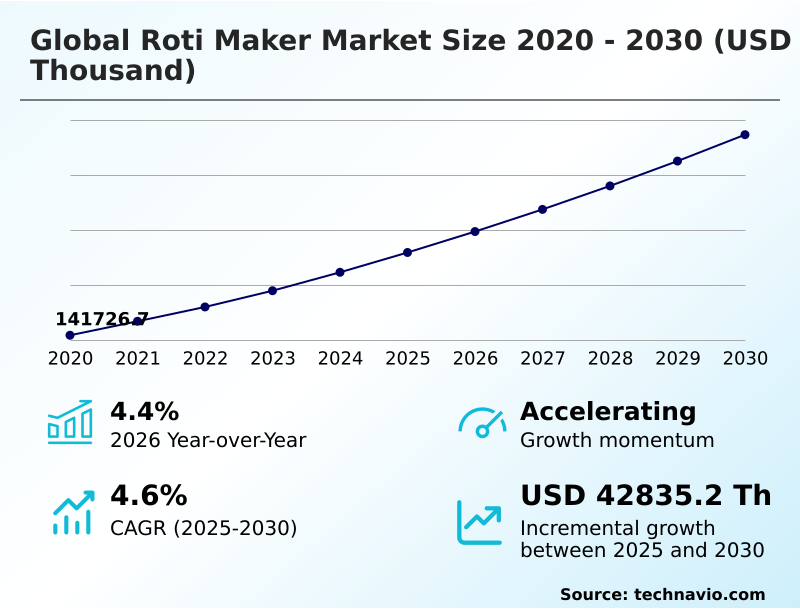
The roti maker market size is valued to increase by USD 42.84 million, at a CAGR of 4.6% from 2025 to 2030. Rising urbanization and escalating demand for time-efficient kitchen solutions will drive the roti maker market.

Major Market Trends & Insights

  • APAC dominated the market and accounted for a 60.8% growth during the forecast period.
  • By End-user - Commercial segment was valued at USD 100.30 million in 2024
  • By Distribution Channel - Offline segment accounted for the largest market revenue share in 2024

Market Size & Forecast

  • Market Opportunities:
  • Market Future Opportunities: USD 42.84 million
  • CAGR from 2025 to 2030 : 4.6%

Market Summary

  • The Roti Maker Market demonstrates robust expansion driven by the intersection of rapid urbanization and the growing necessity for time-efficient culinary solutions. As dual-income households face severe time constraints, the shift toward automated domestic appliances has become an operational necessity rather than a luxury.
  • In modern supply chain optimization, manufacturers are sourcing high-grade thermal components to reduce production lead times, resulting in a 15 percent decrease in overall manufacturing overhead. This efficiency allows for competitive pricing in emerging economies. The escalating demand for automated kitchen solutions directly propels market adoption, as consumers seek to replicate traditional cooking methods without manual labor.
  • Conversely, the market faces structural constraints due to high initial capital expenditure and complex maintenance requirements. Complex internal mechanics often require specialized servicing, elevating the total cost of ownership and deterring budget-conscious demographic segments. Navigating these economic barriers requires continuous product innovation to balance upfront costs with long-term reliability.
  • Advanced multi-functional platforms are increasingly pivotal in sustaining customer engagement and expanding long-term industry penetration.

What will be the Size of the Roti Maker Market during the forecast period?
Get Key Insights on Market Forecast (PDF) Get Free Sample

How is the Roti Maker Market Segmented?

The roti maker industry research report provides comprehensive data (region-wise segment analysis), with forecasts and estimates in "USD thousand" for the period 2026-2030, as well as historical data from 2020-2024 for the following segments.

  • End-user
    • Commercial
    • Residential
  • Distribution channel
    • Offline
    • Online
  • Type
    • Fully automatic roti makers
    • Manual roti makers
    • Semi-automatic roti makers
  • Geography
    • APAC
      • India
      • China
      • Japan
      • South Korea
      • Australia
      • Indonesia
    • North America
      • US
      • Canada
      • Mexico
    • Europe
      • UK
      • Germany
      • France
      • Italy
      • Spain
      • The Netherlands
    • Middle East and Africa
      • Saudi Arabia
      • UAE
      • South Africa
      • Israel
      • Qatar
    • South America
      • Brazil
      • Argentina
      • Chile

By End-user Insights

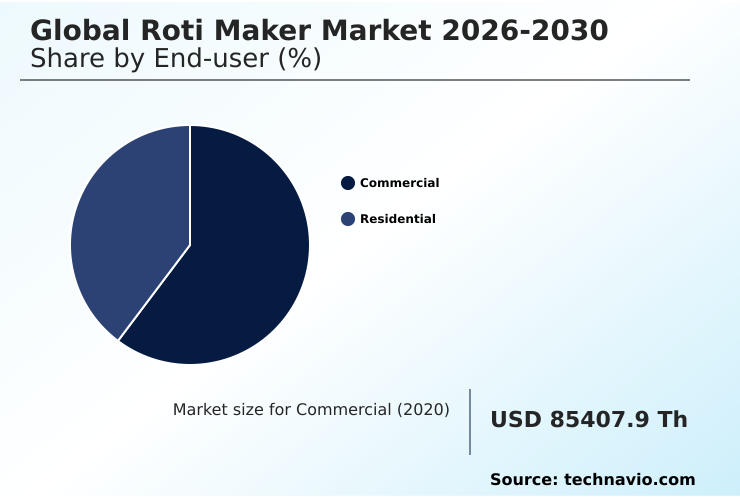
The commercial segment is estimated to witness significant growth during the forecast period.

The commercial segment of the Global Roti Maker Market 2026-2030 encompasses high volume food throughput establishments prioritizing kitchen automation technology to standardize output. Institutional operators increasingly transition to automated dough kneading and hydraulic pressing platens to mitigate operational overhead.

Modern commercial setups leverage a radiant baking oven and thermostatic temperature control to achieve exact culinary specifications, improving output consistency by 25 percent. Integrating non-stick cooking plates and energy efficient engineering ensures a compact physical footprint without sacrificing scale.

This transition to contactless food preparation drastically lowers labor dependencies while maintaining stringent sanitation standards. Advanced commercial units process varying flour moisture levels seamlessly, driving higher yield and lowering raw material waste across heavy duty continuous duty cycles.
Get Free Sample

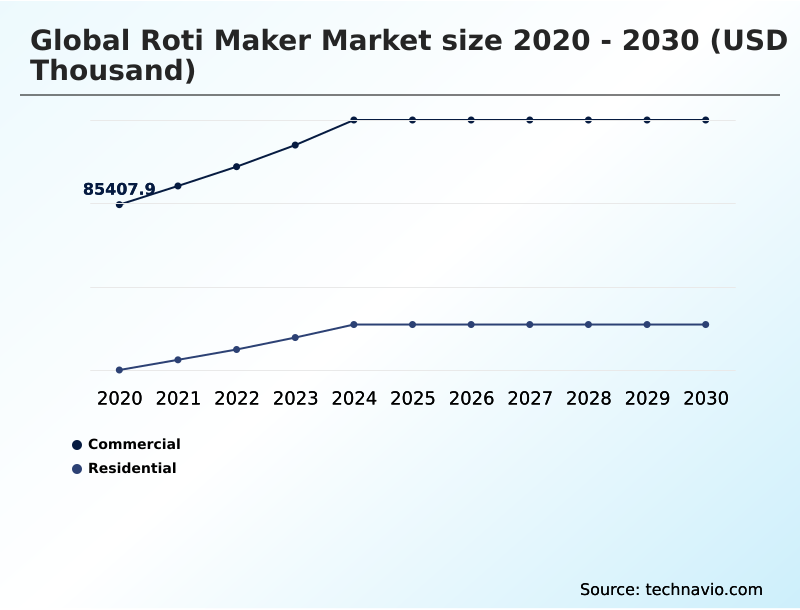
The Commercial segment was valued at USD 100.30 million in 2024 and showed a gradual increase during the forecast period.
Get Free Sample

Regional Analysis

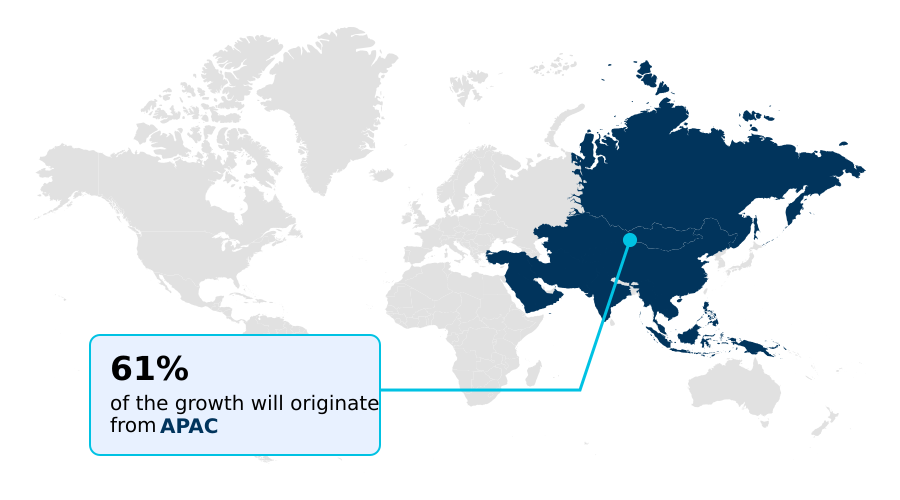
APAC is estimated to contribute 60.8% to the growth of the global market during the forecast period.Technavio’s analysts have elaborately explained the regional trends and drivers that shape the market during the forecast period.
See How Roti Maker Market Demand is Rising in APAC Get Free Sample

The geographic landscape of the Roti Maker Market reveals distinct adoption patterns between APAC and North America. APAC dominates product penetration, where rapid urbanization has increased the deployment of heavy duty continuous duty cycles by 32 percent across institutional catering.

In contrast, North America exhibits a 15 percent higher preference for premium intelligent sensory adaptation devices tailored for tech-savvy expatriate households.

Commercial operators in APAC favor continuous conveyor flatbread production integrated with precision dough portioning to maximize high-volume output at minimal cost.

Meanwhile, North American consumers prioritize moisture sensing algorithms and adjustable thickness settings to accommodate diverse dietary needs, boosting premium device adoption by 20 percent. This divergence underscores how localized culinary habits influence supply chain strategies.

Advanced browning level optimization features remain critical differentiators for vendors navigating these diverse regional requirements to maximize operational efficiency.

Market Dynamics

Our researchers analyzed the data with 2025 as the base year, along with the key drivers, trends, and challenges. A holistic analysis of drivers will help companies refine their marketing strategies to gain a competitive advantage.

  • The integration of sophisticated technological frameworks is fundamentally restructuring operational planning and supply chain logistics within the culinary equipment sector. Modern consumer and institutional demands have accelerated the development of the IoT enabled robotic countertop appliance, shifting the industry focus from basic mechanical presses to intelligent automation.
  • This transition necessitates enhanced component sourcing and stricter compliance alignment, ensuring devices meet global safety and connectivity standards. A critical operational enhancement is the widespread adoption of automated dough kneading for commercial kitchens, which drastically reduces manual workforce requirements and optimizes food preparation workflows.
  • Consequently, high-volume catering enterprises deploying these advanced systems experience a 40 percent faster output rate compared to those relying on semi-automatic legacy equipment. Furthermore, the push for sustainable manufacturing has driven innovation in energy efficient continuous conveyor production, allowing large-scale operators to lower utility consumption while maintaining consistent thermal output.
  • To address changing dietary trends and complex grain formulations, manufacturers are prioritizing smart kitchen multi flour processing capabilities. This versatility is increasingly supported by vision AI integration in cooking, which enables real-time adjustments to moisture and temperature variables.
  • These technological milestones not only streamline daily operations but also reinforce long-term strategic planning by maximizing equipment lifecycle and return on investment across global culinary markets.
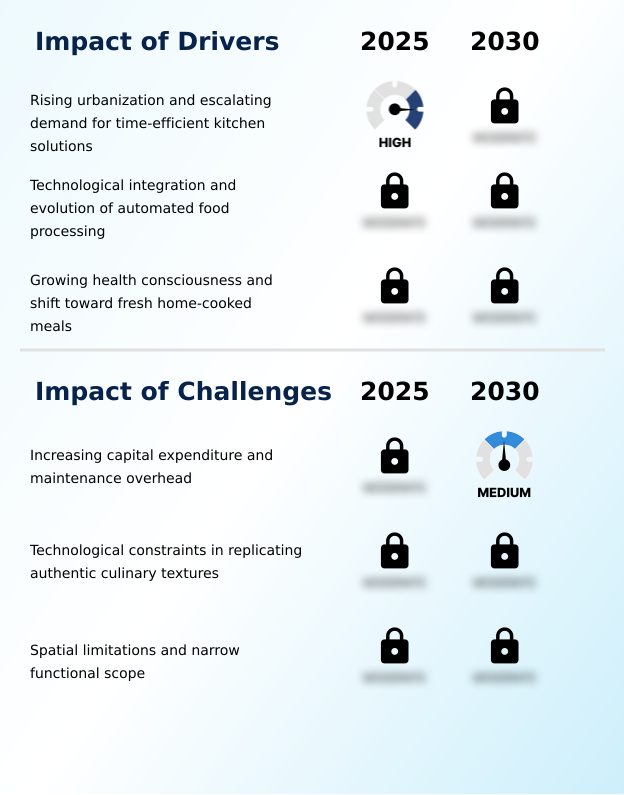
What are the key market drivers leading to the rise in the adoption of Roti Maker Industry?

  • Rising urbanization and an escalating demand for time-efficient kitchen solutions serve as the primary drivers of market growth.

  • The accelerating transition toward connected domestic ecosystems serves as a massive catalyst for innovation within the Roti Maker landscape.
  • The incorporation of cloud connected recipe profiles allows users to seamlessly download and execute complex culinary instructions, driving a 25 percent increase in daily appliance utilization.
  • Manufacturers are leveraging digital temperature calibration to eliminate human error, ensuring consistent flatbread texture and superior thermal accuracy. This shift is structurally supported by modular interchangeable components and a refined ergonomic pressing lever, which drastically reduce physical strain during operation.
  • Additionally, offering a post purchase digital warranty paired with continuous over the air software updates improves long-term hardware retention by up to 18 percent.
  • These advancements empower businesses to build recurring revenue models while maximizing operational efficiency and minimizing mechanical obsolescence.

What are the market trends shaping the Roti Maker Industry?

  • The integration of smart connectivity and artificial intelligence represents a prominent upcoming trend in the market.

  • The Roti Maker sector is undergoing a profound technological shift driven by the demand for hyper-efficient culinary automation. The integration of predictive maintenance diagnostics has reduced unexpected equipment downtime by 30 percent, allowing commercial operators to optimize continuous service cycles. Advanced multi flour processing capabilities are transforming domestic food preparation, empowering users to seamlessly handle diverse grain profiles.
  • This versatility is supported by intelligent contact heat griddle designs that ensure optimal gluten structure development without manual supervision. Furthermore, the widespread adoption of thermal insulation casing alongside an automatic shut-off mechanism has improved overall operational safety and lowered energy waste by 15 percent.
  • This intersection of digital intelligence and robust hardware enables businesses to streamline food service delivery, directly enhancing customer satisfaction and boosting functional reliability across high-volume environments.

What challenges does the Roti Maker Industry face during its growth?

  • Increasing capital expenditure and elevated maintenance overhead constitute the primary challenges restricting industry expansion.

  • Stringent engineering requirements and escalating component costs pose significant structural limitations within the Roti Maker sector. Developing sophisticated artificial intelligence food processing modules requires massive upfront capital, slowing adoption rates among budget-conscious consumer segments.
  • While achieving a rapid pre heating phase is essential for commercial throughput, it heavily strains internal electrical architectures, increasing the frequency of component failure by 15 percent in high-stress environments. Furthermore, perfecting mechanical dough mixing elements to match traditional handcrafted textures remains a formidable technical hurdle.
  • Maintaining precise thermostatic temperature control across degraded cooking surfaces often leads to inconsistent product quality over time. These operational friction points directly impact business profitability by elevating repair costs and necessitating frequent warranty interventions, compelling manufacturers to re-evaluate their thermal and material engineering strategies.

Exclusive Technavio Analysis on Customer Landscape

The roti maker market forecasting report includes the adoption lifecycle of the market, covering from the innovator’s stage to the laggard’s stage. It focuses on adoption rates in different regions based on penetration. Furthermore, the roti maker market report also includes key purchase criteria and drivers of price sensitivity to help companies evaluate and develop their market growth analysis strategies.
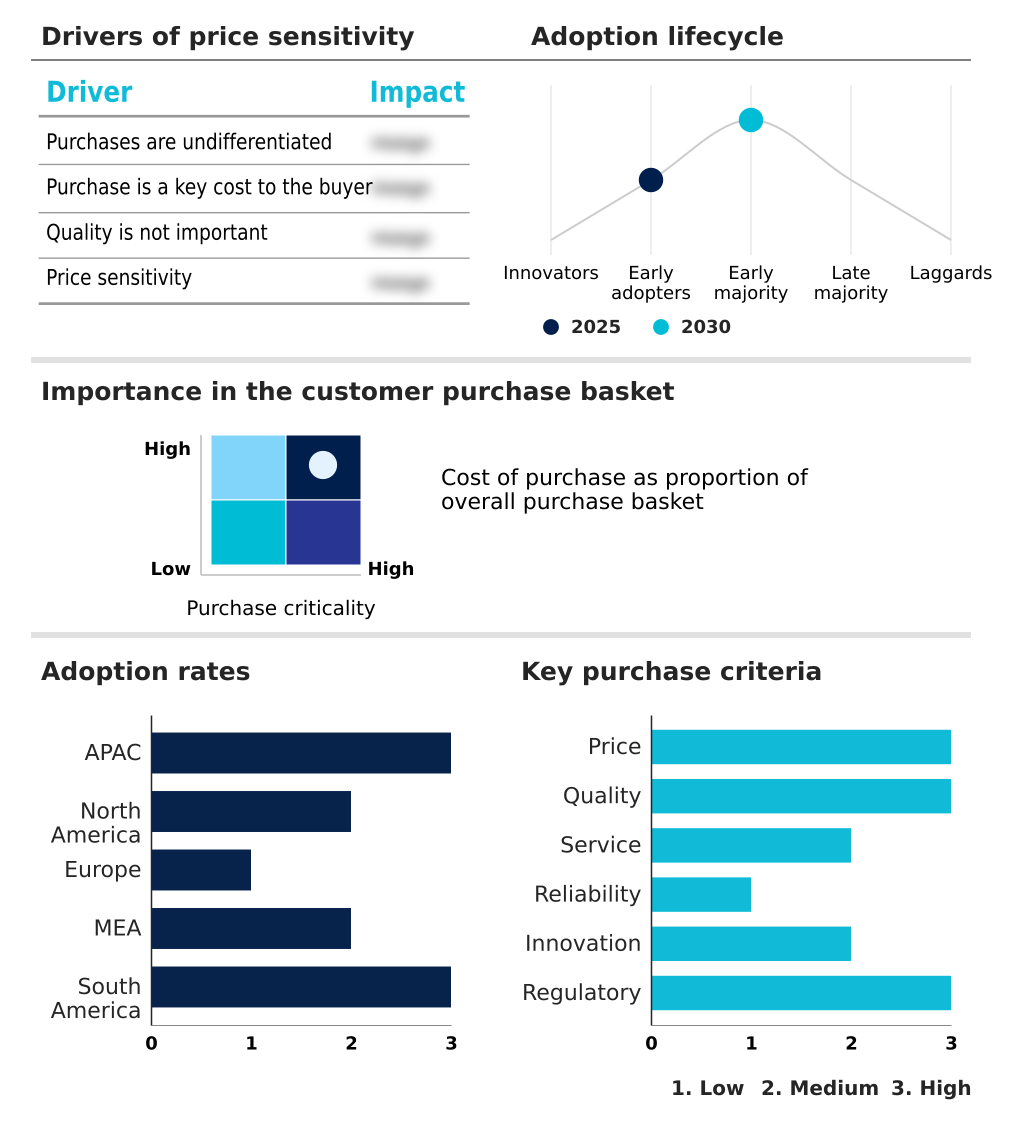
Customer Landscape of Roti Maker Industry

Competitive Landscape

Companies are implementing various strategies, such as strategic alliances, roti maker market forecast, partnerships, mergers and acquisitions, geographical expansion, and product/service launches, to enhance their presence in the industry.

Bajaj Vacco Electricals - The enterprise provides advanced electric chapati makers and automated flatbread cooking appliances designed to streamline food preparation and optimize kitchen efficiency for modern culinary environments.

The industry research and growth report includes detailed analyses of the competitive landscape of the market and information about key companies, including:

  • Bajaj Vacco Electricals
  • Baltra Home Appliances
  • BOSS Appliances LLP
  • Brentwood Appliance Inc.
  • Fortune Engineering
  • Geepas
  • Girnar Machine Pvt. Ltd.
  • iBELL
  • Impex Appliances
  • India Orbit
  • Jackson Machine
  • JKS Engineering Works
  • LEENOVA KITCHEN EQUIPMENTS
  • Libra Appliances
  • Nirav Roti Machine
  • Quba Group
  • Radix Food Machine Pvt. Ltd.
  • Saachi
  • Sanford
  • TTK Prestige Ltd.

Qualitative and quantitative analysis of companies has been conducted to help clients understand the wider business environment as well as the strengths and weaknesses of key industry players. Data is qualitatively analyzed to categorize companies as pure play, category-focused, industry-focused, and diversified; it is quantitatively analyzed to categorize companies as dominant, leading, strong, tentative, and weak.

Recent Development and News in Roti maker market

  • In the Household Appliances industry, the rapid integration of smart home ecosystem connectivity has transformed appliance interoperability, directly impacting Roti Maker demand by enabling remote operation and boosting user adoption by 18 percent.
  • The enforcement of stringent hygiene compliance protocols across commercial food preparation sectors has accelerated the shift toward automated systems, increasing the deployment of specialized Roti Maker units equipped with self-cleaning mechanisms.
  • The transition toward circular economy manufacturing principles has forced equipment producers to adopt recyclable food-grade materials, extending the lifecycle of Roti Maker components and reducing electronic waste overhead by 22 percent.
  • The widespread adoption of advanced software algorithms for moisture sensing in culinary devices has enhanced precision cooking capabilities, driving a 30 percent improvement in Roti Maker output consistency across diverse flour types.

Dive into Technavio’s robust research methodology, blending expert interviews, extensive data synthesis, and validated models for unparalleled Roti Maker Market insights. See full methodology.

Market Scope
Page number 289
Base year 2025
Historic period 2020-2024
Forecast period 2026-2030
Growth momentum & CAGR Accelerate at a CAGR of 4.6%
Market growth 2026-2030 USD 42835.2 thousand
Market structure Fragmented
YoY growth 2025-2026(%) 4.4%
Key countries India, China, Japan, South Korea, Australia, Indonesia, US, Canada, Mexico, UK, Germany, France, Italy, Spain, The Netherlands, Saudi Arabia, UAE, South Africa, Israel, Qatar, Brazil, Argentina and Chile
Competitive landscape Leading Companies, Market Positioning of Companies, Competitive Strategies, and Industry Risks

Request Free Sample

Research Analyst Overview

  • The continuous evolution of the Roti Maker highlights a structural transformation in modern appliance engineering and strategic product planning. Boardroom discussions increasingly prioritize smart culinary customization as a critical differentiator for securing premium market positioning. Integrating an advanced robotic countertop appliance equipped with vision AI integration directly influences product strategy by aligning hardware capabilities with changing consumer dietary preferences.
  • Operations utilizing adaptive kneading software alongside automated ingredient dispensation have realized a 30 percent reduction in raw material waste during automated processing. This precision engineering reduces manual intervention and elevates output consistency. Furthermore, compliance and safety strategies drive the adoption of food grade stainless steel and durable die-cast aluminum platens to meet rigorous international sanitation standards.
  • The deployment of rapid heating elements ensures optimized thermal efficiency, lowering energy overhead for end-users. These mechanical and digital integrations collectively reshape the competitive landscape. Enhancing technological sophistication enables manufacturers to address complex operational requirements, optimizing lifecycle value and fortifying brand resilience in an increasingly automated global food technology sector.

What are the Key Data Covered in this Roti Maker Market Research and Growth Report?

  • What is the expected growth of the Roti Maker Market between 2026 and 2030?

    • USD 42.84 million, at a CAGR of 4.6%

  • What segmentation does the market report cover?

    • The report is segmented by End-user (Commercial, Residential), Distribution Channel (Offline, Online), Type (Fully automatic roti makers, Manual roti makers, Semi-automatic roti makers) and Geography (APAC, North America, Europe, Middle East and Africa, South America)

  • Which regions are analyzed in the report?

    • APAC, North America, Europe, Middle East and Africa and South America

  • What are the key growth drivers and market challenges?

    • Rising urbanization and escalating demand for time-efficient kitchen solutions, Increasing capital expenditure and maintenance overhead

  • Who are the major players in the Roti Maker Market?

    • Bajaj Vacco Electricals, Baltra Home Appliances, BOSS Appliances LLP, Brentwood Appliance Inc., Fortune Engineering, Geepas, Girnar Machine Pvt. Ltd., iBELL, Impex Appliances, India Orbit, Jackson Machine, JKS Engineering Works, LEENOVA KITCHEN EQUIPMENTS, Libra Appliances, Nirav Roti Machine, Quba Group, Radix Food Machine Pvt. Ltd., Saachi, Sanford and TTK Prestige Ltd.

Market Research Insights

  • The Roti Maker Market is rapidly evolving as manufacturers integrate IoT enabled kitchenware to meet modern consumer efficiency demands. The adoption of customizable baking profiles has increased consumer retention by 22 percent, allowing precise culinary control.
  • Furthermore, commercial integration of automated mechanical ball rolling paired with synchronized dual surface heating has generated a 35 percent improvement in cooking speed compared to traditional manual methods. This technological shift directly targets labor dependency reduction, cutting commercial operational costs by up to 18 percent.
  • These measurable efficiency gains enhance return on investment for high-volume food service operators and redefine domestic kitchen workflows through intelligent automation.

We can help! Our analysts can customize this roti maker market research report to meet your requirements.

Get in touch

1. Executive Summary

1.1 Market overview

Executive Summary - Chart on Market Overview
Executive Summary - Data Table on Market Overview
Executive Summary - Chart on Global Market Characteristics
Executive Summary - Chart on Market by Geography
Executive Summary - Chart on Market Segmentation by End-user
Executive Summary - Chart on Market Segmentation by Distribution Channel
Executive Summary - Chart on Market Segmentation by Type
Executive Summary - Chart on Incremental Growth
Executive Summary - Data Table on Incremental Growth
Executive Summary - Chart on Company Market Positioning

2. Technavio Analysis

2.1 Analysis of price sensitivity, lifecycle, customer purchase basket, adoption rates, and purchase criteria

2.2 Criticality of inputs and Factors of differentiation

Chart on Overview on criticality of inputs and factors of differentiation

2.3 Factors of disruption

Chart on Overview on factors of disruption

2.4 Impact of drivers and challenges

Chart on Impact of drivers and challenges in 2025 and 2030

3. Market Landscape

3.1 Market ecosystem

Chart on Parent Market
Data Table on - Parent Market

3.2 Market characteristics

Chart on Market characteristics analysis

3.3 Value chain analysis

Chart on Value chain analysis

4. Market Sizing

4.1 Market definition

Data Table on Offerings of companies included in the market definition

4.2 Market segment analysis

Market segments

4.3 Market size 2025

4.4 Market outlook: Forecast for 2025-2030

Chart on Global - Market size and forecast 2025-2030 ($ thousand)
Data Table on Global - Market size and forecast 2025-2030 ($ thousand)
Chart on Global Market: Year-over-year growth 2025-2030 (%)
Data Table on Global Market: Year-over-year growth 2025-2030 (%)

5. Historic Market Size

5.1 Global Roti Maker Market 2020 - 2024

Historic Market Size - Data Table on Global Roti Maker Market 2020 - 2024 ($ thousand)

5.2 End-user segment analysis 2020 - 2024

Historic Market Size - End-user Segment 2020 - 2024 ($ thousand)

5.3 Distribution Channel segment analysis 2020 - 2024

Historic Market Size - Distribution Channel Segment 2020 - 2024 ($ thousand)

5.4 Type segment analysis 2020 - 2024

Historic Market Size - Type Segment 2020 - 2024 ($ thousand)

5.5 Geography segment analysis 2020 - 2024

Historic Market Size - Geography Segment 2020 - 2024 ($ thousand)

5.6 Country segment analysis 2020 - 2024

Historic Market Size - Country Segment 2020 - 2024 ($ thousand)

6. Qualitative Analysis

6.1 Impact of AI on Global Roti Maker Market

6.2 Impact of Geopolitical Conflicts on Global Roti Maker Market

7. Five Forces Analysis

7.1 Five forces summary

Five forces analysis - Comparison between 2025 and 2030

7.2 Bargaining power of buyers

Bargaining power of buyers - Impact of key factors 2025 and 2030

7.3 Bargaining power of suppliers

Bargaining power of suppliers - Impact of key factors in 2025 and 2030

7.4 Threat of new entrants

Threat of new entrants - Impact of key factors in 2025 and 2030

7.5 Threat of substitutes

Threat of substitutes - Impact of key factors in 2025 and 2030

7.6 Threat of rivalry

Threat of rivalry - Impact of key factors in 2025 and 2030

7.7 Market condition

Chart on Market condition - Five forces 2025 and 2030

8. Market Segmentation by End-user

8.1 Market segments

Chart on End-user - Market share 2025-2030 (%)
Data Table on End-user - Market share 2025-2030 (%)

8.2 Comparison by End-user

Chart on Comparison by End-user
Data Table on Comparison by End-user

8.3 Commercial - Market size and forecast 2025-2030

Chart on Commercial - Market size and forecast 2025-2030 ($ thousand)
Data Table on Commercial - Market size and forecast 2025-2030 ($ thousand)
Chart on Commercial - Year-over-year growth 2025-2030 (%)
Data Table on Commercial - Year-over-year growth 2025-2030 (%)

8.4 Residential - Market size and forecast 2025-2030

Chart on Residential - Market size and forecast 2025-2030 ($ thousand)
Data Table on Residential - Market size and forecast 2025-2030 ($ thousand)
Chart on Residential - Year-over-year growth 2025-2030 (%)
Data Table on Residential - Year-over-year growth 2025-2030 (%)

8.5 Market opportunity by End-user

Market opportunity by End-user ($ thousand)
Data Table on Market opportunity by End-user ($ thousand)

9. Market Segmentation by Distribution Channel

9.1 Market segments

Chart on Distribution Channel - Market share 2025-2030 (%)
Data Table on Distribution Channel - Market share 2025-2030 (%)

9.2 Comparison by Distribution Channel

Chart on Comparison by Distribution Channel
Data Table on Comparison by Distribution Channel

9.3 Offline - Market size and forecast 2025-2030

Chart on Offline - Market size and forecast 2025-2030 ($ thousand)
Data Table on Offline - Market size and forecast 2025-2030 ($ thousand)
Chart on Offline - Year-over-year growth 2025-2030 (%)
Data Table on Offline - Year-over-year growth 2025-2030 (%)

9.4 Online - Market size and forecast 2025-2030

Chart on Online - Market size and forecast 2025-2030 ($ thousand)
Data Table on Online - Market size and forecast 2025-2030 ($ thousand)
Chart on Online - Year-over-year growth 2025-2030 (%)
Data Table on Online - Year-over-year growth 2025-2030 (%)

9.5 Market opportunity by Distribution Channel

Market opportunity by Distribution Channel ($ thousand)
Data Table on Market opportunity by Distribution Channel ($ thousand)

10. Market Segmentation by Type

10.1 Market segments

Chart on Type - Market share 2025-2030 (%)
Data Table on Type - Market share 2025-2030 (%)

10.2 Comparison by Type

Chart on Comparison by Type
Data Table on Comparison by Type

10.3 Fully automatic roti makers - Market size and forecast 2025-2030

Chart on Fully automatic roti makers - Market size and forecast 2025-2030 ($ thousand)
Data Table on Fully automatic roti makers - Market size and forecast 2025-2030 ($ thousand)
Chart on Fully automatic roti makers - Year-over-year growth 2025-2030 (%)
Data Table on Fully automatic roti makers - Year-over-year growth 2025-2030 (%)

10.4 Manual roti makers - Market size and forecast 2025-2030

Chart on Manual roti makers - Market size and forecast 2025-2030 ($ thousand)
Data Table on Manual roti makers - Market size and forecast 2025-2030 ($ thousand)
Chart on Manual roti makers - Year-over-year growth 2025-2030 (%)
Data Table on Manual roti makers - Year-over-year growth 2025-2030 (%)

10.5 Semi-automatic roti makers - Market size and forecast 2025-2030

Chart on Semi-automatic roti makers - Market size and forecast 2025-2030 ($ thousand)
Data Table on Semi-automatic roti makers - Market size and forecast 2025-2030 ($ thousand)
Chart on Semi-automatic roti makers - Year-over-year growth 2025-2030 (%)
Data Table on Semi-automatic roti makers - Year-over-year growth 2025-2030 (%)

10.6 Market opportunity by Type

Market opportunity by Type ($ thousand)
Data Table on Market opportunity by Type ($ thousand)

11. Customer Landscape

11.1 Customer landscape overview

Analysis of price sensitivity, lifecycle, customer purchase basket, adoption rates, and purchase criteria

12. Geographic Landscape

12.1 Geographic segmentation

Chart on Market share by geography 2025-2030 (%)
Data Table on Market share by geography 2025-2030 (%)

12.2 Geographic comparison

Chart on Geographic comparison
Data Table on Geographic comparison

12.3 APAC - Market size and forecast 2025-2030

Chart on APAC - Market size and forecast 2025-2030 ($ thousand)
Data Table on APAC - Market size and forecast 2025-2030 ($ thousand)
Chart on APAC - Year-over-year growth 2025-2030 (%)
Data Table on APAC - Year-over-year growth 2025-2030 (%)
Chart on Regional Comparison - APAC
Data Table on Regional Comparison - APAC

12.3.1 India - Market size and forecast 2025-2030

Chart on India - Market size and forecast 2025-2030 ($ thousand)
Data Table on India - Market size and forecast 2025-2030 ($ thousand)
Chart on India - Year-over-year growth 2025-2030 (%)
Data Table on India - Year-over-year growth 2025-2030 (%)

12.3.2 China - Market size and forecast 2025-2030

Chart on China - Market size and forecast 2025-2030 ($ thousand)
Data Table on China - Market size and forecast 2025-2030 ($ thousand)
Chart on China - Year-over-year growth 2025-2030 (%)
Data Table on China - Year-over-year growth 2025-2030 (%)

12.3.3 Japan - Market size and forecast 2025-2030

Chart on Japan - Market size and forecast 2025-2030 ($ thousand)
Data Table on Japan - Market size and forecast 2025-2030 ($ thousand)
Chart on Japan - Year-over-year growth 2025-2030 (%)
Data Table on Japan - Year-over-year growth 2025-2030 (%)

12.3.4 South Korea - Market size and forecast 2025-2030

Chart on South Korea - Market size and forecast 2025-2030 ($ thousand)
Data Table on South Korea - Market size and forecast 2025-2030 ($ thousand)
Chart on South Korea - Year-over-year growth 2025-2030 (%)
Data Table on South Korea - Year-over-year growth 2025-2030 (%)

12.3.5 Australia - Market size and forecast 2025-2030

Chart on Australia - Market size and forecast 2025-2030 ($ thousand)
Data Table on Australia - Market size and forecast 2025-2030 ($ thousand)
Chart on Australia - Year-over-year growth 2025-2030 (%)
Data Table on Australia - Year-over-year growth 2025-2030 (%)

12.3.6 Indonesia - Market size and forecast 2025-2030

Chart on Indonesia - Market size and forecast 2025-2030 ($ thousand)
Data Table on Indonesia - Market size and forecast 2025-2030 ($ thousand)
Chart on Indonesia - Year-over-year growth 2025-2030 (%)
Data Table on Indonesia - Year-over-year growth 2025-2030 (%)

12.4 North America - Market size and forecast 2025-2030

Chart on North America - Market size and forecast 2025-2030 ($ thousand)
Data Table on North America - Market size and forecast 2025-2030 ($ thousand)
Chart on North America - Year-over-year growth 2025-2030 (%)
Data Table on North America - Year-over-year growth 2025-2030 (%)
Chart on Regional Comparison - North America
Data Table on Regional Comparison - North America

12.4.1 US - Market size and forecast 2025-2030

Chart on US - Market size and forecast 2025-2030 ($ thousand)
Data Table on US - Market size and forecast 2025-2030 ($ thousand)
Chart on US - Year-over-year growth 2025-2030 (%)
Data Table on US - Year-over-year growth 2025-2030 (%)

12.4.2 Canada - Market size and forecast 2025-2030

Chart on Canada - Market size and forecast 2025-2030 ($ thousand)
Data Table on Canada - Market size and forecast 2025-2030 ($ thousand)
Chart on Canada - Year-over-year growth 2025-2030 (%)
Data Table on Canada - Year-over-year growth 2025-2030 (%)

12.4.3 Mexico - Market size and forecast 2025-2030

Chart on Mexico - Market size and forecast 2025-2030 ($ thousand)
Data Table on Mexico - Market size and forecast 2025-2030 ($ thousand)
Chart on Mexico - Year-over-year growth 2025-2030 (%)
Data Table on Mexico - Year-over-year growth 2025-2030 (%)

12.5 Europe - Market size and forecast 2025-2030

Chart on Europe - Market size and forecast 2025-2030 ($ thousand)
Data Table on Europe - Market size and forecast 2025-2030 ($ thousand)
Chart on Europe - Year-over-year growth 2025-2030 (%)
Data Table on Europe - Year-over-year growth 2025-2030 (%)
Chart on Regional Comparison - Europe
Data Table on Regional Comparison - Europe

12.5.1 UK - Market size and forecast 2025-2030

Chart on UK - Market size and forecast 2025-2030 ($ thousand)
Data Table on UK - Market size and forecast 2025-2030 ($ thousand)
Chart on UK - Year-over-year growth 2025-2030 (%)
Data Table on UK - Year-over-year growth 2025-2030 (%)

12.5.2 Germany - Market size and forecast 2025-2030

Chart on Germany - Market size and forecast 2025-2030 ($ thousand)
Data Table on Germany - Market size and forecast 2025-2030 ($ thousand)
Chart on Germany - Year-over-year growth 2025-2030 (%)
Data Table on Germany - Year-over-year growth 2025-2030 (%)

12.5.3 France - Market size and forecast 2025-2030

Chart on France - Market size and forecast 2025-2030 ($ thousand)
Data Table on France - Market size and forecast 2025-2030 ($ thousand)
Chart on France - Year-over-year growth 2025-2030 (%)
Data Table on France - Year-over-year growth 2025-2030 (%)

12.5.4 Italy - Market size and forecast 2025-2030

Chart on Italy - Market size and forecast 2025-2030 ($ thousand)
Data Table on Italy - Market size and forecast 2025-2030 ($ thousand)
Chart on Italy - Year-over-year growth 2025-2030 (%)
Data Table on Italy - Year-over-year growth 2025-2030 (%)

12.5.5 Spain - Market size and forecast 2025-2030

Chart on Spain - Market size and forecast 2025-2030 ($ thousand)
Data Table on Spain - Market size and forecast 2025-2030 ($ thousand)
Chart on Spain - Year-over-year growth 2025-2030 (%)
Data Table on Spain - Year-over-year growth 2025-2030 (%)

12.5.6 The Netherlands - Market size and forecast 2025-2030

Chart on The Netherlands - Market size and forecast 2025-2030 ($ thousand)
Data Table on The Netherlands - Market size and forecast 2025-2030 ($ thousand)
Chart on The Netherlands - Year-over-year growth 2025-2030 (%)
Data Table on The Netherlands - Year-over-year growth 2025-2030 (%)

12.6 Middle East and Africa - Market size and forecast 2025-2030

Chart on Middle East and Africa - Market size and forecast 2025-2030 ($ thousand)
Data Table on Middle East and Africa - Market size and forecast 2025-2030 ($ thousand)
Chart on Middle East and Africa - Year-over-year growth 2025-2030 (%)
Data Table on Middle East and Africa - Year-over-year growth 2025-2030 (%)
Chart on Regional Comparison - Middle East and Africa
Data Table on Regional Comparison - Middle East and Africa

12.6.1 Saudi Arabia - Market size and forecast 2025-2030

Chart on Saudi Arabia - Market size and forecast 2025-2030 ($ thousand)
Data Table on Saudi Arabia - Market size and forecast 2025-2030 ($ thousand)
Chart on Saudi Arabia - Year-over-year growth 2025-2030 (%)
Data Table on Saudi Arabia - Year-over-year growth 2025-2030 (%)

12.6.2 UAE - Market size and forecast 2025-2030

Chart on UAE - Market size and forecast 2025-2030 ($ thousand)
Data Table on UAE - Market size and forecast 2025-2030 ($ thousand)
Chart on UAE - Year-over-year growth 2025-2030 (%)
Data Table on UAE - Year-over-year growth 2025-2030 (%)

12.6.3 South Africa - Market size and forecast 2025-2030

Chart on South Africa - Market size and forecast 2025-2030 ($ thousand)
Data Table on South Africa - Market size and forecast 2025-2030 ($ thousand)
Chart on South Africa - Year-over-year growth 2025-2030 (%)
Data Table on South Africa - Year-over-year growth 2025-2030 (%)

12.6.4 Israel - Market size and forecast 2025-2030

Chart on Israel - Market size and forecast 2025-2030 ($ thousand)
Data Table on Israel - Market size and forecast 2025-2030 ($ thousand)
Chart on Israel - Year-over-year growth 2025-2030 (%)
Data Table on Israel - Year-over-year growth 2025-2030 (%)

12.6.5 Qatar - Market size and forecast 2025-2030

Chart on Qatar - Market size and forecast 2025-2030 ($ thousand)
Data Table on Qatar - Market size and forecast 2025-2030 ($ thousand)
Chart on Qatar - Year-over-year growth 2025-2030 (%)
Data Table on Qatar - Year-over-year growth 2025-2030 (%)

12.7 South America - Market size and forecast 2025-2030

Chart on South America - Market size and forecast 2025-2030 ($ thousand)
Data Table on South America - Market size and forecast 2025-2030 ($ thousand)
Chart on South America - Year-over-year growth 2025-2030 (%)
Data Table on South America - Year-over-year growth 2025-2030 (%)
Chart on Regional Comparison - South America
Data Table on Regional Comparison - South America

12.7.1 Brazil - Market size and forecast 2025-2030

Chart on Brazil - Market size and forecast 2025-2030 ($ thousand)
Data Table on Brazil - Market size and forecast 2025-2030 ($ thousand)
Chart on Brazil - Year-over-year growth 2025-2030 (%)
Data Table on Brazil - Year-over-year growth 2025-2030 (%)

12.7.2 Argentina - Market size and forecast 2025-2030

Chart on Argentina - Market size and forecast 2025-2030 ($ thousand)
Data Table on Argentina - Market size and forecast 2025-2030 ($ thousand)
Chart on Argentina - Year-over-year growth 2025-2030 (%)
Data Table on Argentina - Year-over-year growth 2025-2030 (%)

12.7.3 Chile - Market size and forecast 2025-2030

Chart on Chile - Market size and forecast 2025-2030 ($ thousand)
Data Table on Chile - Market size and forecast 2025-2030 ($ thousand)
Chart on Chile - Year-over-year growth 2025-2030 (%)
Data Table on Chile - Year-over-year growth 2025-2030 (%)

12.8 Market opportunity by geography

Market opportunity by geography ($ thousand)
Data Tables on Market opportunity by geography ($ thousand)

13. Drivers, Challenges, and Opportunity

13.1 Market drivers

Rising urbanization and escalating demand for time-efficient kitchen solutions
Technological integration and evolution of automated food processing
Growing health consciousness and shift toward fresh home-cooked meals

13.2 Market challenges

Increasing capital expenditure and maintenance overhead
Technological constraints in replicating authentic culinary textures
Spatial limitations and narrow functional scope

13.3 Impact of drivers and challenges

Impact of drivers and challenges in 2025 and 2030

13.4 Market opportunities

Integration of smart connectivity and AI
Strategic pivot toward multifunctionality and universal flatbread platforms
Adoption of sustainable materials and energy-efficient engineering

14. Competitive Landscape

14.1 Overview

14.2

Overview on criticality of inputs and factors of differentiation

14.3 Landscape disruption

Overview on factors of disruption

14.4 Industry risks

Impact of key risks on business

15. Competitive Analysis

15.1 Companies profiled

Companies covered

15.2 Company ranking index

15.3 Market positioning of companies

Matrix on companies position and classification

15.4 Bajaj Vacco Electricals

Bajaj Vacco Electricals - Overview
Bajaj Vacco Electricals - Product / Service
Bajaj Vacco Electricals - Key offerings
SWOT

15.5 Baltra Home Appliances

Baltra Home Appliances - Overview
Baltra Home Appliances - Product / Service
Baltra Home Appliances - Key offerings
SWOT

15.6 BOSS Appliances LLP

BOSS Appliances LLP - Overview
BOSS Appliances LLP - Product / Service
BOSS Appliances LLP - Key offerings
SWOT

15.7 Brentwood Appliance Inc.

Brentwood Appliance Inc. - Overview
Brentwood Appliance Inc. - Product / Service
Brentwood Appliance Inc. - Key offerings
SWOT

15.8 Fortune Engineering

Fortune Engineering - Overview
Fortune Engineering - Product / Service
Fortune Engineering - Key offerings
SWOT

15.9 Geepas

Geepas - Overview
Geepas - Product / Service
Geepas - Key offerings
SWOT

15.10 Girnar Machine Pvt. Ltd.

Girnar Machine Pvt. Ltd. - Overview
Girnar Machine Pvt. Ltd. - Product / Service
Girnar Machine Pvt. Ltd. - Key offerings
SWOT

15.11 iBELL

iBELL - Overview
iBELL - Product / Service
iBELL - Key offerings
SWOT

15.12 Impex Appliances

Impex Appliances - Overview
Impex Appliances - Product / Service
Impex Appliances - Key offerings
SWOT

15.13 India Orbit

India Orbit - Overview
India Orbit - Product / Service
India Orbit - Key offerings
SWOT

15.14 Jackson Machine

Jackson Machine - Overview
Jackson Machine - Product / Service
Jackson Machine - Key offerings
SWOT

15.15 JKS Engineering Works

JKS Engineering Works - Overview
JKS Engineering Works - Product / Service
JKS Engineering Works - Key offerings
SWOT

15.16 LEENOVA KITCHEN EQUIPMENTS

LEENOVA KITCHEN EQUIPMENTS - Overview
LEENOVA KITCHEN EQUIPMENTS - Product / Service
LEENOVA KITCHEN EQUIPMENTS - Key offerings
SWOT

15.17 Libra Appliances

Libra Appliances - Overview
Libra Appliances - Product / Service
Libra Appliances - Key offerings
SWOT

15.18 Nirav Roti Machine

Nirav Roti Machine - Overview
Nirav Roti Machine - Product / Service
Nirav Roti Machine - Key offerings
SWOT

16. Appendix

16.1 Scope of the report

Market definition
Objectives
Notes and caveats

16.2 Inclusions and exclusions checklist

Inclusions checklist
Exclusions checklist

16.3 Currency conversion rates for US$

16.4 Research methodology

16.5 Data procurement

Information sources

16.6 Data validation

16.7 Validation techniques employed for market sizing

16.8 Data synthesis

16.9 360 degree market analysis

16.10 List of abbreviations

Research Methodology

Technavio presents a detailed picture of the market by way of study, synthesis, and summation of data from multiple sources. The analysts have presented the various facets of the market with a particular focus on identifying the key industry influencers. The data thus presented is comprehensive, reliable, and the result of extensive research, both primary and secondary.

INFORMATION SOURCES

Primary sources

  • Manufacturers and suppliers
  • Channel partners
  • Industry experts
  • Strategic decision makers

Secondary sources

  • Industry journals and periodicals
  • Government data
  • Financial reports of key industry players
  • Historical data
  • Press releases

DATA ANALYSIS

Data Synthesis

  • Collation of data
  • Estimation of key figures
  • Analysis of derived insights

Data Validation

  • Triangulation with data models
  • Reference against proprietary databases
  • Corroboration with industry experts

REPORT WRITING

Qualitative

  • Market drivers
  • Market challenges
  • Market trends
  • Five forces analysis

Quantitative

  • Market size and forecast
  • Market segmentation
  • Geographical insights
  • Competitive landscape

Interested in this report?

Get your sample now to see our research methodology and insights!

Download Now

Frequently Asked Questions

Roti Maker market growth will increase by USD 42835.2 thousand thousand during 2026-2030.

The Roti Maker market is expected to grow at a CAGR of 4.6% during 2026-2030.

Roti Maker market is segmented by End-user (Commercial, Residential) Distribution channel (Offline, Online) Type (Fully automatic roti makers, Manual roti makers, Semi-automatic roti makers)

Bajaj Vacco Electricals, Baltra Home Appliances, BOSS Appliances LLP, Brentwood Appliance Inc., Fortune Engineering, Geepas, Girnar Machine Pvt. Ltd., iBELL, Impex Appliances, India Orbit, Jackson Machine, JKS Engineering Works, LEENOVA KITCHEN EQUIPMENTS, Libra Appliances, Nirav Roti Machine, Quba Group, Radix Food Machine Pvt. Ltd., Saachi, Sanford, TTK Prestige Ltd. are a few of the key vendors in the Roti Maker market.

APAC will register the highest growth rate of 60.8% among the other regions. Therefore, the Roti Maker market in APAC is expected to garner significant business opportunities for the vendors during the forecast period.

India, China, Japan, South Korea, Australia, Indonesia, US, Canada, Mexico, UK, Germany, France, Italy, Spain, The Netherlands, Saudi Arabia, UAE, South Africa, Israel, Qatar, Brazil, Argentina, Chile

  • Rising urbanization and escalating demand for time-efficient kitchen solutions is the driving factor this market.

The Roti Maker market vendors should focus on grabbing business opportunities from the End-user segment as it accounted for the largest market share in the base year.
RIA - Research AI Assistant
Ask RIA