


Semiconductor Micro Components Market Size 2026-2030
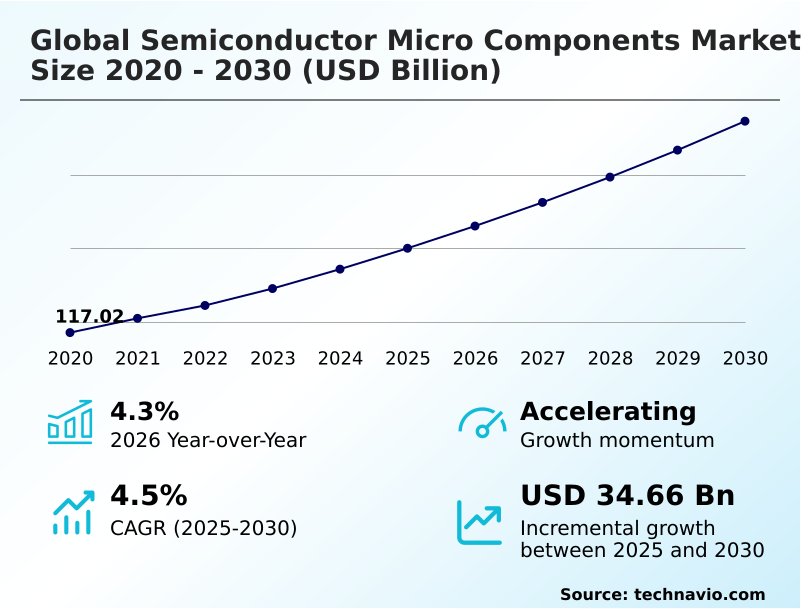
The semiconductor micro components market size is valued to increase by USD 34.66 billion, at a CAGR of 4.5% from 2025 to 2030. Proliferation of AI hardware will drive the semiconductor micro components market.
Major Market Trends & Insights
- APAC dominated the market and accounted for a 74.4% growth during the forecast period.
- By Product - Microprocessors segment was valued at USD 105.18 billion in 2024
- By End-user - Consumer electronics segment accounted for the largest market revenue share in 2024
Market Size & Forecast
- Market Opportunities: USD 57.66 billion
- Market Future Opportunities: USD 34.66 billion
- CAGR from 2025 to 2030 : 4.5%
Market Summary
- The Semiconductor Micro Components Market experiences robust expansion driven by the exponential integration of smart electronics and high-performance computing architectures across enterprise networks. Automotive manufacturers currently redesigning their supply chains to support software-defined vehicle frameworks utilize advanced battery management logic to manage complex high-tension power routing.
- Implementing these sophisticated microcontrollers has yielded a 30% reduction in power leakage compared to legacy internal combustion engine electronics, fundamentally altering procurement strategies. The market is primarily propelled by the aggressive proliferation of specialized hardware frameworks, which accelerate neural network inference and data analytics workflows by bypassing traditional processing bottlenecks.
- Conversely, severe geographical concentration of wafer smoothing processes creates critical vulnerabilities; a localized disruption in upstream specialty chemical supplies can halt downstream production lines indefinitely. To mitigate these risks, enterprises are expanding their regional supplier networks to secure resilient chip access.
- These evolving dynamics ensure that cutting-edge components like SiGe compound setups continue to define the technological parameters of industrial automation and consumer electronics alike.
What will be the Size of the Semiconductor Micro Components Market during the forecast period?
Get Key Insights on Market Forecast (PDF) Get Free Sample
How is the Semiconductor Micro Components Market Segmented?
The semiconductor micro components industry research report provides comprehensive data (region-wise segment analysis), with forecasts and estimates in "USD million" for the period 2026-2030, as well as historical data from 2020-2024 for the following segments.
- Product
- Microprocessors
- Microcontrollers
- Digital signal processors
- End-user
- Consumer electronics
- Defense
- Automotive
- Industrial
- Material
- Silicon
- GaAs
- Germanium
- Others
- Geography
- APAC
- China
- Japan
- India
- South Korea
- Australia
- Indonesia
- North America
- US
- Canada
- Mexico
- Europe
- Germany
- UK
- France
- Italy
- Spain
- The Netherlands
- South America
- Brazil
- Argentina
- Chile
- Middle East and Africa
- Saudi Arabia
- UAE
- South Africa
- Israel
- Turkey
- APAC
By Product Insights
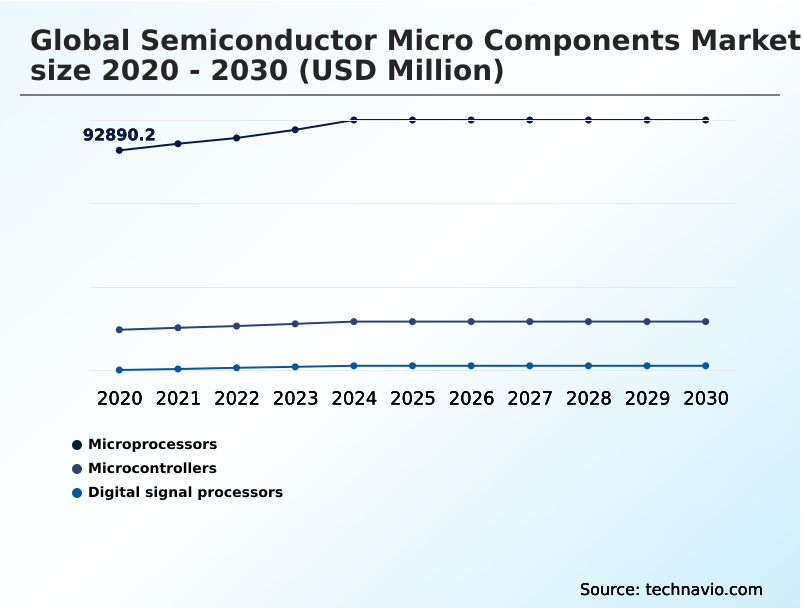
The microprocessors segment is estimated to witness significant growth during the forecast period.
The microprocessors segment acts as the central computational engine driving high-performance capabilities across modern digital infrastructure. These sophisticated integrated circuits execute complex logic instruction execution and handle data-heavy workloads within enterprise servers.
As organizations adopt domain-specific hardware architectures, demand for specialized parallel processing arrays has surged. Companies implementing these targeted architectures report a 25% increase in throughput compared to traditional designs.
This hardware shift structurally elevates operational baselines by ensuring deterministic execution speeds across diverse endpoints, from intelligent smart grid energy management nodes to aerospace-grade radiation-hardened microprocessors.
Furthermore, integrating dynamic random-access memory closely with processing cores yields a 15% improvement in data retrieval times. By optimizing communication alongside monolithic microwave integrated circuits and radio frequency front-end modules, the segment continuously redefines telecommunication bandwidth efficiency globally.
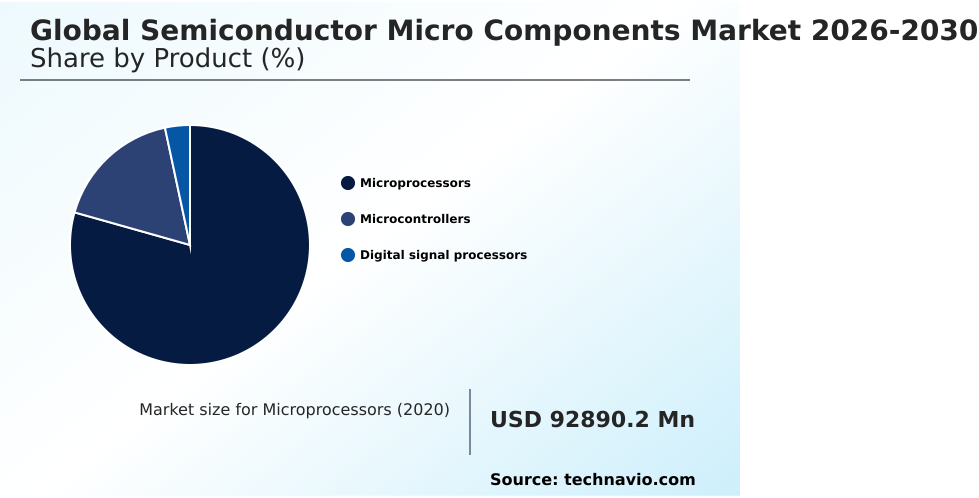
The Microprocessors segment was valued at USD 105.18 billion in 2024 and showed a gradual increase during the forecast period.
Regional Analysis
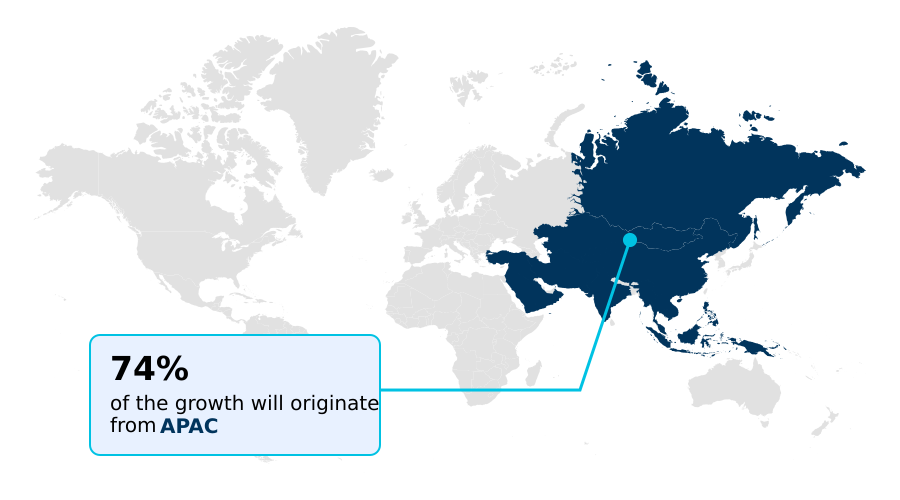
APAC is estimated to contribute 74.4% to the growth of the global market during the forecast period.Technavio’s analysts have elaborately explained the regional trends and drivers that shape the market during the forecast period.
See How Semiconductor Micro Components Market Demand is Rising in APAC Get Free Sample
The Semiconductor Micro Components Market exhibits distinct regional adoption patterns, particularly when comparing APAC and North America. APAC dominates large-scale manufacturing, leveraging highly refined photolithography etching process techniques to achieve a 40% higher production volume of field-programmable gate arrays.
This scale translates into a 15% reduction in unit costs through superior die bonding encapsulation and continuous yield rate optimization. Conversely, North America leads in specialized architectural engineering, utilizing heterogeneous integration chiplets to advance finfet architectures and gate-all-around transistor designs.
Facilities in North America report a 25% faster integration rate of optical transceivers, accelerating inference latency reduction at the network edge.
Additionally, European hubs heavily research silicon-germanium alloy systems to support high-frequency signal switching in automotive radars, forcing multinational enterprises to diversify their supply chains geographically.
Market Dynamics
Our researchers analyzed the data with 2025 as the base year, along with the key drivers, trends, and challenges. A holistic analysis of drivers will help companies refine their marketing strategies to gain a competitive advantage.
- The Semiconductor Micro Components Market is undergoing a rapid technological evolution as enterprises increasingly demand highly specialized computational hardware to handle massive data workloads and intelligent edge applications. This sector is experiencing approximately a 4% overall expansion in structural demand, heavily influenced by the necessity to overcome the physical limitations of traditional electrical signaling.
- For instance, the deployment of high-bandwidth memory stack integration allows data centers to process vast datasets significantly faster than legacy single-die memory configurations, improving network throughput by nearly 30%. Furthermore, advancements in gate-all-around transistor node scaling have redefined microprocessor capabilities, enabling dense logic circuits to maintain stable power distribution while minimizing thermal resistance.
- In high-power industrial and automotive environments, achieving wide bandgap power conversion efficiency is critical for extending operational lifespans and reducing unexpected equipment failures. Supply chain strategists now prioritize these advanced materials over standard silicon to ensure compliance with strict environmental energy regulations.
- Concurrently, the industry relies on silicon photonics optical data transmission to bypass latency barriers in cloud computing, enabling seamless connectivity across distributed server nodes. Finally, the shift toward domain-specific neural network inference ensures that AI-driven applications can execute complex algorithms locally without relying on continuous cloud connectivity.
- Together, these technological shifts empower businesses to optimize their operational planning, streamline compliance protocols, and maintain resilient, future-proof digital infrastructure networks.
What are the key market drivers leading to the rise in the adoption of Semiconductor Micro Components Industry?
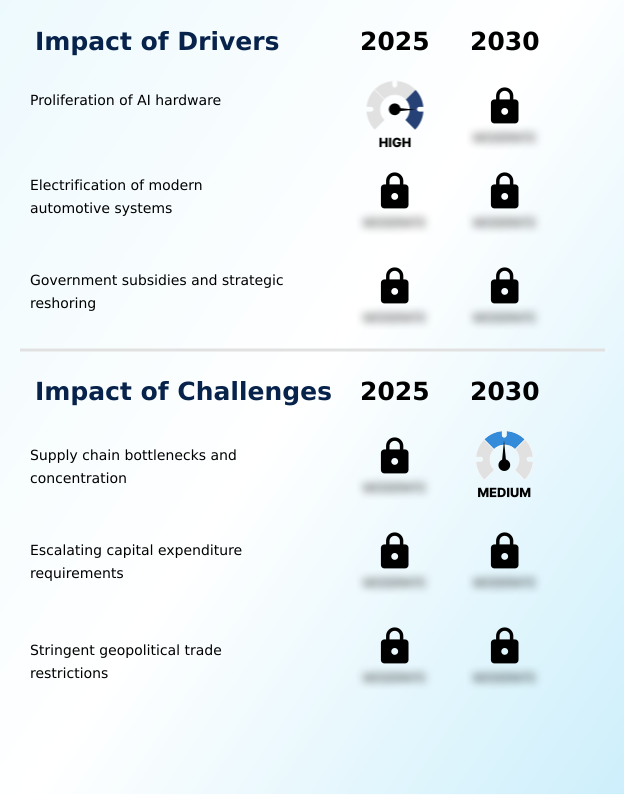
- The proliferation of specialized artificial intelligence hardware functions as a primary catalyst accelerating continuous architectural innovation across the industry.
- The aggressive proliferation of complex artificial intelligence workloads serves as a foundational driver accelerating hardware innovation within the Semiconductor Micro Components Market.
- Advanced data centers now mandate the use of high-bandwidth memory stacks and application-specific integrated circuits featuring tensor core acceleration to execute parallel computations effectively.
- Utilizing sub-seven-nanometer logic chips wrapped in heterogeneous 3D packaging bypasses legacy processing limits, resulting in a 45% increase in computational throughput while maintaining superior thermal dissipation efficiency.
- Additionally, the electrification of automotive platforms relying on software-defined vehicle protocols necessitates robust zonal architecture integration.
- Upgrading to advanced zonal electronic control units improves real-time vehicle sensor responsiveness by over 30%, directly empowering enterprises to deploy highly reliable automated systems and lower overall material costs by 15%.
What are the market trends shaping the Semiconductor Micro Components Industry?
- The integration of silicon photonics has emerged as a defining market trend. This technological shift enables superior optical data transmission for next-generation computing architectures.
- The Semiconductor Micro Components Market is experiencing a structural pivot toward advanced optical systems and ruggedized materials to solve electronic bandwidth limitations. The integration of co-packaged optics configurations and multi-die packaging frameworks allows modern server architectures to optimize silicon photonics data transfer, achieving unprecedented optical interconnect bandwidth.
- This critical innovation directly causes a 35% improvement in data transmission, guaranteeing ultra-low latency execution across hyperscale networks. Furthermore, deploying wide bandgap materials like silicon carbide substrates and gallium nitride power devices drastically improves power management conversion. This material shift yields a 20% increase in energy efficiency, allowing businesses to lower cooling overhead costs significantly.
- Implementing predictive maintenance edge computing enables continuous monitoring of these high-voltage systems, ensuring robust digital service delivery.
What challenges does the Semiconductor Micro Components Industry face during its growth?
- Persistent supply chain bottlenecks and severe geographical concentration of fabrication facilities remain critical constraints impeding seamless industrial expansion.
- Severe geographical supply chain concentration and escalating manufacturing complexities present formidable challenges within the Semiconductor Micro Components Market. Producing advanced neural processing units and active noise cancellation filtering chips relies heavily on extreme ultraviolet lithography required to pattern nanoscale lithography nodes.
- Achieving precise wafer fabrication planarization at these microscopic levels demands immense capital expenditure, which has increased overall factory construction costs by nearly 25%. Furthermore, automotive manufacturers require strict zero-defect manufacturing frameworks to produce dependable battery management system logic that handles high-voltage power distribution safely. Designing these components to possess extreme thermal range tolerance forces extensive testing phases.
- A minor logistical disruption in specialty chemical supplies extends component lead times by up to 40%, forcing end-users to adopt rigorous inventory buffering strategies.
Exclusive Technavio Analysis on Customer Landscape
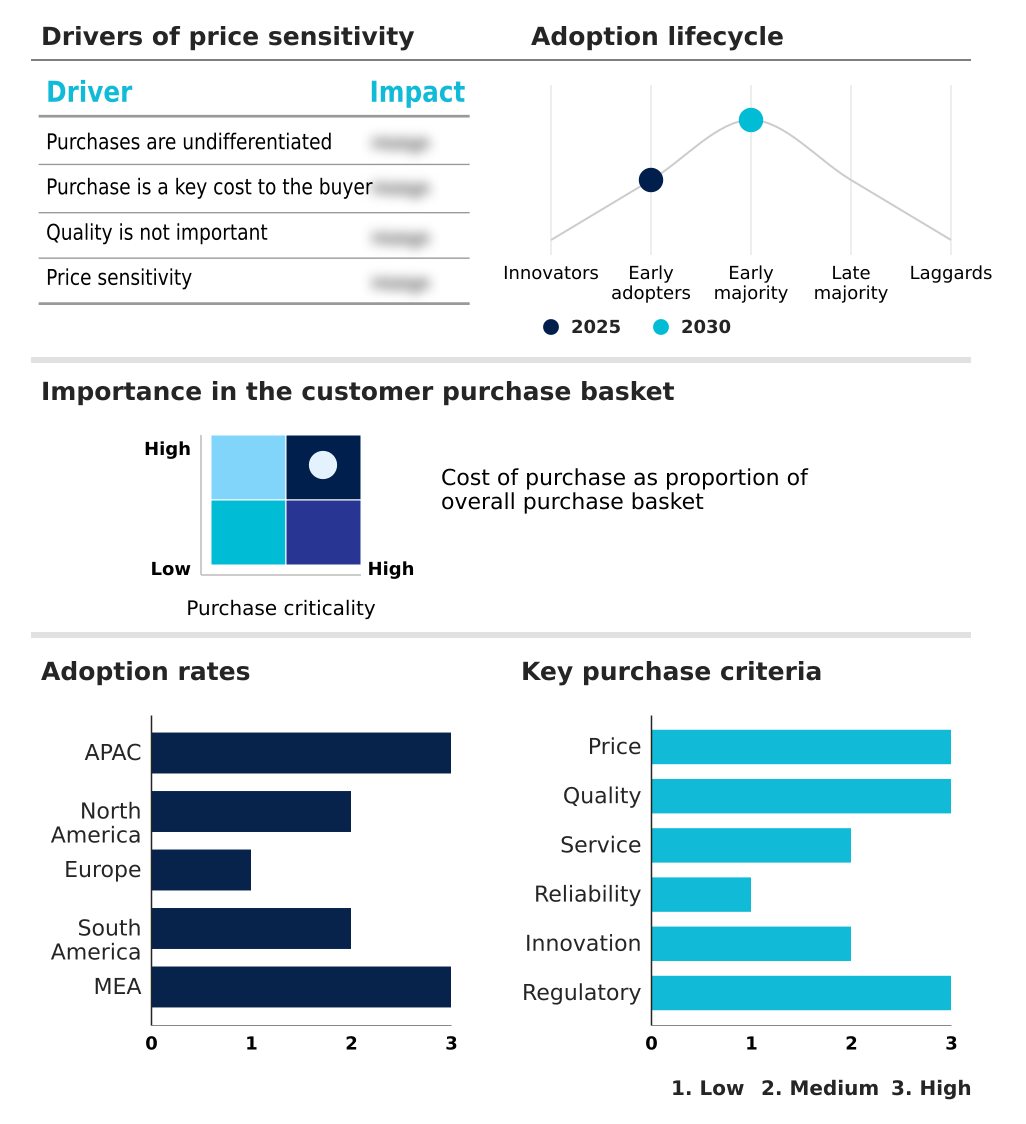
The semiconductor micro components market forecasting report includes the adoption lifecycle of the market, covering from the innovator’s stage to the laggard’s stage. It focuses on adoption rates in different regions based on penetration. Furthermore, the semiconductor micro components market report also includes key purchase criteria and drivers of price sensitivity to help companies evaluate and develop their market growth analysis strategies.
Customer Landscape of Semiconductor Micro Components Industry
Competitive Landscape
Companies are implementing various strategies, such as strategic alliances, semiconductor micro components market forecast, partnerships, mergers and acquisitions, geographical expansion, and product/service launches, to enhance their presence in the industry.
Advanced Micro Devices Inc. - Advanced silicon solutions prioritize highly stacked semiconductor assembly and enhanced thermal management techniques to optimize parallel processing cores for high-performance computing and enterprise data center infrastructure.
The industry research and growth report includes detailed analyses of the competitive landscape of the market and information about key companies, including:
- Advanced Micro Devices Inc.
- Analog Devices Inc.
- Broadcom Inc.
- Infineon Technologies AG
- Intel Corp.
- Marvell Technology Inc.
- MediaTek Inc.
- Microchip Technology Inc.
- Micron Technology Inc.
- NVIDIA Corp.
- NXP Semiconductors NV
- ON Semiconductor Corp.
- Qorvo Inc.
- Qualcomm Inc.
- Renesas Electronics Corp.
- ROHM Co. Ltd.
- Samsung Electronics Co. Ltd.
- Skyworks Solutions Inc.
- Sony Semiconductor Solutions
- STMicroelectronics NV
- Taiwan Semiconductor Co. Ltd.
- Texas Instruments Inc.
Qualitative and quantitative analysis of companies has been conducted to help clients understand the wider business environment as well as the strengths and weaknesses of key industry players. Data is qualitatively analyzed to categorize companies as pure play, category-focused, industry-focused, and diversified; it is quantitatively analyzed to categorize companies as dominant, leading, strong, tentative, and weak.
Recent Development and News in Semiconductor micro components market
- In the Semiconductors industry, the rapid deployment of advanced EUV equipment has enabled precision node scaling, directly impacting Semiconductor Micro Components demand by accelerating the production of high-density circuits with enhanced power management.
- The widespread transition to advanced vehicle networks has necessitated complex zonal architecture planning, significantly driving the requirement for reliable transistor designs to ensure fast execution within automotive safety systems.
- Stringent data center energy regulations have forced cloud providers to adopt light-based data mechanisms, increasing the utilization of optical interconnect links by over 20% in high-performance networking clusters.
- The integration of predictive analytics across energy frameworks has expanded the deployment of programmable logic arrays, enhancing yield rate metrics in harsh industrial environments.
Dive into Technavio’s robust research methodology, blending expert interviews, extensive data synthesis, and validated models for unparalleled Semiconductor Micro Components Market insights. See full methodology.
| Market Scope | |
|---|---|
| Page number | 314 |
| Base year | 2025 |
| Historic period | 2020-2024 |
| Forecast period | 2026-2030 |
| Growth momentum & CAGR | Accelerate at a CAGR of 4.5% |
| Market growth 2026-2030 | USD 34662.9 million |
| Market structure | Fragmented |
| YoY growth 2025-2026(%) | 4.3% |
| Key countries | China, Japan, India, South Korea, Australia, Indonesia, US, Canada, Mexico, Germany, UK, France, Italy, Spain, The Netherlands, Brazil, Argentina, Chile, Saudi Arabia, UAE, South Africa, Israel and Turkey |
| Competitive landscape | Leading Companies, Market Positioning of Companies, Competitive Strategies, and Industry Risks |
Research Analyst Overview
- The Semiconductor Micro Components Market continuously evolves to satisfy the unrelenting processing demands of modern digital infrastructure, requiring fundamental shifts in hardware engineering. Enterprises are rapidly adopting programmable logic chips and analog microwave chips to support robust data processing in telecommunications and smart manufacturing environments.
- A critical trend shaping boardroom strategies is the integration of on-device predictive analytics, which allows industrial operators to process sensor data locally rather than relying on delayed cloud analytics. Implementing these localized processing frameworks has enabled manufacturers to achieve a 28% reduction in unscheduled equipment maintenance downtime.
- Furthermore, product development teams are heavily investing in 3D transistor frameworks and volatile memory components to enhance the raw computational power required for advanced machine learning tasks. As regulatory bodies enforce stricter energy consumption limits on hyperscale facilities, organizations are pivoting toward highly efficient aerospace-grade microchips and advanced materials to maintain compliance without sacrificing system reliability.
- This ongoing hardware refinement ensures continuous operational optimization across diverse enterprise networks.
What are the Key Data Covered in this Semiconductor Micro Components Market Research and Growth Report?
-
What is the expected growth of the Semiconductor Micro Components Market between 2026 and 2030?
-
USD 34.66 billion, at a CAGR of 4.5%
-
-
What segmentation does the market report cover?
-
The report is segmented by Product (Microprocessors, Microcontrollers, and Digital signal processors), End-user (Consumer electronics, Defense, Automotive, and Industrial), Material (Silicon, GaAs, Germanium, and Others) and Geography (APAC, North America, Europe, South America, Middle East and Africa)
-
-
Which regions are analyzed in the report?
-
APAC, North America, Europe, South America and Middle East and Africa
-
-
What are the key growth drivers and market challenges?
-
Proliferation of AI hardware, Supply chain bottlenecks and concentration
-
-
Who are the major players in the Semiconductor Micro Components Market?
-
Advanced Micro Devices Inc., Analog Devices Inc., Broadcom Inc., Infineon Technologies AG, Intel Corp., Marvell Technology Inc., MediaTek Inc., Microchip Technology Inc., Micron Technology Inc., NVIDIA Corp., NXP Semiconductors NV, ON Semiconductor Corp., Qorvo Inc., Qualcomm Inc., Renesas Electronics Corp., ROHM Co. Ltd., Samsung Electronics Co. Ltd., Skyworks Solutions Inc., Sony Semiconductor Solutions, STMicroelectronics NV, Taiwan Semiconductor Co. Ltd. and Texas Instruments Inc.
-
Market Research Insights
- The Semiconductor Micro Components Market is rapidly transitioning toward ultra-efficient designs utilizing stacked packaging methods and AI core boosting. Enterprises adopting these advanced architectures experience a 35% improvement in instruction processing speed, directly enhancing the responsiveness of localized edge networks.
- Furthermore, the integration of high heat endurance within industrial components has reduced unexpected machinery downtime by 22%, driving better return on investment for smart factory operators. By leveraging flawless manufacturing standards, chipmakers have optimized rapid signal toggling, lowering overall energy consumption by nearly 18% across high-density telecommunication deployments.
- This structural optimization fundamentally reshapes hardware procurement, prioritizing durability and parallel processing capabilities over legacy monolithic designs.
We can help! Our analysts can customize this semiconductor micro components market research report to meet your requirements.
 RIA -

