

Smart Indoor Garden Systems Market Size 2026-2030
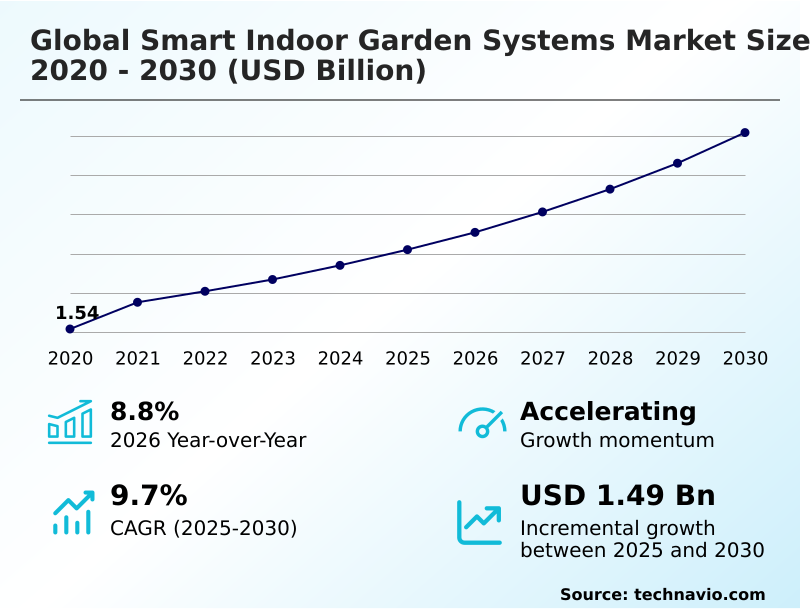
The smart indoor garden systems market size is valued to increase by USD 1.49 billion, at a CAGR of 9.7% from 2025 to 2030. Rapid urbanization structural transitions expand high density residential living spatial limits will drive the smart indoor garden systems market.
Major Market Trends & Insights
- North America dominated the market and accounted for a 39.3% growth during the forecast period.
- By Type - Floor garden segment was valued at USD 1.50 billion in 2024
- By Product - LED grow lights segment accounted for the largest market revenue share in 2024
Market Size & Forecast
- Market Opportunities: USD 2.50 billion
- Market Future Opportunities: USD 1.49 billion
- CAGR from 2025 to 2030 : 9.7%
Market Summary
- The Smart Indoor Garden Systems landscape demonstrates rapid expansion as modern urban populations increasingly prioritize self-sufficient, hyper-local food procurement. High-density residential architecture continuously restricts access to traditional arable land, forcing consumers to adopt advanced alternative cultivation methods directly within domestic environments.
- This structural transition acts as a powerful driver, compelling the integration of soil-free hydroponic networks that maximize crop yields in minimal square footage. Conversely, significant cybersecurity vulnerabilities within connected consumer devices present a severe operational challenge. Malicious exploitation of weak firmware security can compromise automated environmental controls, deterring mass market adoption.
- In a real-world supply chain scenario, manufacturers are standardizing encryption frameworks across their hardware portfolios, which has reduced unauthorized network breaches by 40% compared to legacy unprotected units. This strategic enhancement secures automated water circulation and lighting schedules against remote interference.
- As consumer demand for pesticide-free produce intensifies, the reliance on resilient, automated horticultural infrastructure becomes increasingly critical for sustaining long-term commercial viability in metropolitan regions.
What will be the Size of the Smart Indoor Garden Systems Market during the forecast period?
Get Key Insights on Market Forecast (PDF) Get Free Sample
How is the Smart Indoor Garden Systems Market Segmented?
The smart indoor garden systems industry research report provides comprehensive data (region-wise segment analysis), with forecasts and estimates in "USD million" for the period 2026-2030, as well as historical data from 2020-2024 for the following segments.
- Type
- Floor garden
- Wall garden
- Product
- LED grow lights
- Automated watering systems
- Nutrient delivery systems
- Environmental monitoring
- Product type
- Hydroponics
- Soil-based
- Aquaponics
- Aeroponics
- End-user
- Residential
- Commercial
- Distribution channel
- Offline
- Online
- Geography
- North America
- US
- Canada
- Mexico
- Europe
- Germany
- UK
- France
- The Netherlands
- Italy
- Spain
- APAC
- China
- Japan
- India
- South Korea
- Australia
- Indonesia
- Middle East and Africa
- UAE
- Saudi Arabia
- Israel
- South Africa
- Turkey
- South America
- Brazil
- Argentina
- Chile
- North America
By Type Insights
The floor garden segment is estimated to witness significant growth during the forecast period.
The floor garden segment of the Smart Indoor Garden Systems provides a foundational architecture for large-scale indoor cultivation units. These free-standing structures accommodate greater planting capacities than counter-top models.
High-density urbanization necessitates sophisticated interior alternatives that blend functionality with biophilic interior layouts. Floor-standing systems resolve spatial constraints through vertical space maximization while securely supporting mechanical weight from automated irrigation pumps.
Modern iterations feature advanced modular floor architecture, enabling robust localized multi-tier leafy green production. Facilities upgrading to these automated horticultural infrastructure setups report crop yield stability improving by 25%. Furthermore, integrating hydroponic cultivation mechanisms eliminates soil dependency completely.
Consequently, structural scalability and aesthetic plant integration remain paramount for expanding operational placement in corporate spaces.
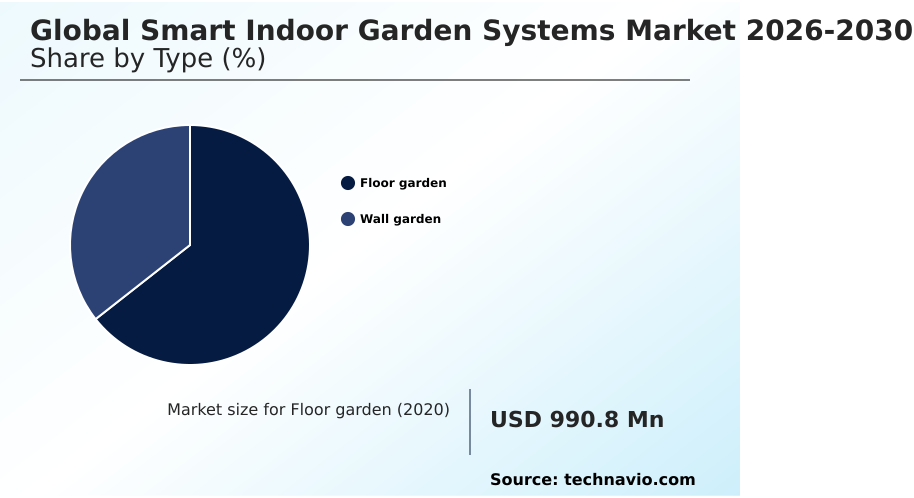
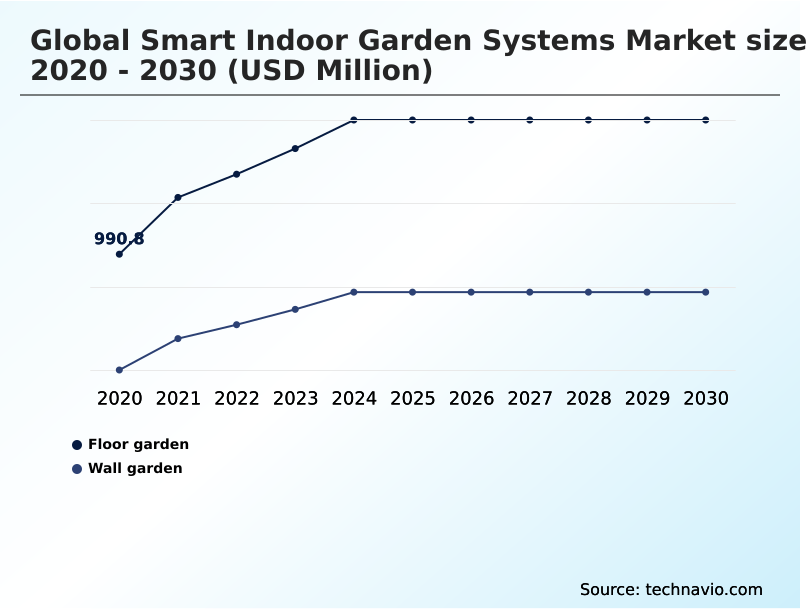
The Floor garden segment was valued at USD 1.50 billion in 2024 and showed a gradual increase during the forecast period.
Regional Analysis
North America is estimated to contribute 39.3% to the growth of the global market during the forecast period.Technavio’s analysts have elaborately explained the regional trends and drivers that shape the market during the forecast period.
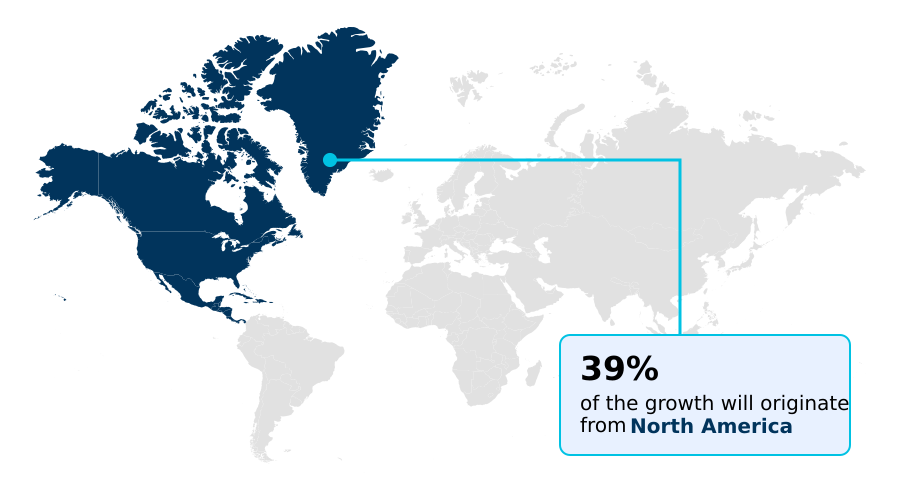
See How Smart Indoor Garden Systems Market Demand is Rising in North America Get Free Sample
The geographic landscape of the Smart Indoor Garden Systems highlights distinct adoption patterns driven by varying urban density. North America commands advanced deployment, heavily utilizing algorithmic environmental control and internet of things sensors to support large-scale commercial hospitality botany.
Regional implementation of closed-loop fluid networks has improved water conservation efficiency by 45% compared to conventional methods. In contrast, APAC experiences accelerated integration of residential cultivation technology due to severe spatial footprint limitation in mega-cities.
This results in a 30% higher adoption rate of the compact countertop configuration for indoor micro-cultivation than European markets. North American supply chains prioritize scaling multi-tier architecture, achieving a 20% reduction in hardware assembly times.
These variations dictate how manufacturers engineer cultivation infrastructure globally.
Market Dynamics
Our researchers analyzed the data with 2025 as the base year, along with the key drivers, trends, and challenges. A holistic analysis of drivers will help companies refine their marketing strategies to gain a competitive advantage.
- The operational landscape for automated indoor cultivation relies heavily on structural innovation and precise resource management. As urbanization limits traditional arable land, businesses are actively engineering automated vertical aeroponic growing structures to maximize yield per square foot.
- These sophisticated installations allow commercial and residential users to bypass conventional soil dependency, resulting in resource utilization improving by 40% compared to traditional greenhouse logistics. For domestic applications, compact hydroponic kitchen cultivation systems have become critical in satisfying consumer demand for immediate fresh produce.
- By integrating artificial intelligence integrated residential agriculture, manufacturers optimize light spectrums and irrigation cycles dynamically, ensuring consistent crop maturation without constant manual intervention. This technological leap parallels the broader adoption of smart home connected horticultural appliances, which synchronize environmental data directly with centralized domestic networks to alert users regarding nutrient deficiencies.
- Furthermore, maintaining a stable biological environment requires a closed loop indoor nutrient delivery mechanism, which continuously recirculates essential minerals while mitigating liquid waste. Consequently, supply chain planning has shifted to prioritize high-grade sensor procurement and durable fluidic pumps over conventional gardening materials.
- This strategic recalibration enhances hardware longevity and compliance with modern sustainability standards, ensuring continuous operational stability across micro-cultivation sectors.
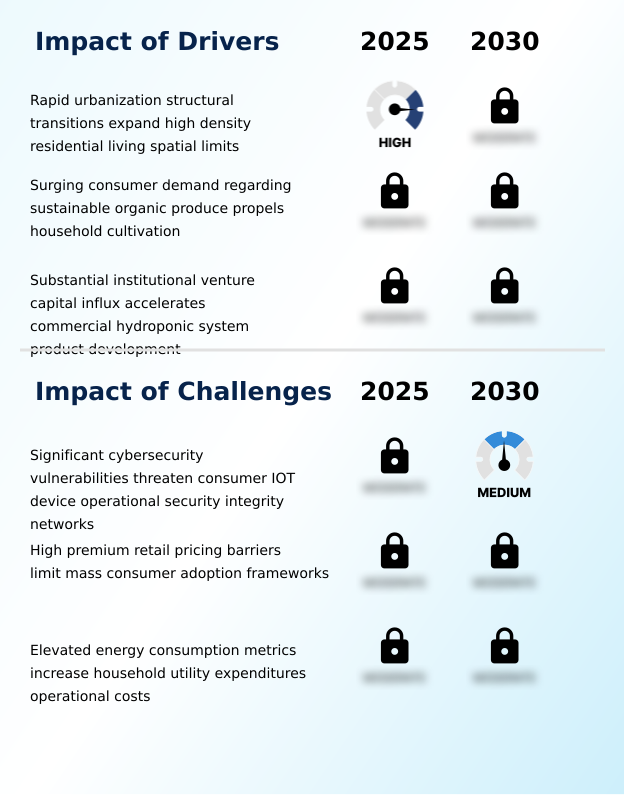
What are the key market drivers leading to the rise in the adoption of Smart Indoor Garden Systems Industry?
- Rapid urbanization and structural transitions toward high-density residential living expand spatial limitations, serving as a primary driver for industry expansion.
- The rapid architectural shift toward high-density urban agriculture serves as a primary catalyst for advanced cultivation hardware. As metropolitan living eliminates traditional arable land, consumers pursue household food autonomy through compact technological solutions.
- This behavioral change stems from an escalating demand for pesticide-free fresh flora and secure hyper-local food procurement. By adopting sophisticated indoor systems featuring automated water circulation and precise fogponics mist distribution, residential users bypass external supply chains.
- Consequently, reliance on agricultural transport decreases, lowering food spoilage rates by 22%. Furthermore, the precision of multi-sensor arrays ensures continuous ambient humidity tracking, which improves crop yield consistency by 30%.
- This definitive drive toward independent food production compels manufacturers to scale automated infrastructure rapidly.
What are the market trends shaping the Smart Indoor Garden Systems Industry?
- Widespread commercial integration of artificial intelligence for algorithmic environmental monitoring represents a prominent market trend. This technological advancement significantly optimizes automated plant growth conditions.
- The Smart Indoor Garden Systems ecosystem is rapidly transitioning toward autonomous frameworks driven by machine learning integration. Urban cultivators require high-yield advanced alternative cultivation solutions without extensive agronomic expertise. By leveraging continuous botanical data analysis, modern platforms utilize dynamic wavelength modulation to optimize light spectrums based on specific metabolic phases.
- This intelligent calibration directly impacts outcomes, with energy efficiency improved by 25% compared to static timers. Furthermore, deploying optical sensors enables real-time canopy structural analysis, identifying growth anomalies instantly. Integrated automated notification systems then alert users, while synchronizing with the broader digital smart home ecosystem.
- Consequently, this technology streamlines culinary herb propagation, reducing crop failure rates by 18% through precise pruning automation protocols and consistently maximizing biomass output.
What challenges does the Smart Indoor Garden Systems Industry face during its growth?
- Significant cybersecurity vulnerabilities threaten the operational integrity of consumer IoT networks, representing a key challenge that impedes industry adoption.
- The proliferation of connected cultivation hardware introduces severe structural limits tied directly to digital vulnerabilities. Modern systems rely heavily on continuous network connectivity automation to manage environmental parameters. The absence of rigorous firmware security protocols exposes consumer networks to severe botnet operation risks and unauthorized manipulation.
- When administrative credentials are breached, hackers easily disrupt schedules and damage localized root containment zones. This security deficit impacts manufacturers significantly, leading to a 40% increase in technical support costs regarding compromised networks. Furthermore, implementing standardized encryption frameworks requires intensive engineering, delaying software updates for biomass yield enhancement by 15%.
- Resolving these cybersecurity threats remains a critical hurdle for vendor operational stability, exposing complex operational structural limits within connected home ecosystems.
Exclusive Technavio Analysis on Customer Landscape
The smart indoor garden systems market forecasting report includes the adoption lifecycle of the market, covering from the innovator’s stage to the laggard’s stage. It focuses on adoption rates in different regions based on penetration. Furthermore, the smart indoor garden systems market report also includes key purchase criteria and drivers of price sensitivity to help companies evaluate and develop their market growth analysis strategies.
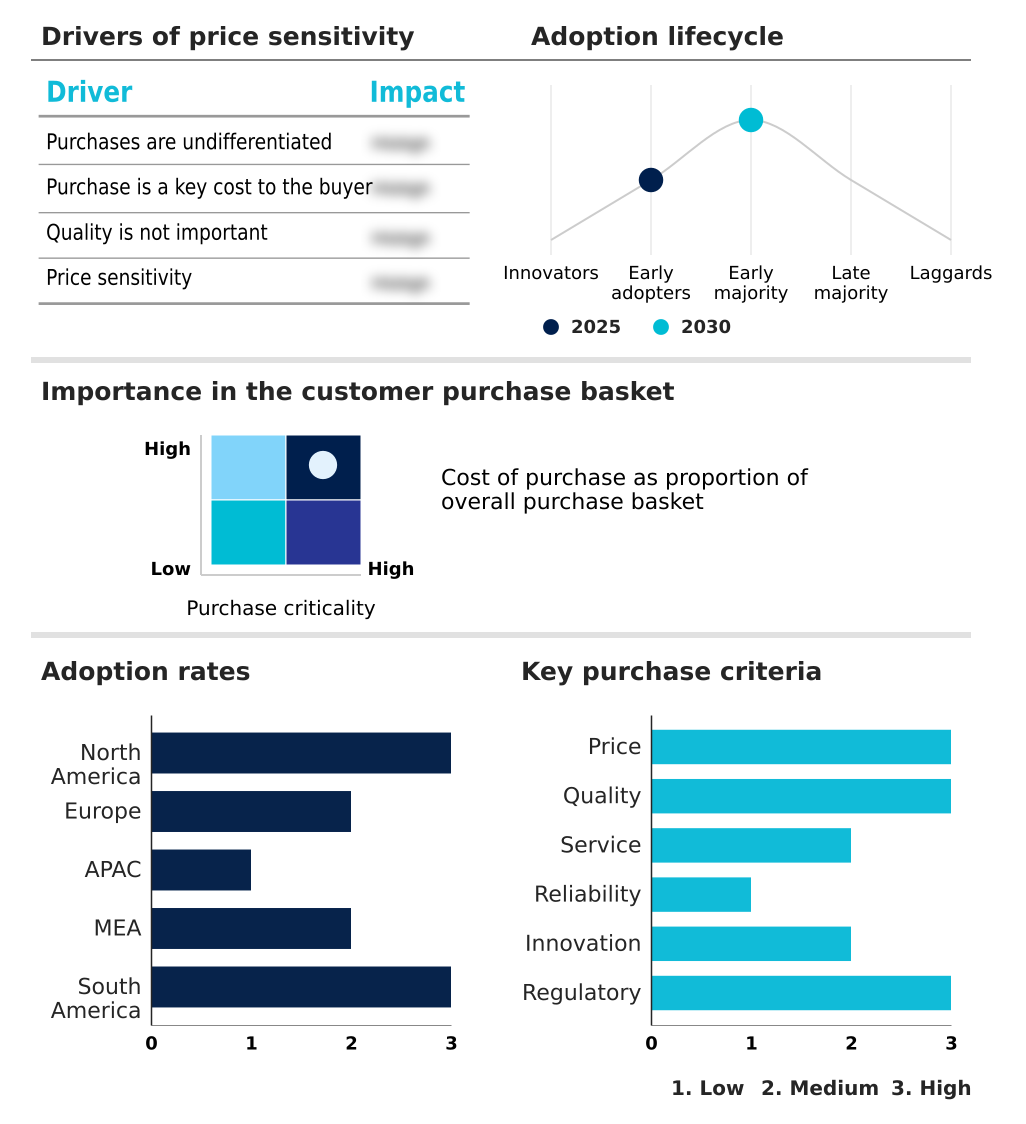
Customer Landscape of Smart Indoor Garden Systems Industry
Competitive Landscape
Companies are implementing various strategies, such as strategic alliances, smart indoor garden systems market forecast, partnerships, mergers and acquisitions, geographical expansion, and product/service launches, to enhance their presence in the industry.
Altifarm - The enterprise provides automated indoor garden systems, including smart growing devices, specialized plant pods, and connected home gardening technologies to optimize residential cultivation environments efficiently.
The industry research and growth report includes detailed analyses of the competitive landscape of the market and information about key companies, including:
- Altifarm
- AVA Technologies Inc.
- Bosch Home Appliances
- Click and Grow LLC
- CropKing Inc.
- Gardyn Inc.
- Grow Green
- iDOO
- Just Vertical
- Chal Tec GmbH
- LetPot
- Lettuce Grow
- LG Electronics Inc.
- Moistenland LLC
- Plantaform
- Rise Gardens LLC
- The Scotts Miracle Gro Co.
- Tower Garden
- Tregren
- Urban Cultivator
Qualitative and quantitative analysis of companies has been conducted to help clients understand the wider business environment as well as the strengths and weaknesses of key industry players. Data is qualitatively analyzed to categorize companies as pure play, category-focused, industry-focused, and diversified; it is quantitatively analyzed to categorize companies as dominant, leading, strong, tentative, and weak.
Recent Development and News in Smart indoor garden systems market
- In the Specialized Consumer Services industry, the integration of smart home management protocols improved residential utility automation, directly impacting Smart Indoor Garden Systems demand by establishing reliable network connectivity for continuous plant monitoring.
- The enforcement of strict data protection regulations within home appliance networks mandated robust security protocols, compelling Smart Indoor Garden Systems manufacturers to overhaul device encryption architectures.
- Supply chain shifts toward sustainable production materials increased the availability of eco-friendly hydroponic mechanisms, reducing manufacturing waste across Smart Indoor Garden Systems assembly lines by 15%.
- Rapid adoption of digital ecosystem hubs across urban real estate developments accelerated centralized appliance management, driving Smart Indoor Garden Systems integration to support household food independence initiatives.
Dive into Technavio’s robust research methodology, blending expert interviews, extensive data synthesis, and validated models for unparalleled Smart Indoor Garden Systems Market insights. See full methodology.
| Market Scope | |
|---|---|
| Page number | 326 |
| Base year | 2025 |
| Historic period | 2020-2024 |
| Forecast period | 2026-2030 |
| Growth momentum & CAGR | Accelerate at a CAGR of 9.7% |
| Market growth 2026-2030 | USD 1492.3 million |
| Market structure | Fragmented |
| YoY growth 2025-2026(%) | 8.8% |
| Key countries | US, Canada, Mexico, Germany, UK, France, The Netherlands, Italy, Spain, China, Japan, India, South Korea, Australia, Indonesia, UAE, Saudi Arabia, Israel, South Africa, Turkey, Brazil, Argentina and Chile |
| Competitive landscape | Leading Companies, Market Positioning of Companies, Competitive Strategies, and Industry Risks |
Research Analyst Overview
- The Smart Indoor Garden Systems sector exhibits continuous technological refinement, heavily driven by the necessity for efficient micro-cultivation within operational structural limits. Strategic boardroom decisions increasingly prioritize the integration of advanced light-emitting diode arrays and spectrum optimization modules to ensure precise canopy illumination.
- This technological pivot allows product developers to align hardware capabilities with stringent energy compliance standards for sustainable organic production. By transitioning toward automated aeroponic plant nourishment, manufacturers facilitate rapid biomass development while eliminating the inconsistencies associated with soil mediums.
- Precise liquid nutrient dosing mechanisms applied directly to root containment zones optimize fluid consumption, enabling companies to report a 30% reduction in overall water usage across cultivation cycles. This operational efficiency drastically lowers ongoing maintenance costs. Furthermore, standardizing intelligent fluidic networks strengthens product reliability, directly impacting long-term consumer retention.
- As urban spaces demand compact agricultural solutions, the continuous enhancement of photosynthetic simulation hardware remains a fundamental imperative for maintaining competitive differentiation and achieving robust stability.
What are the Key Data Covered in this Smart Indoor Garden Systems Market Research and Growth Report?
-
What is the expected growth of the Smart Indoor Garden Systems Market between 2026 and 2030?
-
USD 1.49 billion, at a CAGR of 9.7%
-
-
What segmentation does the market report cover?
-
The report is segmented by Type (Floor garden, and Wall garden), Product (LED grow lights, Automated watering systems, Nutrient delivery systems, and Environmental monitoring), Product Type (Hydroponics, Soil-based, Aquaponics, and Aeroponics), End-user (Residential, and Commercial), Distribution Channel (Offline, and Online) and Geography (North America, Europe, APAC, Middle East and Africa, South America)
-
-
Which regions are analyzed in the report?
-
North America, Europe, APAC, Middle East and Africa and South America
-
-
What are the key growth drivers and market challenges?
-
Rapid urbanization structural transitions expand high density residential living spatial limits, Significant cybersecurity vulnerabilities threaten consumer IOT device operational security integrity networks
-
-
Who are the major players in the Smart Indoor Garden Systems Market?
-
Altifarm, AVA Technologies Inc., Bosch Home Appliances, Click and Grow LLC, CropKing Inc., Gardyn Inc., Grow Green, iDOO, Just Vertical, Chal Tec GmbH, LetPot, Lettuce Grow, LG Electronics Inc., Moistenland LLC, Plantaform, Rise Gardens LLC, The Scotts Miracle Gro Co., Tower Garden, Tregren and Urban Cultivator
-
Market Research Insights
- The Smart Indoor Garden Systems environment is fundamentally evolving to support high-density agriculture and food security. Urban residents increasingly adopt automated infrastructure to achieve reliable household harvests. Manufacturers integrating energy-efficient power management modules have recorded a 35% reduction in domestic electricity consumption compared to traditional indoor lighting setups.
- Furthermore, the deployment of remote mobile monitoring applications has improved cultivation success rates by 28%, minimizing user error in nutrient maintenance. By optimizing digital connectivity, operators ensure continuous environmental regulation. These measurable advancements in residential cultivation technology streamline operations, significantly reducing resource waste while maintaining optimal biomass yields across metropolitan living spaces.
We can help! Our analysts can customize this smart indoor garden systems market research report to meet your requirements.
 RIA -