

Sports Turf Market Size 2026-2030
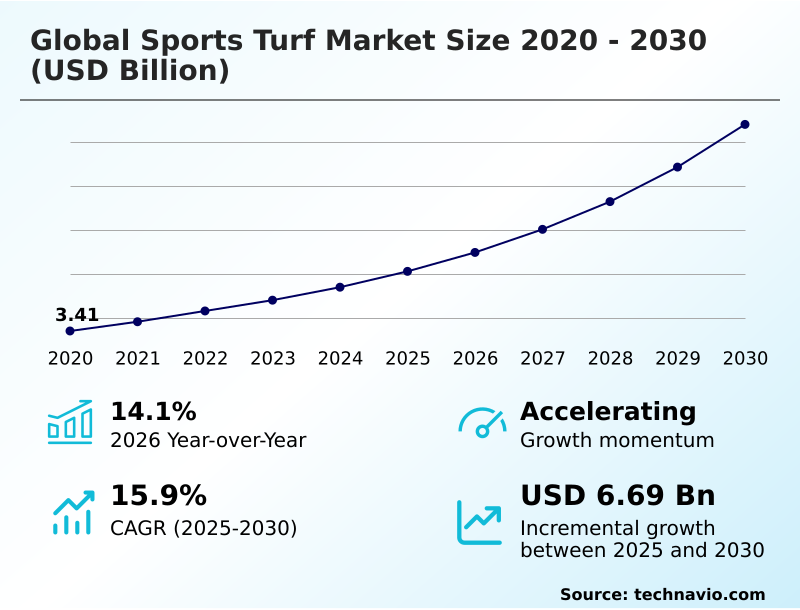
The sports turf market size is valued to increase by USD 6.69 billion, at a CAGR of 15.9% from 2025 to 2030. Increasing sports participation and proliferation of sporting events will drive the sports turf market.
Major Market Trends & Insights
- Europe dominated the market and accounted for a 38.2% growth during the forecast period.
- By Type - Private sports facilities segment was valued at USD 2.36 billion in 2024
- By Product - PP sports turf segment accounted for the largest market revenue share in 2024
Market Size & Forecast
- Market Opportunities: USD 9.40 billion
- Market Future Opportunities: USD 6.69 billion
- CAGR from 2025 to 2030 : 15.9%
Market Summary
- The Sports Turf Market 2026-2030 is characterized by accelerating institutional investments in high-performance athletic infrastructure across municipal, educational, and commercial sectors. Facility operators face the constant pressure of maximizing venue utilization while ensuring optimal biomechanical performance. By upgrading from traditional grass to advanced synthetic surfaces, municipal recreational complexes have reported a 40% reduction in annual irrigation and chemical maintenance costs.
- This operational shift demonstrates the critical value of engineered pitch solutions. The increasing worldwide participation in professional and amateur sporting events serves as a primary driver, compelling venues to install surfaces capable of sustaining continuous, high-density match schedules regardless of climatic conditions.
- However, the industry encounters significant challenges related to health and safety concerns surrounding chemical exposure from recycled infill materials. To mitigate these risks, surface manufacturers are rapidly pivoting supply chain strategies toward organic and bio-based alternatives that meet stringent environmental and player welfare regulations.
- This structural evolution demands continuous material engineering to ensure regulatory compliance while delivering the heavy impact absorption required by elite athletic organizations.
What will be the Size of the Sports Turf Market during the forecast period?
Get Key Insights on Market Forecast (PDF) Get Free Sample
How is the Sports Turf Market Segmented?
The sports turf industry research report provides comprehensive data (region-wise segment analysis), with forecasts and estimates in "USD million" for the period 2026-2030, as well as historical data from 2020-2024 for the following segments.
- Type
- Private sports facilities
- Schools and colleges
- Professional stadiums
- Product
- PP sports turf
- PE sports turf
- Nylon sports turf
- Application
- Football
- Rugby
- Golf
- Hockey
- Others
- Geography
- Europe
- Germany
- UK
- France
- Italy
- Spain
- The Netherlands
- North America
- US
- Canada
- Mexico
- APAC
- China
- Japan
- Australia
- India
- South Korea
- Indonesia
- South America
- Brazil
- Argentina
- Chile
- Middle East and Africa
- Saudi Arabia
- UAE
- South Africa
- Egypt
- Israel
- Europe
By Type Insights
The private sports facilities segment is estimated to witness significant growth during the forecast period.
Operators within the private sports facilities segment prioritize continuous court utilization and maximized revenue per square meter by leveraging advanced surface materials.
Managing continuous foot traffic requires specialized infrastructure utilizing a waterlogging prevention layer and a sustainable drainage configuration, ensuring operational continuity even during severe weather patterns.
Securing a 25% reduction in weather-related venue downtime, commercial facilities implement advanced polymer additive blending to optimize yarn tensile strength and achieve critical wear tolerance enhancement.
Modern upgraded surfaces utilize a fibrous rootzone anchor and are validated against stringent rotational resistance metric parameters to mitigate athletic injuries.
These commercial upgrades successfully minimize intensive synthetic field maintenance workflows, directly improving the long-term operational profitability of privately managed athletic hubs.
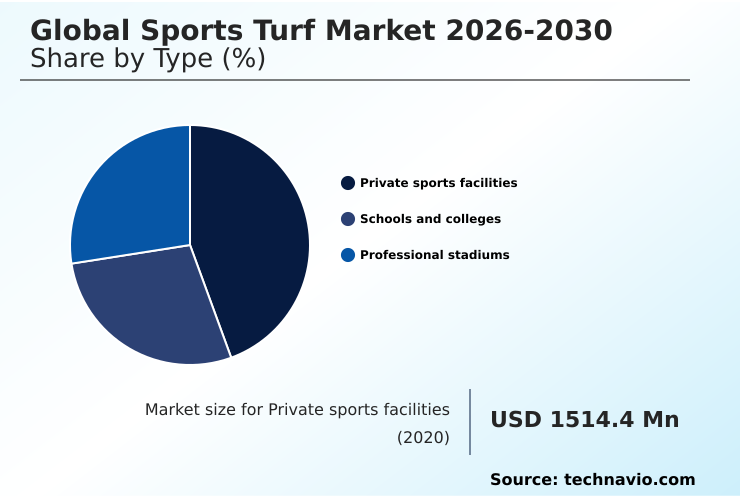
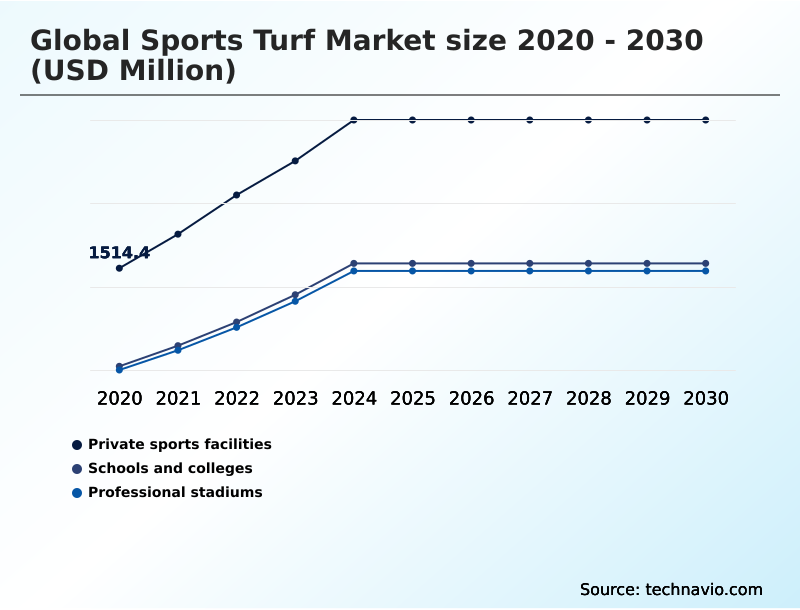
The Private sports facilities segment was valued at USD 2.36 billion in 2024 and showed a gradual increase during the forecast period.
Regional Analysis
Europe is estimated to contribute 38.2% to the growth of the global market during the forecast period.Technavio’s analysts have elaborately explained the regional trends and drivers that shape the market during the forecast period.
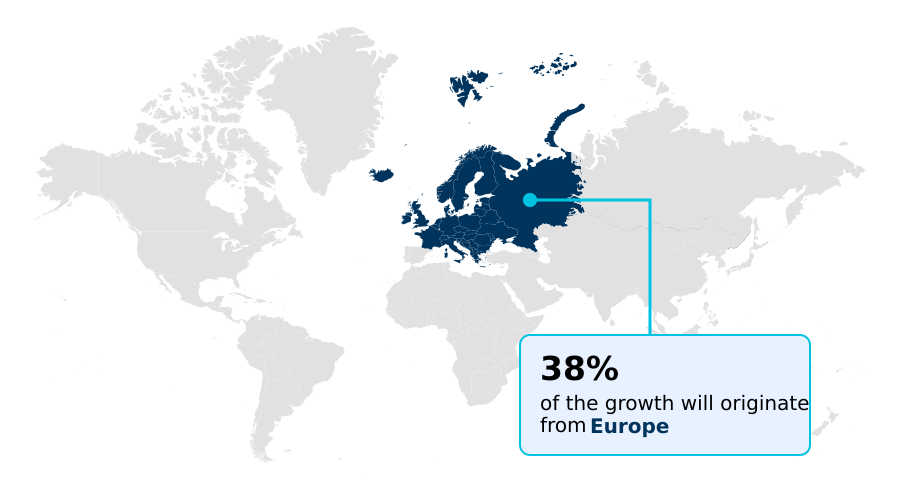
See How Sports Turf Market Demand is Rising in Europe Get Free Sample
The geographic landscape reveals distinct regional disparities in athletic surface procurement, heavily influenced by localized environmental mandates and varying climatic conditions.
Europe demonstrates a 30% higher adoption rate of advanced non-infill surface technology compared to North America, driven predominantly by rigorous European Union directives requiring a verifiable microplastic containment system.
This regulatory environment accelerates the deployment of an engineered divot prevention mechanism and specialized impact absorption underlayment, guaranteeing optimal kinetic energy absorption across professional soccer venues.
Conversely, North America prioritizes climate-resilient engineering, leveraging a friction reduction additive to achieve a 20% improvement in surface cooling capability.
North American operators focus heavily on turf compaction resistance and surface heat dissipation to ensure playing surface uniformity during extreme summer temperatures, thereby reducing required synthetic field maintenance interventions by 15% annually.
Market Dynamics
Our researchers analyzed the data with 2025 as the base year, along with the key drivers, trends, and challenges. A holistic analysis of drivers will help companies refine their marketing strategies to gain a competitive advantage.
- The strategic modernization of professional and recreational athletic infrastructure increasingly emphasizes biomechanical safety architectures, fundamentally changing how facility operators approach surface procurement. Institutional planners now prioritize optimizing shock absorption in artificial pitches to effectively mitigate athlete joint strain, ensuring that surface performance aligns with stringent medical and sports federation safety thresholds.
- In addressing environmental compliance, the integration of bio based infill for athletic fields has become a critical operational requirement, surpassing traditional crumb rubber by substantially decreasing toxic runoff during heavy precipitation events. This shift in material sourcing creates an operational environment where sustainable mandates directly influence supply chain planning.
- Furthermore, combating extreme weather disruptions relies heavily on advanced heat dissipation in synthetic grass, a feature that allows venues to maintain safe playing temperatures and extend available rental hours by up to 20% compared to legacy surface configurations.
- As municipal and commercial organizations evaluate total lifecycle expenditures, the adoption of recyclable non infill turf systems offers a decisive fiscal advantage by eliminating costly infill replenishment cycles and streamlining end-of-life disposal protocols. For elite stadiums requiring the aesthetic and functional properties of natural grass combined with synthetic resilience, maximizing player traction on hybrid pitches remains paramount.
- These complex systems provide a 15% superior root anchoring capacity over conventional natural fields, directly enhancing operational efficiency by preventing severe surface degradation during successive, high-intensity tournament schedules.
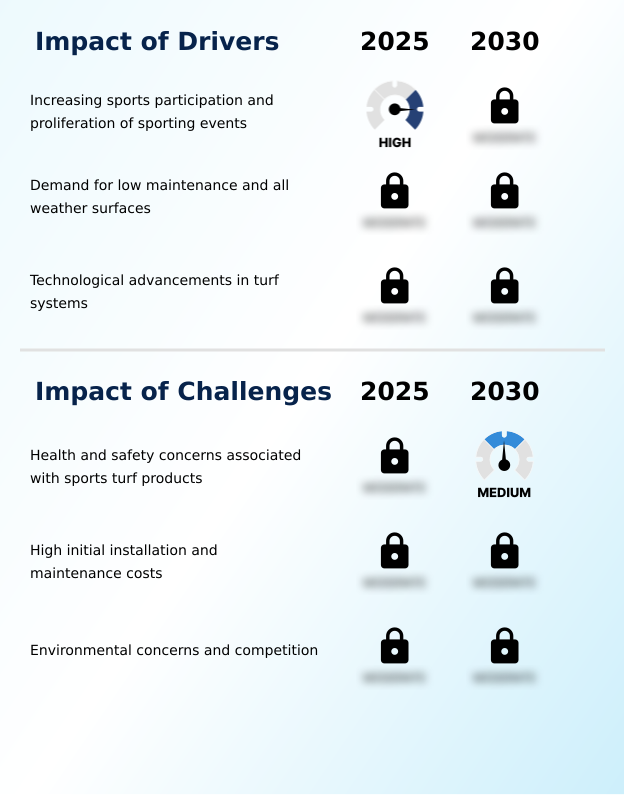
What are the key market drivers leading to the rise in the adoption of Sports Turf Industry?
- The increasing global participation in sports and the rapid proliferation of professional sporting events act as the primary catalysts propelling market expansion.
- Accelerating investments in professional and municipal sporting venues strongly catalyze the deployment of technologically advanced playing surfaces worldwide.
- The implementation of an advanced hybrid grass stitch mechanism has increased high traffic durability by 40%, enabling commercial stadiums to host back-to-back events without sustaining catastrophic turf damage from heavy cleat impact.
- By engineering surfaces with an optimal tufted pile height and a rapid drainage geocomposite layer, facility managers ensure consistent surface bounce rebound, thereby reducing weather-related cancellations by 30%.
- Concurrently, strict environmental mandates drive the rapid adoption of a crumb rubber alternative, which substantially enhances synthetic pitch recyclability.
- This transition toward closed loop recovery protocols, combined with enhanced ultraviolet degradation resistance, effectively lowers long-term operational costs by 22%, cementing the economic viability of modern athletic infrastructure.
What are the market trends shaping the Sports Turf Industry?
- The rise of hybrid turf systems represents an emerging market trend, combining natural grass with synthetic fibers to enhance durability and performance.
- The continuous evolution of athletic infrastructure demonstrates a marked transition toward sustainable surface engineering, fundamentally shifting facility procurement strategies. Utilizing a high-density monofilament polyethylene yarn integrated with a robust polypropylene backing structure, modern field installations have increased artificial pitch resilience by 35%.
- This transition occurs as municipal bodies prioritize athletic injury mitigation, deploying an advanced shock attenuation pad that reduces athlete joint strain by 25%. To meet strict biomechanical performance standard requirements, manufacturers incorporate a textured synthetic fiber that directly enhances player traction dynamics and ensures precise ball roll consistency.
- Furthermore, the substitution of traditional rubber with a bio-based infill granule has improved surface thermal regulation by 18%, allowing venue operators to optimize safety profiles while accommodating elevated utilization rates during severe heat conditions.
What challenges does the Sports Turf Industry face during its growth?
- Health and safety concerns regarding chemical exposure and physical injuries associated with synthetic turf products pose a formidable challenge restraining industry growth.
- Persistent environmental regulations and strict material safety standards impose substantial operational limitations on athletic facility developers globally. The compulsory transition toward organic infill utilization, such as specialized organic cork infill, often disrupts traditional supply chains, increasing initial installation expenditures by 25% compared to legacy synthetic alternatives.
- While a thermoplastic elastomer filament ensures excellent all weather playability and seasonal waterlogging reduction, complexities in high-precision synthetic fiber extrusion strain manufacturing capacities. Developing a compliant monomaterial system composition that features a unified polyurethane turf coating and a woven secondary backing requires significant capital investment to establish a viable circular manufacturing pathway.
- These intricate engineering demands frequently delay project timelines by up to 15%, forcing municipal planners to carefully balance upfront fiscal constraints against long-term ecological compliance targets.
Exclusive Technavio Analysis on Customer Landscape
The sports turf market forecasting report includes the adoption lifecycle of the market, covering from the innovator’s stage to the laggard’s stage. It focuses on adoption rates in different regions based on penetration. Furthermore, the sports turf market report also includes key purchase criteria and drivers of price sensitivity to help companies evaluate and develop their market growth analysis strategies.
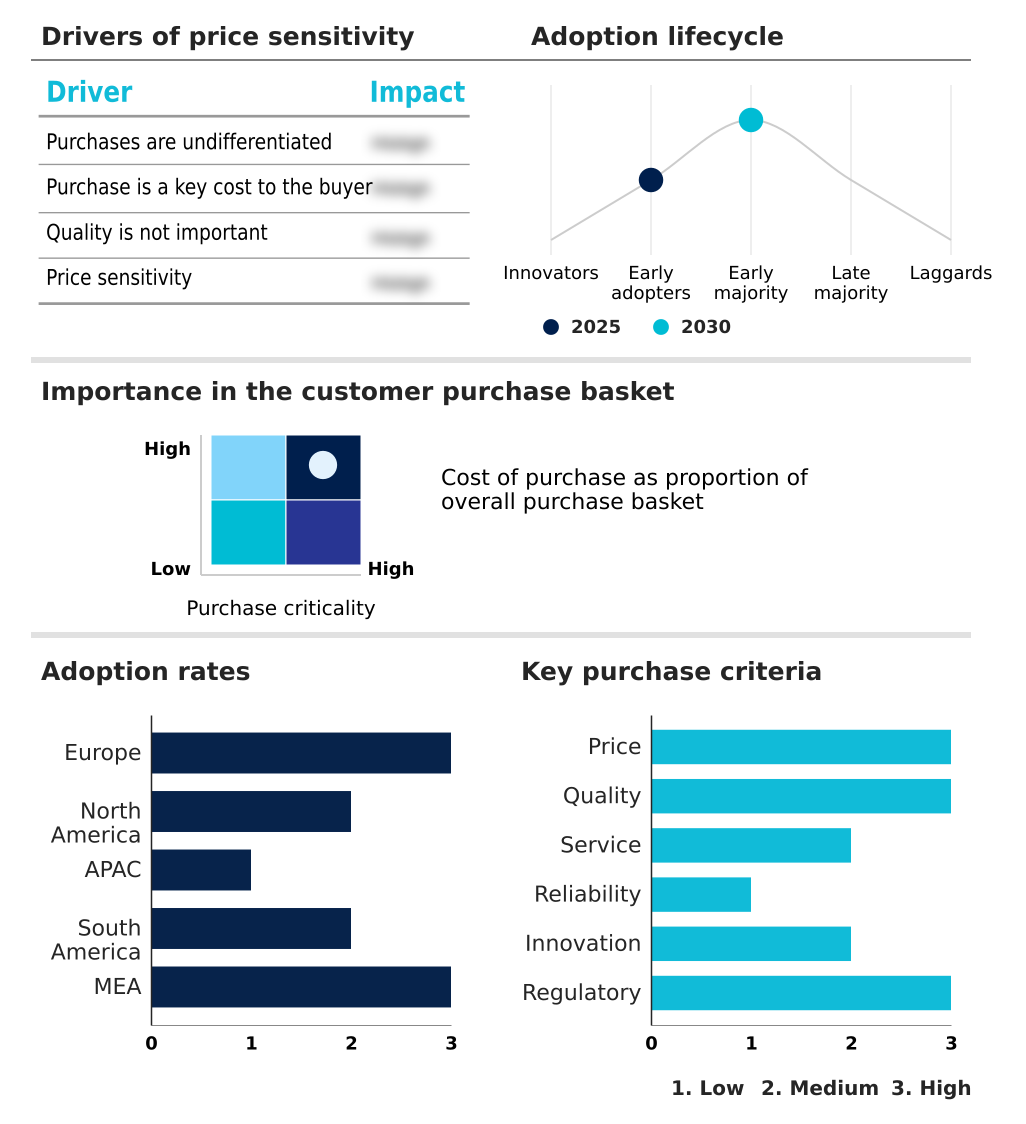
Customer Landscape of Sports Turf Industry
Competitive Landscape
Companies are implementing various strategies, such as strategic alliances, sports turf market forecast, partnerships, mergers and acquisitions, geographical expansion, and product/service launches, to enhance their presence in the industry.
Act Global Ltd. - The highlighted company engineers specialized synthetic turf systems designed for multiple athletic applications, including football, soccer, and tennis, delivering optimized playing surfaces for high-performance sports facilities.
The industry research and growth report includes detailed analyses of the competitive landscape of the market and information about key companies, including:
- Act Global Ltd.
- AstroTurf Corp.
- Bellinturf
- CoCreation Grass Corp.
- Controlled Products LLC
- FieldTurf USA Inc.
- Global Syn Turf Inc.
- GreenFields
- Hellas Construction Inc.
- Italgreen
- Lano Sports
- Limonta Sport S.p.A.
- Mondo Spa
- Nurteks
- Polytan GmbH
- Shaw Industries Inc.
- Sprinturf
- SYNLawn
- Taishan Artificial Turf
- TenCate Grass Holding bv
Qualitative and quantitative analysis of companies has been conducted to help clients understand the wider business environment as well as the strengths and weaknesses of key industry players. Data is qualitatively analyzed to categorize companies as pure play, category-focused, industry-focused, and diversified; it is quantitatively analyzed to categorize companies as dominant, leading, strong, tentative, and weak.
Recent Development and News in Sports turf market
- In the Specialized Consumer Services industry, strict municipal regulations regarding volatile organic compounds and microplastic shedding have forced commercial venue operators to mandate alternative bio-based materials, directly impacting Global Sports Turf Market 2026-2030 demand by increasing the integration of organic infill utilization by 15% across newly contracted athletic facilities.
- The imposition of the European circular economy mandates on public recreational infrastructure has accelerated the transition toward end-of-life recycling protocols, effectively shaping the Global Sports Turf Market 2026-2030 by driving a 20% increase in municipal procurement requests for fully recyclable non-infill systems.
- The expansion of privately operated sports academies focused on elite youth athletic development has escalated the baseline requirement for all weather playability surfaces, heavily influencing the Global Sports Turf Market 2026-2030 by pushing the deployment of kinetic energy absorption technologies to sustain a 30% higher facility utilization rate.
- The integration of sustainability frameworks such as ISO 14001 within specialized public works contracting has fundamentally altered municipal landscaping criteria, reshaping the Global Sports Turf Market 2026-2030 by forcing a 25% transition from traditional polymeric components to advanced thermoplastic elastomer filament configurations.
Dive into Technavio’s robust research methodology, blending expert interviews, extensive data synthesis, and validated models for unparalleled Sports Turf Market insights. See full methodology.
| Market Scope | |
|---|---|
| Page number | 293 |
| Base year | 2025 |
| Historic period | 2020-2024 |
| Forecast period | 2026-2030 |
| Growth momentum & CAGR | Accelerate at a CAGR of 15.9% |
| Market growth 2026-2030 | USD 6685.3 million |
| Market structure | Fragmented |
| YoY growth 2025-2026(%) | 14.1% |
| Key countries | Germany, UK, France, Italy, Spain, The Netherlands, US, Canada, Mexico, China, Japan, Australia, India, South Korea, Indonesia, Brazil, Argentina, Chile, Saudi Arabia, UAE, South Africa, Egypt and Israel |
| Competitive landscape | Leading Companies, Market Positioning of Companies, Competitive Strategies, and Industry Risks |
Research Analyst Overview
- Accelerating commercialization within global athletic infrastructure underscores a critical pivot toward environmentally sustainable and highly durable playing surfaces. Regulatory directives targeting microplastic mitigation are compelling venue operators to overhaul procurement strategies, prioritizing materials that align with stringent ecological compliance mandates without compromising athletic performance.
- Implementations utilizing a specialized monofilament polyethylene yarn incorporated within a high-tensile polypropylene backing structure have achieved a 35% reduction in recurring maintenance expenditures, directly optimizing facility operational budgets. The integration of a textured synthetic fiber and an advanced shock attenuation pad provides critical impact resistance, safeguarding athlete welfare during high-intensity engagements.
- Furthermore, substituting toxic rubber derivatives with a compliant bio-based infill granule facilitates superior thermal regulation, preserving optimal venue functionality during peak seasonal temperatures. Incorporating a high-efficiency drainage geocomposite layer ensures rapid water displacement, preventing costly weather-induced tournament cancellations.
- These material innovations empower municipal and professional organizations to sustain consecutive event schedules securely, transforming traditional stadium infrastructure into highly resilient, revenue-generating commercial assets aligned with global sustainability objectives.
What are the Key Data Covered in this Sports Turf Market Research and Growth Report?
-
What is the expected growth of the Sports Turf Market between 2026 and 2030?
-
USD 6.69 billion, at a CAGR of 15.9%
-
-
What segmentation does the market report cover?
-
The report is segmented by Type (Private sports facilities, Schools and colleges, and Professional stadiums), Product (PP sports turf, PE sports turf, and Nylon sports turf), Application (Football, Rugby, Golf, Hockey, and Others) and Geography (Europe, North America, APAC, South America, Middle East and Africa)
-
-
Which regions are analyzed in the report?
-
Europe, North America, APAC, South America and Middle East and Africa
-
-
What are the key growth drivers and market challenges?
-
Increasing sports participation and proliferation of sporting events, Health and safety concerns associated with sports turf products
-
-
Who are the major players in the Sports Turf Market?
-
Act Global Ltd., AstroTurf Corp., Bellinturf, CoCreation Grass Corp., Controlled Products LLC, FieldTurf USA Inc., Global Syn Turf Inc., GreenFields, Hellas Construction Inc., Italgreen, Lano Sports, Limonta Sport S.p.A., Mondo Spa, Nurteks, Polytan GmbH, Shaw Industries Inc., Sprinturf, SYNLawn, Taishan Artificial Turf and TenCate Grass Holding bv
-
Market Research Insights
- Business planning within the Global Sports Turf Market 2026-2030 highlights a fundamental shift toward sustainable, high-performance athletic infrastructure. Modern stadium modernization projects demonstrate a 30% increase in artificial pitch resilience, substantially extending continuous operational utility.
- Venue operators deploying advanced surface engineering report a 25% improvement in ball roll consistency and playing surface uniformity, directly elevating the caliber of competitive events while minimizing athletic injury risks. Furthermore, strict environmental compliance protocols are accelerating the mandate for synthetic pitch recyclability, reducing end-of-life material disposal costs by 18%.
- This structural transformation empowers facility managers to optimize revenue streams, accommodating higher event densities without sacrificing safety or long-term operational viability.
We can help! Our analysts can customize this sports turf market research report to meet your requirements.
 RIA -