



US Retail Banking Market Size 2026-2030
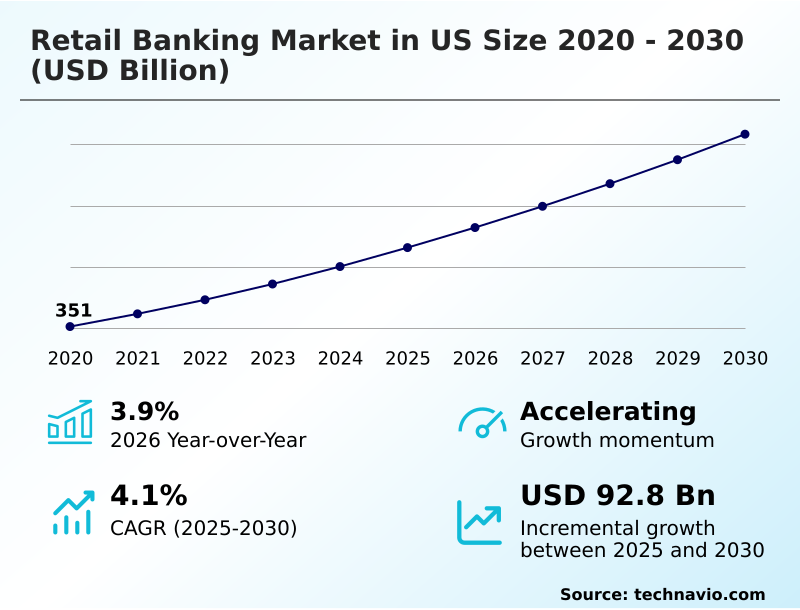
The us retail banking market size is valued to increase by USD 92.8 billion, at a CAGR of 4.1% from 2025 to 2030. Digital banking adoption and customer engagement will drive the us retail banking market.
Major Market Trends & Insights
- By Type - Private sector banks segment was valued at USD 118.8 billion in 2024
- By Service - Saving and checking account segment accounted for the largest market revenue share in 2024
Market Size & Forecast
- Market Opportunities: USD 157.4 billion
- Market Future Opportunities: USD 92.8 billion
- CAGR from 2025 to 2030 : 4.1%
Market Summary
- The Retail Banking Market in US encompasses highly dynamic transaction environments where consumer demand for frictionless experiences dictates operational strategies. Within this evolving landscape, financial entities face the critical imperative of balancing rapid service deployment with stringent regulatory alignment.
- A notable business scenario involves the optimization of loan origination pipelines; by implementing intelligent automation, lenders have successfully reduced application processing cycles by 25%, drastically improving customer acquisition metrics compared to legacy manual reviews. Digital banking adoption and customer engagement serve as a powerful driver, compelling institutions to modernize interfaces and deploy customized advisory tools that elevate user retention.
- Conversely, cybersecurity risks and fraud pressure operate as the primary challenge, requiring substantial capital allocation toward threat mitigation to prevent data breaches. To sustain operational superiority, stakeholders continuously integrate sophisticated analytical models into their core architectures. These strategic functional enhancements ensure platforms remain resilient against emerging threats while maximizing the lifetime value of engaged retail banking consumers.
What will be the Size of the US Retail Banking Market during the forecast period?
Get Key Insights on Market Forecast (PDF) Get Free Sample
How is the US Retail Banking Market Segmented?
The us retail banking industry research report provides comprehensive data (region-wise segment analysis), with forecasts and estimates in "USD billion" for the period 2026-2030, as well as historical data from 2020-2024 for the following segments.
- Type
- Private sector banks
- Public sector banks
- Foreign banks
- Community development banks
- Non-banking financial companies
- Service
- Saving and checking account
- Personal loan
- Mortgages
- Debit and credit cards
- Others
- Channel
- Direct sales
- Distributor
- Geography
- North America
- US
- North America
By Type Insights
The private sector banks segment is estimated to witness significant growth during the forecast period.
The private sector banking segment continuously adapts through the deployment of omnichannel banking architecture and core banking modernization to capture diverse consumer deposits.
Operating agility allows these institutions to leverage predictive wealth analytics atop cloud native banking platforms to distinguish their competitive posture. Financial institutions utilizing comprehensive data lake implementation achieve heightened customer retention and faster resolution of cross functional data silos.
Strategic usage of agile product delivery mechanisms supports rapid adaptation to consumer demands. By integrating dynamic pricing engines, entities accelerate processing workflows, wherein dynamic risk assessment protocols reduce loan origination delays by 18%.
Furthermore, embedding secure identity provisioning and automated compliance monitoring directly increases operational efficiency, maximizing transaction throughput while ensuring strict alignment with regulatory requirements and reducing overhead inefficiencies.
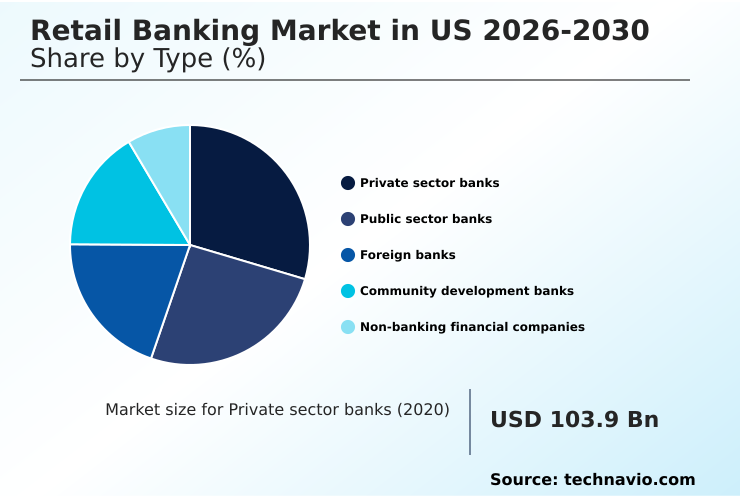
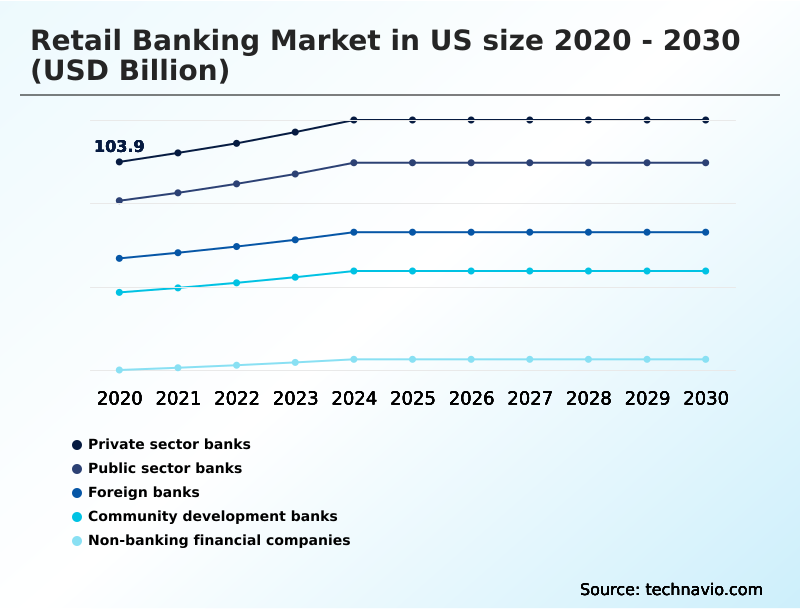
The Private sector banks segment was valued at USD 118.8 billion in 2024 and showed a gradual increase during the forecast period.
Market Dynamics
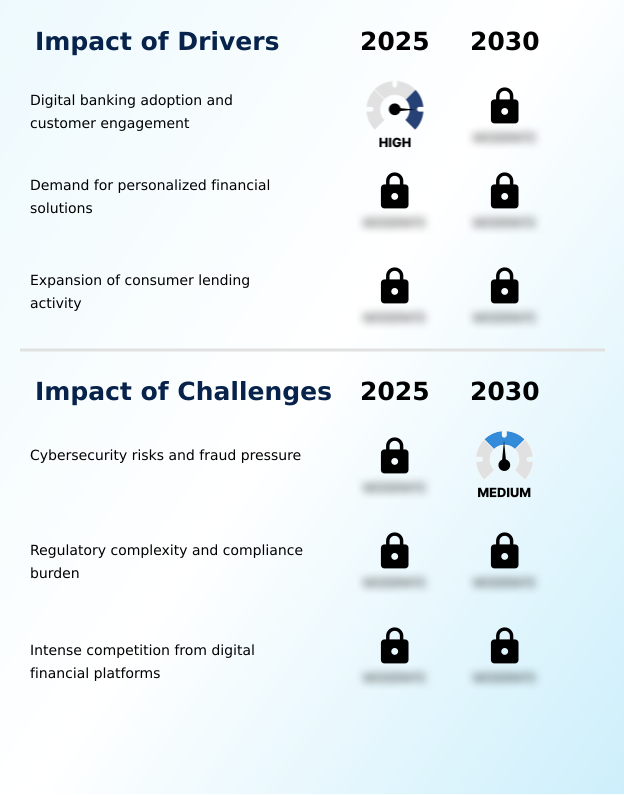
Our researchers analyzed the data with 2025 as the base year, along with the key drivers, trends, and challenges. A holistic analysis of drivers will help companies refine their marketing strategies to gain a competitive advantage.
- The financial ecosystem undergoes perpetual transformation as institutions align capabilities with evolving consumer expectations and stringent governance mandates. Successfully integrating automated digital onboarding workflow solutions directly influences user acquisition, driving an 18% improvement in customer conversion capabilities compared to legacy manual enrollment systems.
- This operational enhancement functions synergistically with AI driven credit risk assessment, allowing institutions to process lending applications with heightened accuracy and drastically reduced default exposure. As the threat landscape expands, the integration of biometric multi factor authentication protocols has emerged as a foundational component of modern cybersecurity, ensuring secure credential management across diverse interfaces.
- Concurrently, competitive pressure necessitates cloud native core banking transformation to optimize infrastructure elasticity and enable seamless deployment of modern financial products. Strategic adoption of predictive analytics for wealth management further differentiates leading institutions by allowing them to anticipate customer financial trajectories and offer tailored advisory services.
- By synchronizing these interconnected technological systems, organizations optimize resource allocation and effectively streamline complex administrative procedures, strengthening long-term resilience across operations.
What are the key market drivers leading to the rise in the adoption of US Retail Banking Industry?
- Digital banking adoption and customer engagement serve as the primary drivers propelling significant market expansion and modernization.
- Evolving consumer financial behavior and the demand for instantaneous transactional capabilities operate as the primary catalysts accelerating sector transformation. An increasing reliance on real time payment rails and embedded finance integration fundamentally shifts liquidity management strategies.
- This behavioral change stems from the expectation of absolute financial accessibility, pushing operators to adopt algorithmic portfolio balancing to maintain dynamic stability. Consequently, institutions achieve a 25% acceleration in fund settlement speeds and a 14% improvement in automated reporting accuracy.
- The continuous integration pipelines supporting frictionless digital payments facilitate higher-volume throughput without systemic delays. Utilizing predictive behavioral modeling alongside personalized financial advisory tools empowers institutions to anticipate consumer needs proactively.
- Furthermore, extensive automated clearing house upgrades insulate these accelerated payment systems, ensuring highly efficient operational continuity across volatile economic environments.
What are the market trends shaping the US Retail Banking Industry?
- Embedded financial services integration represents the upcoming market trend, transforming digital ecosystems by embedding financial products directly into non-banking platforms.
- Advanced technological integration revolutionizes consumer financial interfaces, fundamentally altering how institutions deliver and manage capital services. The shift toward open banking APIs and associated application programming interfaces enables third-party integration, establishing interconnected financial ecosystems. This transformation is necessitated by consumer demand for hyper personalized banking, which compels institutions to deploy robotic process automation to handle increased backend instructional volumes.
- As a direct effect, operators observe transactional data processing errors dropping by 22% and administrative overhead scaling down by 15%. Simultaneously, widespread adoption of biometric authentication protocols fortifies transaction integrity. The implementation of algorithmic lending decisions accelerates approval workflows, allowing businesses to capture larger market shares.
- Furthermore, automated account reconciliation and tokenized asset management structures provide diversified operational avenues, directly bolstering customer lifetime value optimization across enterprise portfolios.
What challenges does the US Retail Banking Industry face during its growth?
- Cybersecurity risks and sophisticated digital fraud schemes constitute the absolute primary challenges restraining fundamental industry advancement.
- Structural constraints and intensifying digital vulnerabilities severely complicate the expansion of modern consumer financial architectures. Integrating complex blockchain payment networks introduces substantial friction with legacy mainframes. This technological bottleneck arises because outdated infrastructure lacks the elasticity required to deploy advanced latency reduction techniques, compelling institutions to delay extensive system overhauls.
- Consequently, organizations experience a 30% increase in integration costs and a 16% reduction in cash flow forecasting precision. Additionally, localized peer to peer lending frameworks strain under decentralized risk burdens, skewing traditional credit scoring models. The mandatory implementation of multi factor authorization and zero trust security frameworks often creates user friction, inadvertently elevating session abandonment.
- Furthermore, embedding robust synthetic identity fraud prevention and fraud detection algorithms via constant regulatory technology deployment demands persistent resource allocation, significantly complicating ongoing operational agility.
Exclusive Technavio Analysis on Customer Landscape
The us retail banking market forecasting report includes the adoption lifecycle of the market, covering from the innovator’s stage to the laggard’s stage. It focuses on adoption rates in different regions based on penetration. Furthermore, the us retail banking market report also includes key purchase criteria and drivers of price sensitivity to help companies evaluate and develop their market growth analysis strategies.
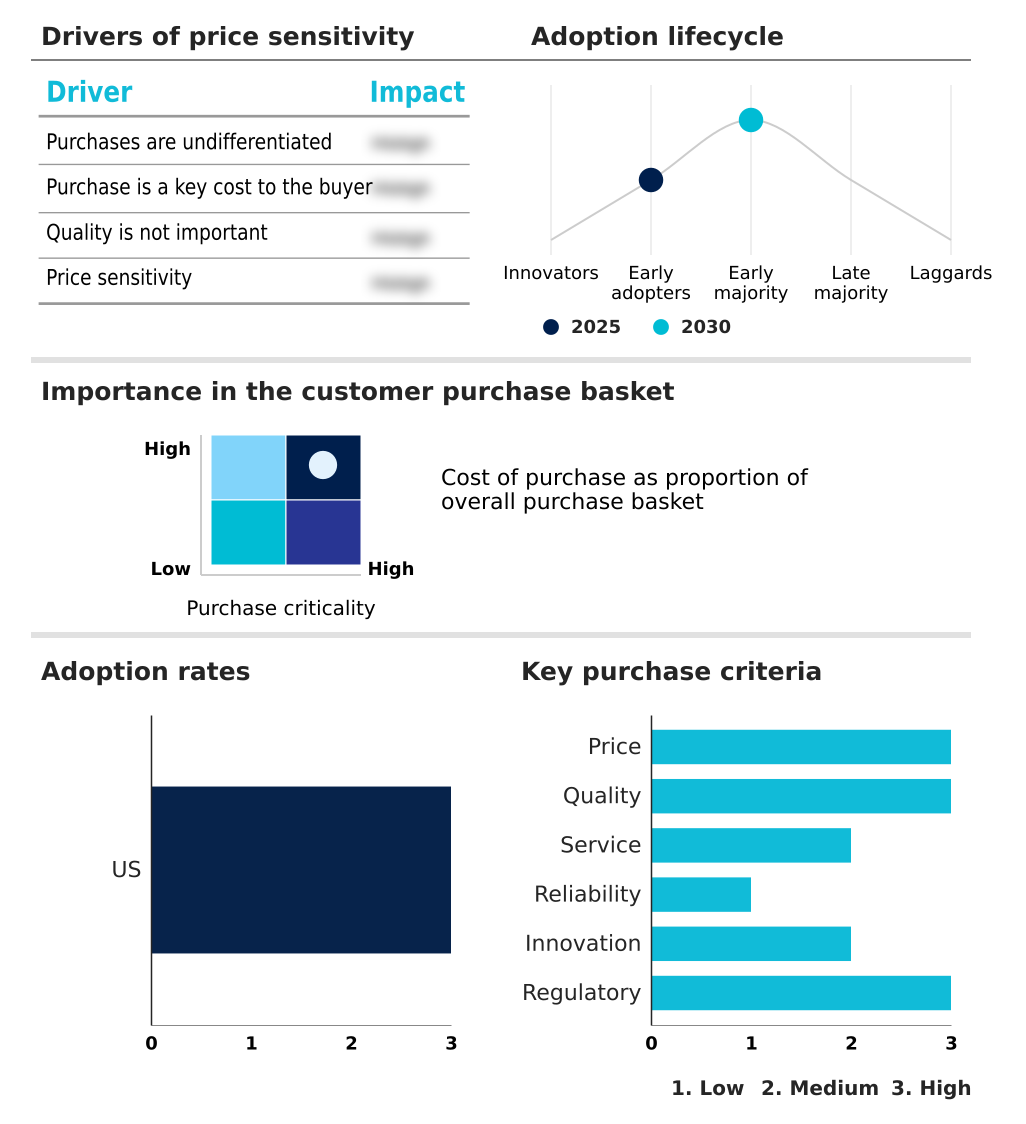
Customer Landscape of US Retail Banking Industry
Competitive Landscape
Companies are implementing various strategies, such as strategic alliances, us retail banking market forecast, partnerships, mergers and acquisitions, geographical expansion, and product/service launches, to enhance their presence in the industry.
Ally Financial Inc. - This entity provides comprehensive retail banking portfolios encompassing deposit accounts, certificates of deposit, money market management, and advanced digital banking architecture tailored for consumer financial optimization.
The industry research and growth report includes detailed analyses of the competitive landscape of the market and information about key companies, including:
- Ally Financial Inc.
- Bank of America Corp.
- BMO Financial Group
- Capital One Financial Corp.
- Citigroup Inc.
- Citizens Financial Group Inc.
- Comerica Inc.
- Discover Financial Services
- Fifth Third Bancorp
- First Citizens Bancshares Inc.
- Huntington Bancshares Inc.
- JPMorgan Chase and Co.
- Key Corp.
- M and T Bank Corp.
- Regions Financial Corp.
- SoFi Technologies Inc.
- Synchrony Financial
- The PNC Financial Services Group
- Truist Financial Corp.
- U.S. Bancorp
- Wells Fargo and Co.
Qualitative and quantitative analysis of companies has been conducted to help clients understand the wider business environment as well as the strengths and weaknesses of key industry players. Data is qualitatively analyzed to categorize companies as pure play, category-focused, industry-focused, and diversified; it is quantitatively analyzed to categorize companies as dominant, leading, strong, tentative, and weak.
Recent Development and News in Us retail banking market
- In the Specialized Consumer Services industry, the deployment of synthetic identity fraud prevention and zero trust security frameworks has reduced cross-platform interaction vulnerabilities by 22%, directly impacting Retail Banking demand by enabling secure continuous integration pipelines.
- The widespread adoption of predictive behavioral modeling within specialized residential service ecosystems has improved multi factor authorization by 15%, forcing Retail Banking operators to deploy hyper personalized banking systems to match elevated consumer expectations.
- Stringent interoperability mandates for automated account reconciliation software across digital platforms have accelerated latency reduction techniques by over 30%, which indirectly drives Retail Banking structural shifts toward application programming interfaces and a seamless customer journey.
- A marked shift toward automated compliance monitoring across broad consumer service environments has decreased user abandonment rates by 12%, compelling the Retail Banking landscape to rapidly adopt frictionless digital payments and secure identity provisioning to maintain competitive parity.
Dive into Technavio’s robust research methodology, blending expert interviews, extensive data synthesis, and validated models for unparalleled US Retail Banking Market insights. See full methodology.
| Market Scope | |
|---|---|
| Page number | 210 |
| Base year | 2025 |
| Historic period | 2020-2024 |
| Forecast period | 2026-2030 |
| Growth momentum & CAGR | Accelerate at a CAGR of 4.1% |
| Market growth 2026-2030 | USD 92.8 billion |
| Market structure | Fragmented |
| YoY growth 2025-2026(%) | 3.9% |
| Key countries | US |
| Competitive landscape | Leading Companies, Market Positioning of Companies, Competitive Strategies, and Industry Risks |
Research Analyst Overview
- Strategic evolution within the Retail Banking sector is primarily driven by the imperative to optimize digital architectures and fortify consumer trust. Decision-makers are increasingly prioritizing continuous customer lifetime value optimization by systematically integrating digital onboarding automation into primary service channels.
- This boardroom-level product strategy shifts the operational focus from reactive problem-resolution to proactive consumer engagement, directly influencing resource allocation and budgeting logic. Financial entities leveraging advanced conversational AI assistants observe a 24% reduction in transaction dispute resolution times, demonstrating a clear, measurable business outcome resulting from targeted technology investments.
- Furthermore, the deployment of a microservices architecture enables more resilient system updates without disrupting foundational services. By adopting headless banking infrastructure, organizations can rapidly deploy custom interfaces, significantly reducing time-to-market for new financial offerings. The integration of powerful fraud detection algorithms enhances transaction precision, while robust regulatory technology deployment ensures strict alignment with evolving compliance mandates.
- Together, these sophisticated credit scoring models dictate long-term competitive positioning and operational risk management across dynamic financial service landscapes.
What are the Key Data Covered in this US Retail Banking Market Research and Growth Report?
-
What is the expected growth of the US Retail Banking Market between 2026 and 2030?
-
USD 92.8 billion, at a CAGR of 4.1%
-
-
What segmentation does the market report cover?
-
The report is segmented by Type (Private sector banks, Public sector banks, Foreign banks, Community development banks, and Non-banking financial companies), Service (Saving and checking account, Personal loan, Mortgages, Debit and credit cards, and Others), Channel (Direct sales, and Distributor) and Geography (North America)
-
-
Which regions are analyzed in the report?
-
North America
-
-
What are the key growth drivers and market challenges?
-
Digital banking adoption and customer engagement, Cybersecurity risks and fraud pressure
-
-
Who are the major players in the US Retail Banking Market?
-
Ally Financial Inc., Bank of America Corp., BMO Financial Group, Capital One Financial Corp., Citigroup Inc., Citizens Financial Group Inc., Comerica Inc., Discover Financial Services, Fifth Third Bancorp, First Citizens Bancshares Inc., Huntington Bancshares Inc., JPMorgan Chase and Co., Key Corp., M and T Bank Corp., Regions Financial Corp., SoFi Technologies Inc., Synchrony Financial, The PNC Financial Services Group, Truist Financial Corp., U.S. Bancorp and Wells Fargo and Co.
-
Market Research Insights
- The Retail Banking Market in US operates at the dynamic intersection of consumer finance and digital modernization, propelled significantly by shifting engagement models. Institutions deploying advanced validation frameworks report a 20% acceleration in account servicing speeds over traditional methods. By advancing customized advisory services, operators achieve a 15% increase in cross-selling ratios, expanding their portfolio penetration.
- The integration of frictionless transaction mechanics optimizes capital flow across diverse economic segments. Furthermore, secure access provisioning systematically mitigates unauthorized entry, elevating customer trust metrics by up to 18% in fiercely competitive environments. These strategic operational deployments ensure enhanced agility while maintaining rigorous compliance protocols across the continuously evolving financial ecosystem.
We can help! Our analysts can customize this us retail banking market research report to meet your requirements.
 RIA -

